

Donald Bitzer, Unsung Pioneer of Interactive Computing, Dies at 90

Donald Bitzer, an electrical engineer who pioneered the PLATO computer system in the 1960s and ’70s at the University of Illinois, died on December 10 at the age of 90. PLATO, which blended instant messaging, email, chat rooms, and gaming on flat plasma screens, was a digital foretelling of the future. His son, David, confirmed the news.https://wordpress.com/
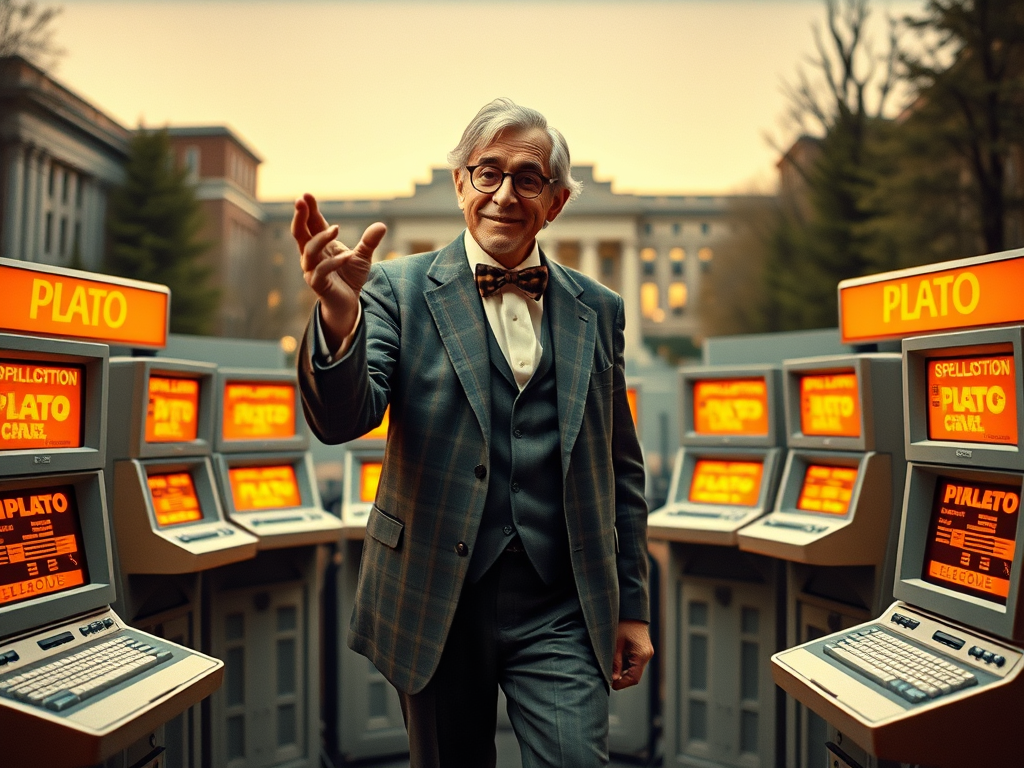
Dr. Bitzer, often seen in unconventional attire and known for performing magic tricks during lectures, was a charismatic yet underappreciated figure in the computing world. His work, overshadowed at times by stories of Silicon Valley prodigies, played a crucial role in the development of modern technology. As tech entrepreneur Brian Dear noted in The Friendly Orange Glow: The Untold Story of the Rise of Cyberculture (2018), the innovations behind PLATO and its early online community have been shockingly overlooked despite their significance.
As a professor of electrical and computer engineering at the University of Illinois, Dr. Bitzer began developing PLATO in 1960 to help educators create interactive, personalized learning materials. Over time, the system evolved into an entire culture—both physical and digital—with its own language and customs.
PLATO, short for Programmed Logic for Automatic Teaching Operations, originally operated on television-like screens connected to the ILLIAC I, a massive machine weighing five tons and powered by 2,800 vacuum tubes. To enhance interactivity, Dr. Bitzer, in collaboration with Professor H. Gene Slottow and graduate student Robert Willson, invented a plasma display in 1964, using gas-infused pixels. This technology would later become the foundation for flat-screen televisions.
PLATO terminals, which glowed with bright orange text and graphics, were installed across the University of Illinois campus and later expanded to other universities and high schools nationwide. These terminals, connected via phone lines, served as an early version of social networking, allowing students to study, play games, communicate in chat rooms, and make digital friends. As Ray Ozzie, a former student of Dr. Bitzer’s who went on to become Microsoft’s CTO, recalled: “It was a little glimpse of what the internet would later become. And it was all fostered by Don’s vision.”
Dr. Bitzer was an eccentric and creative professor, often using magic tricks to explain complex topics. He worked at the Computer-Based Education Research Laboratory, located just across the street from the rival Digital Computer Laboratory, with two distinct philosophies of computing in play. “There was a thousand-mile gap between those buildings, even though they were across the street,” Ozzie explained. “One was about formal theory; the other was all about applying computer science to real-world solutions.”
For Ozzie and many of Dr. Bitzer’s students, the choice was clear: “I could submit my code on punch cards, or I could use the PLATO system with these glowing orange screens. It was insane, and I had to be a part of it.”
In 1981, as personal computers were gaining popularity, Dr. Bitzer appeared on The Phil Donahue Show to showcase PLATO’s capabilities. As he demonstrated how to interact with the system, Donahue marveled, saying, “Can we get a little closer? This is an electronic miracle.”

Born on January 1, 1934, in East St. Louis, Illinois, Dr. Bitzer grew up in Collinsville. His father, Jesse Bitzer, owned a car dealership, and his mother, Marjorie, passed away from cancer when he was 17. From a young age, Donald was fascinated with science, spending time experimenting with a chemistry set in his basement. “Even in first grade, I’d rather be in my basement than in class,” he recalled in a 2022 interview.
After earning a bachelor’s degree in electrical engineering from the University of Illinois in 1955, he went on to complete his master’s and Ph.D. He taught at the university for 29 years before joining North Carolina State University’s computer science department in 1990. In 2002, Dr. Bitzer and his collaborators won an Emmy Award for their work on plasma screens.
He married his high school sweetheart, Maryann Drost, in 1955. She passed away in 2022. Dr. Bitzer is survived by his son, three grandchildren, two great-grandchildren, and his sister, Carol Lampe.
Despite its groundbreaking nature, PLATO did not achieve widespread commercial success. The system was licensed to Control Data Corporation in the mid-1970s, but as the mainframe business declined, so did PLATO’s fortunes.
Brian Dear, in his book The Friendly Orange Glow, sought to preserve PLATO’s legacy. He interviewed hundreds of students and software developers who used the terminals in the 1970s, many of whom described a digital experience that was ahead of its time. As Dear noted, “We’re all living the PLATO life now,” with modern technology such as smartphones embodying the same interconnectedness PLATO once offered.


Leave a Reply