
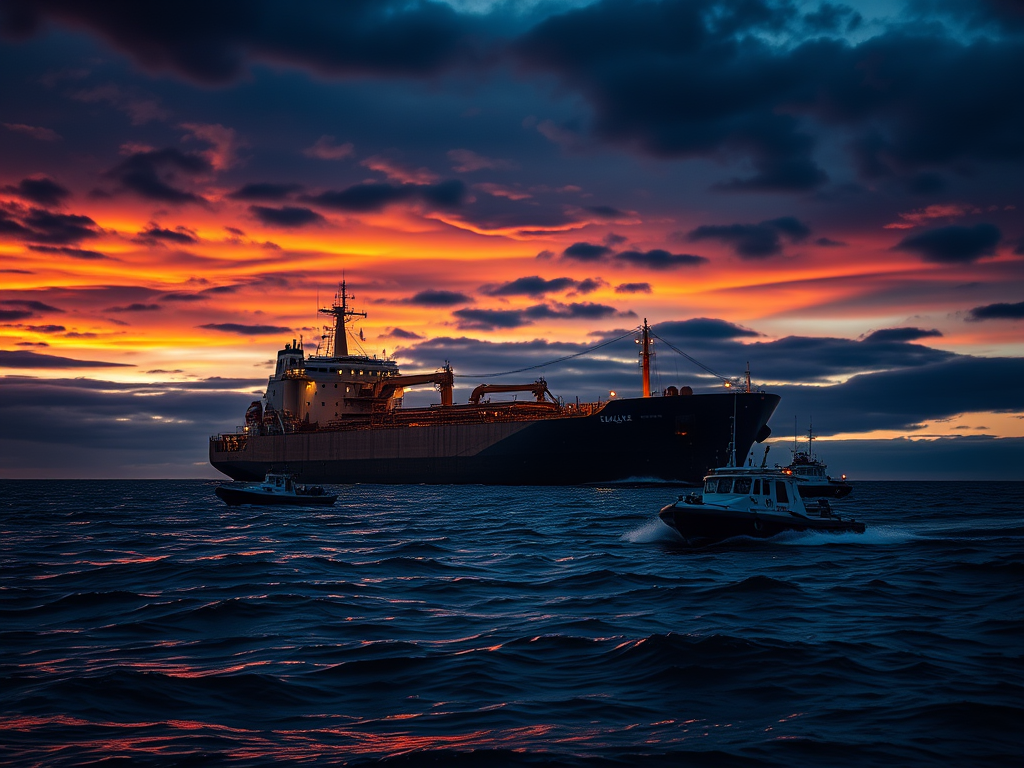


On Thursday, Finnish authorities detained an oil tanker, suspecting its involvement in the sabotage of crucial undersea cables. The authorities suggested that the ship could be part of Russia’s “shadow fleet,” a group of vessels operating covertly to evade Western sanctions.https://wordpress.com/
The Finnish police confirmed that they boarded the Eagle S tanker in Finnish waters. The vessel, registered in the Cook Islands, had been en route from St. Petersburg, Russia, to Port Said, Egypt, when it was intercepted.
The police are investigating whether the tanker played a role in the recent sabotage of the Estlink 2 submarine cable, which connects Finland to Estonia. Finnish authorities also reported damage to four additional cables used for data transmission. The police referred to the cable cuts as “aggravated vandalism.”
Authorities speculated that the Eagle S might belong to Russia’s shadow fleet, which emerged as a strategy to bypass Western-imposed price caps on Russian oil exports. These price caps were introduced in response to Russia’s invasion of Ukraine in February 2022.

In order to circumvent these sanctions, Russia invested billions into a fleet of largely unmarked tankers that often operate under flags from countries like Gabon. These vessels typically transport Russian oil to nations like India and China, which are not bound by the price caps.
This shadow fleet has proven to be largely effective: by October, nearly 70% of Russia’s oil exports were being transported by these tankers, according to the Kyiv School of Economics.
However, using these tankers for acts of sabotage against European infrastructure marks an unprecedented escalation.
Sami Rakshit, head of Finland’s customs agency, commented that authorities suspect the vessel in question is part of the shadow fleet, though he provided no additional details.
Finnish Prime Minister Petteri Orpo emphasized that while there was no direct evidence linking the Eagle S to Russia, the incident highlighted the vulnerability of Baltic nations to potential Russian interference.
“This incident underscores the threat posed by the shadow fleet in the Baltic Sea,” Orpo remarked. “Our main priority is to find effective ways to stop it.” He added that the shadow fleet contributes to financing Russia’s war efforts in Ukraine, and this must be halted.
The Finnish government has not contacted Russia regarding the vessel. Following its seizure, the Eagle S remains anchored in Finnish waters, where it is under investigation in collaboration with Estonian authorities.
This investigation is part of broader concerns over recent undersea cable disruptions. Several cables have been damaged in recent months, sparking fears of a coordinated campaign against NATO members supporting Ukraine.
NATO Secretary General Jens Stoltenberg expressed solidarity with Estonia, condemning any attacks on critical infrastructure and offering further support.
The sabotage of undersea pipelines like the Nord Stream gas line in 2022 raised suspicions of Ukrainian involvement, though the identities of those behind the blasts remain unclear.
Just last month, two fiber-optic cables in the Baltic Sea were severed, with German officials calling it an act of sabotage. One of the cables linked Finland and Germany, while the other connected Lithuania and Sweden, all NATO members.
Russian vessels have been spotted in the Baltic and North Seas near critical infrastructure, and many Russian tankers have switched flags to avoid detection. Last month, European naval forces monitored a Chinese commercial ship in the Baltic after two more fiber-optic cables were cut.
A task force, including officials from Finland, Sweden, and Lithuania, is investigating whether the Chinese ship’s anchor caused the damage. While U.S. intelligence officials believe the cables were cut accidentally, European authorities have not ruled out sabotage.
Finnish officials are now looking into whether the Eagle S was responsible for cutting the Estlink 2 cable.
Prime Minister Orpo revealed that Finnish leaders had been in talks with officials from Estonia, Sweden, Norway, Denmark, Poland, NATO, and the European Commission to address the recent cable disruptions.
European Commission President Ursula von der Leyen praised Finland’s swift action in detaining the vessel and reaffirmed the EU’s commitment to strengthening protections for critical infrastructure, including undersea cables.
Estonian Prime Minister Kristen Michal expressed satisfaction at the coordinated efforts between Finland and Estonia to respond to the cable sabotage, commending their decisive action in detaining the suspected vessel for further investigation.
Despite the damage to the Estlink 2 cable, there was minimal disruption to services in Finland and Estonia. According to Estonian officials, the incident had no significant public impact, although communication between Helsinki and Rostock, Germany, was briefly affected. Cinia, a digital communications company, noted that cable repairs could take several weeks.




Leave a Reply