

Behind Afghanistan’s Fall, U.S.-Backed Militias Worse Than the Taliban

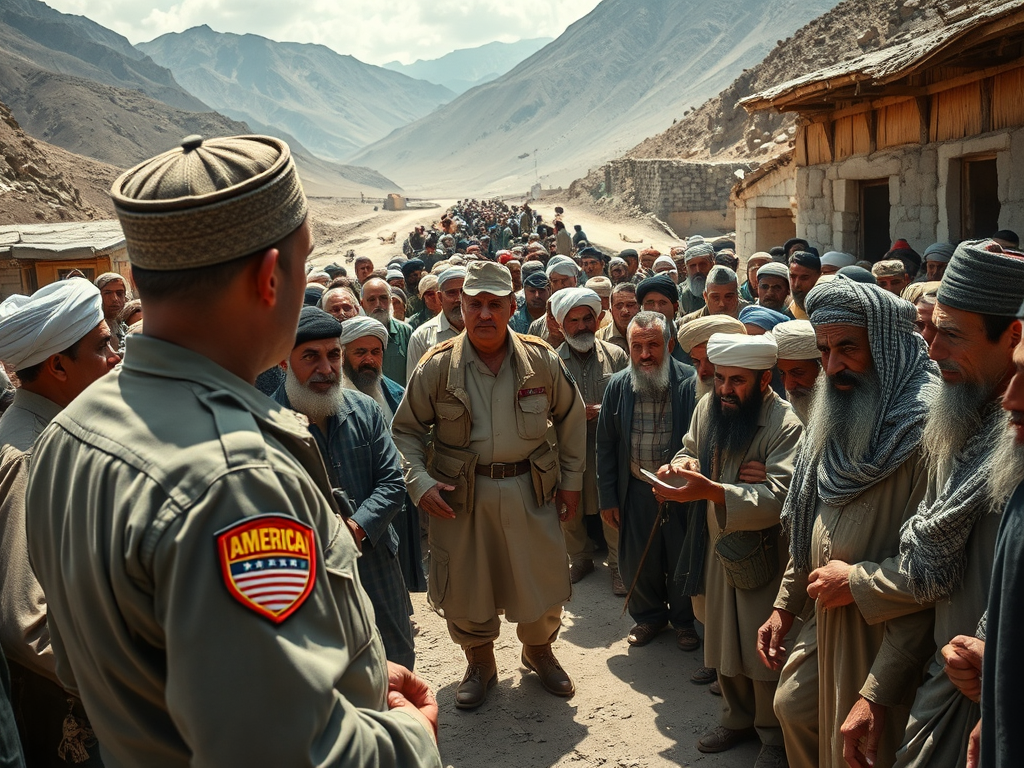
The Taliban was drawing nearer, steadily advancing on territory that had once seemed secure, the American officer warned. Four of his soldiers had just been killed, and he urgently needed Afghans willing to take up arms and resist.https://wordpress.com/
“Who will step up?” the officer implored, addressing a crowd of 150 Afghan elders.

The people in Kunduz Province largely supported the American forces and were opposed to the Taliban. However, recruiting local police officers was proving to be a slow process. By the summer of 2009, local officials and the American officer — a lieutenant colonel from the Georgia National Guard — resorted to a risky solution: hiring private militias.
A murmur of unease spread through the crowd.

“I don’t think this is a good idea,” an elderly man spoke up, according to four individuals present at the meeting. “We’ve seen this before. The militias will become a bigger problem than the Taliban.”
Amid the discontent, Mohammad Omar, a former warlord, stood up and condemned the critics as cowards.

“I will fight the Taliban!” he declared.
The meeting in Kunduz, northern Afghanistan, was never officially recorded in the history of the war. Yet, locals insist this seemingly insignificant moment significantly altered the course of the conflict in ways that Washington has yet to fully grasp.
For years, American forces had supported militias in the north to combat the Taliban. However, the strategy backfired — these groups, with their brutal tactics, terrorized the civilian population, transforming a once secure U.S. stronghold into a key center for the insurgency. People began to see the militias — and, by extension, the Americans — not as liberators, but as oppressors.
Take Mr. Omar, for example. Known as “the Wall Breaker,” he became emblematic of the abusive militia commander, terrorizing the local population by robbing, kidnapping, and even killing in the name of fighting the Taliban.

And Mr. Omar was just one of many militia leaders empowered by the U.S. and its allies — both openly and covertly.
This support for militias set the stage for the chaos that erupted during the American withdrawal in 2021. The north, once considered a bulwark of American values like democracy and women’s rights, quickly fell to the Taliban — the first region to do so.
While President-elect Donald Trump has blamed President Biden for the chaotic end to America’s longest war, vowing to hold those responsible accountable, Biden has shifted blame to the Afghan forces, accusing them of surrendering too quickly.

“Political leaders gave up and fled the country,” Biden said after the withdrawal. “The Afghan military collapsed.”
Both perspectives, however, overlook a deeper reason for the rapid collapse: As revealed in a New York Times investigation, in places like Kunduz, the U.S. had already set the stage for its defeat long before Afghan soldiers dropped their weapons.
For years, the U.S. funded and trained militias that ravaged homes and destroyed entire communities. These groups engaged in atrocities such as torture, kidnapping for ransom, and massacres, generating a decade of resentment toward both the Afghan government and its American backers.
The Afghan military, already stretched thin, recognized that it was defending a government with little to no popular support. When the Taliban offered Afghan soldiers a choice — their lives in exchange for their weapons — many chose to surrender.

The regions devastated by Mr. Omar and other warlords had long been off-limits to outsiders, but over 50 interviews conducted in Kunduz over 18 months revealed the dire consequences of U.S. support for militias. This state-sponsored brutality played a central role in how the U.S. and its Afghan allies lost the north — and how, despite spending two decades and $2 trillion, Afghanistan ultimately fell to the Taliban.
Other investigations have highlighted how the U.S. funded Afghan forces involved in atrocities and, in some cases, even killed its own allies, thereby hastening its defeat in Afghanistan.
The fall of Kunduz in 2021 marked the culmination of another American blunder: enlisting criminals to fight the Taliban.
“The militias shot at civilians and killed innocents,” said Rahim Jan, whose family was murdered by Mr. Omar, as confirmed by other villagers. With no other options, he said, “we supported the Taliban because they fought the militias.”
Even the Taliban, typically eager to boast of their victories, attributed their success in Kunduz to American missteps.
“The U.S. empowered bandits and murderers in the name of counterinsurgency,” said Matiullah Rohani, a former Taliban commander now serving as the information and culture minister in Kunduz. “But this only pushed more people into the hands of the Taliban.”

While human rights organizations, academics, and journalists have documented militia abuses, the extent of this violence — and its role in the Taliban’s rapid takeover — remains largely absent from the American narrative following the withdrawal.
Today, with the militias gone, the full impact of their actions — in terms of both human and political costs — is becoming clear.

Earlier accounts had blamed Afghan officials in the north for raising their own militias. However, The Times investigation revealed that the U.S. was involved in recruiting militias in Kunduz far earlier than previously known, with consequences far more severe than U.S. officials have acknowledged.
Over the course of its 20-year involvement in Afghanistan, the U.S. launched numerous initiatives to recruit, train, and fund local militias to resist the Taliban. Some of these militias were formally created within the police force, while others were ad hoc, with sporadic funding and training. In many cases, the Afghan government distributed U.S. funds, effectively giving militias the stamp of American approval.
Most of these efforts, however, were flawed. The militias soon grew too powerful to disarm. While they did fight the Taliban, they fought each other even more, creating the kind of civil war environment that had allowed the Taliban to rise to power in the 1990s. Many Afghans, disgusted by the militias’ predatory behavior, began to view the Taliban as their protectors and joined the insurgency.

One of the first militias formed in the Kunduz district of Khanabad was the brainchild of the Georgia National Guard officer, desperate to push back the Taliban. This effort, which involved Mr. Omar, was among the earliest and most controversial.
“There was no doubt in my mind that Mr. Omar was a leader in that community,” said Lt. Col. Kenneth Payne, a now-retired officer with the Georgia National Guard. “At the time, he was saying all the right things.”

Colonel Payne had not been tasked with recruiting militias but had a broader mandate. He decided to back Mr. Omar’s group, despite the risks.
But the strategy backfired, as it often did when militias were empowered. Mr. Omar, now the leader of a militia, soon became notorious for his brutal tactics.
Months after the fateful summer meeting, a Taliban fighter lay dying in a collapsed guesthouse. Outside, Mr. Omar, the self-proclaimed “Wall Breaker,” was directing his men in mortar attacks on the building. The mortar rounds, indiscriminate in their destruction, caused nearby homes to collapse, terrifying the residents.
Eventually, Mr. Omar withdrew, fearing the Taliban might send reinforcements, but not before looting a local store and harassing the villagers, actions that turned many against him.

Despite his violence and ineffective leadership, the name “Wall Breaker” stuck, symbolizing both his brutal methods and his ultimate failure.
And this was just the beginning of his reign of terror. In another district, his looting and abuse grew so extensive that it catalyzed the area’s turn to the Taliban. “He even took people’s dogs,” one local recalled.
Mr. Omar, whose long history of violence stretched back to the Soviet-Afghan war, used his newfound power to settle old scores, exacting revenge on rivals from previous conflicts.
Akhtar Mohammad recalled how Mr. Omar rounded up and executed his father, uncle, and brother, allegedly for attacking his convoy with a roadside bomb. Mr. Mohammad insisted his family had no involvement and that the bombing was merely an excuse — the two families had been feuding for decades.
“The militias gave you the power to settle scores,” Mr. Mohammad explained.
Colonel Payne, who initially saw progress, acknowledged that his efforts ultimately failed after he left the area, and the region descended into chaos.
“We thought we had made a difference,” he said, clearly troubled by the outcome.

Leave a Reply