

Al-Assad’s Soldiers Hope for Amnesty. First, They Have to Take a Number.

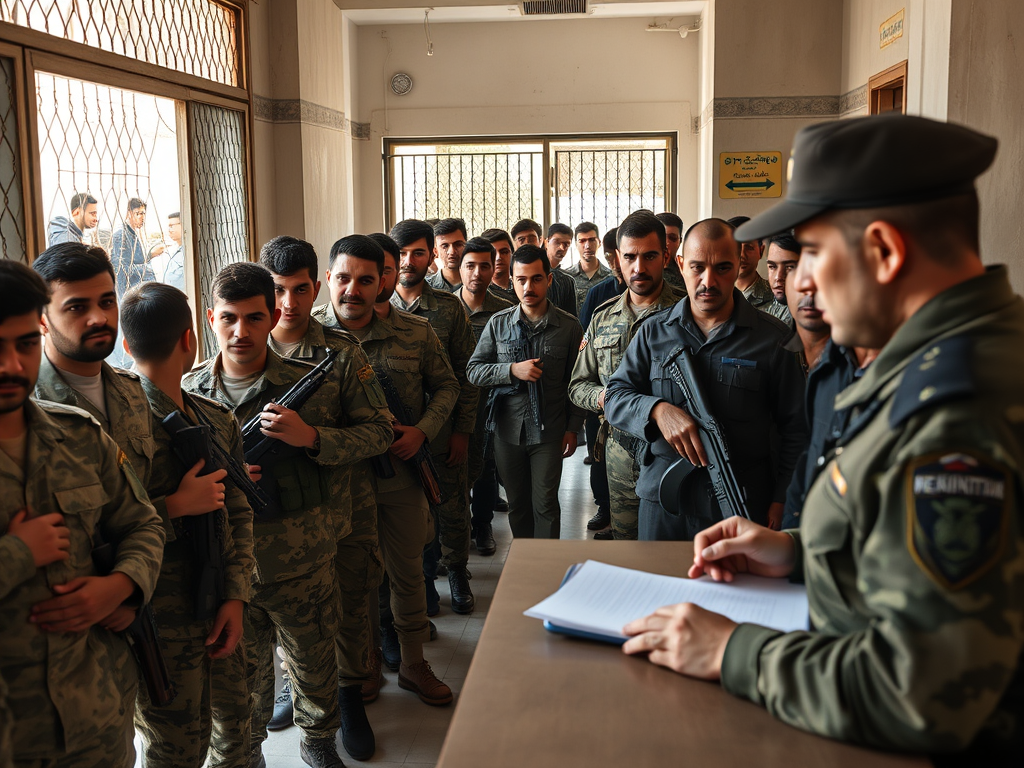
This week, hundreds of soldiers and police officers gathered at a former security facility in Latakia, a city in western Syria, in response to the new government’s call to sever their connections with the ousted regime of President Bashar al-Assad.https://wordpress.com/

For decades, the Assad government maintained a brutal security network responsible for detaining, torturing, and executing its opponents. Last week, the rebel coalition that deposed Assad announced plans to hunt down high-ranking officials involved in these crimes, while offering amnesty to lower-ranking conscripts.

When the so-called reconciliation center opened on Sunday in Latakia, a province long loyal to Assad, over 600 people showed up. The following day, the crowd grew, with the line stretching the entire length of the security complex.
The individuals gathered there sought to clear their names and regularize their status, although the centers are merely the first step, and the full process remains unclear.

Through online and televised messages, the Syrian transitional government, led by the rebel faction Hayat Tahrir al-Sham, urged former soldiers, military officers, and even military medical personnel to surrender their identification, weapons, and vehicles.
According to staff at the Latakia center, one of the first to open, similar facilities had been or would be set up in other regions across Syria.
After hours of waiting and pushing to get a number, some individuals finally made their way inside.

At a desk near the entrance, a police officer from the new Syrian government recorded each person’s name and assigned them a temporary ID number in blue ink. Next, they were asked to stand against a wall and hold their number up for a photograph.
Former soldiers and officers handed in their weapons through two windows lined with metal security bars. One man had brought a Soviet-era machine gun, but it was too large to pass through the window, so he had to hand it over at the front door.

Every few seconds, the sound of guns being cocked echoed as men checked to ensure their weapons were unloaded.
Mohammad Mustafa, a 26-year-old security officer with Hayat Tahrir al-Sham’s interior ministry, dressed in black with a beanie and face mask, stood in the middle of a room that had once been used for interrogations under Assad’s regime. Now, it had been converted into an impromptu weapons storage area.

The new authorities had collected numerous AK-47s, handguns, and other firearms, sorting them into piles by type.
This was just one part of the process. In another room, Warrant Officer Othman Karoom, 40, who had recently served as a traffic police officer in the rebel-held city of Idlib, filled out spreadsheets with the details of each individual.

“What was your specialty?” he asked as Mohammad al-Jarrah, 28, took a seat in front of him.
“Cannons,” al-Jarrah replied, quickly adding, “I was a conscript.”
“How much did you shell Maraat Misrin and Jebel al Zawiyah?” Karoom asked, naming his hometown and a nearby area. “He whose hands have blood on them…”
“I swear, those who have blood on their hands,” al-Jarrah responded, “will all be known.”

While former rebels worked inside gathering information, the line outside continued to grow, with men—and a few women—hoping for their chance at amnesty.
As the hours passed in the cold, a group of men began to shout and push their way forward, attempting to force their entry into the building. A police officer of the new government rushed over with his rifle raised. Soon, order was restored as officers pushed many back outside the gate.
A few people were injured in the chaos but were allowed to remain inside to be processed.
It may take some time before any of the former soldiers and officers learn their fate.
Mr. Mustafa of the interior ministry explained that everyone would need to report back in three months for a full investigation at a security headquarters.
“Right now, we don’t have time,” he said.



Leave a Reply