
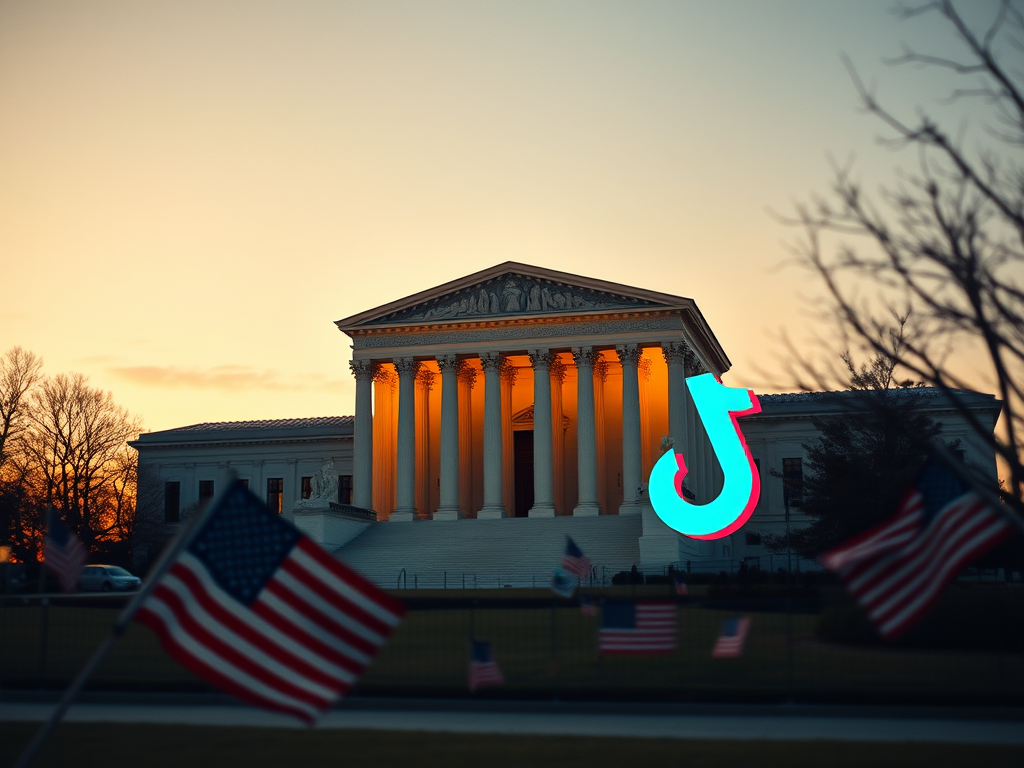

Supreme Court Fast-Tracks TikTok Case in Face of Jan. 19 Deadline

On Wednesday, the U.S. Supreme Court agreed to review TikTok’s challenge against a law that could result in the platform’s ban in the United States. This move accelerates the legal process, with oral arguments set for next month.https://wordpress.com/
The Court allotted two hours for the hearing on January 10, signaling the importance of the case, which pits constitutional protections of free speech against national security concerns raised by the government.
TikTok, along with its parent company ByteDance, filed an emergency petition just two days prior, requesting that the Court temporarily block the law. In a departure from its usual procedures, the Court did not ask the government to respond but treated the petition as a request for review and granted it.
The law, which gained significant bipartisan support, mandates that ByteDance either sell TikTok to a non-Chinese company or face a ban in the U.S. TikTok argues that this violates the First Amendment, while the Biden administration and lawmakers contend that, due to TikTok’s Chinese ownership, the app poses a national security risk by potentially allowing the Chinese government to access vast amounts of user data and spread disinformation.
Although the Court did not block the law while the case progresses, it suggests a ruling could be issued before the January 19 deadline imposed by the law. This would resolve the matter before President-elect Donald Trump is inaugurated on January 20.
The law permits the president to extend the deadline by 90 days under specific circumstances. Trump has shown mixed signals regarding his stance on TikTok, meeting with the platform’s executives at his Mar-a-Lago residence this week.
The outcome of this case will have significant implications. Since TikTok’s arrival in the U.S. in 2018, it has grown into a cultural force, influencing various aspects of American life. Its user base, particularly among younger generations, relies on the app for news, entertainment, and shopping, driven by its sophisticated recommendation algorithm. The app’s addictive nature stems from its ability to track and adapt to user preferences, even down to the amount of time spent on each video.
TikTok’s presence in the U.S. is crucial for its future, as the country represents its largest market. A ban would severely damage ByteDance’s prospects and could undermine the app’s global appeal. In 2020, India, TikTok’s largest market at the time, banned the app following a geopolitical dispute with China, leaving approximately 200 million users without access.
The Court has required both parties to submit simultaneous briefs by December 27, addressing whether the law, formally known as the “Protecting Americans From Foreign Adversary Controlled Applications Act,” infringes on the First Amendment.
President Biden signed the law earlier this year after bipartisan concerns over national security risks, citing the Chinese government’s potential control over private companies like TikTok. However, no concrete evidence has been presented to show that TikTok has been used to gather sensitive data or spread propaganda. Additionally, lawmakers have pointed out that platforms like Facebook and YouTube are banned in China, while TikTok itself is not available there.
TikTok asserts that selling the company is unfeasible due to legal, technological, and financial barriers, and that such a sale would likely be blocked by Beijing. The company also emphasizes that ByteDance is largely owned by global investors, dismissing concerns over the app’s security as exaggerated.
The government rejects TikTok’s characterization of the law as a “ban” and argues that a sale remains a viable option. Judge Sri Srinivasan, in a concurring opinion on the U.S. Court of Appeals for the District of Columbia Circuit’s ruling against TikTok, questioned the notion that China would block a sale. He stated that Congress has the constitutional authority to legislate without being constrained by another country’s preferences.
Despite competition from U.S. tech giants like Meta (Facebook, Instagram) and Google (YouTube), TikTok has maintained its position. Influencers on the platform have begun preparing for the potential loss of TikTok, urging followers to join them on Instagram and YouTube. A countdown clock, signifying the impending threat of a ban, has been circulating among content creators.
To address security concerns, TikTok has proposed Project Texas, a plan to segregate U.S. user data from the rest of the company’s operations. However, U.S. officials have dismissed this as insufficient.
In recent terms, the Supreme Court has shown significant interest in applying free speech principles to major tech companies, although it has refrained from issuing definitive rulings. The Court has also grappled with the scope of the First Amendment’s protections for foreign entities, typically denying constitutional protections for speech outside the U.S.
The Supreme Court has agreed to hear two separate cases related to TikTok: one from the company itself (TikTok v. Garland, No. 24-656) and another from TikTok users and content creators (Firebaugh v. Garland, No. 24-657).
A brief filed in the latter case underscores the broad ramifications of the Court’s decision. It argues that most content shared on TikTok is unrelated to geopolitical issues, with users primarily engaging in discussions about entertainment, health, cooking, and other daily activities. While acknowledging that political content has increased, the brief highlights the importance of free expression at stake, especially given that many TikTok users under 30 turn to the platform for news and political information.
In a brief supporting the law, Senate Republican leader Mitch McConnell argued that the law is fully in line with the First Amendment, stating, “The right to free speech enshrined in the First Amendment does not apply to a corporate agent of the Chinese Communist Party.” He contended that the law was a well-measured response to national security concerns that would withstand constitutional scrutiny.

Leave a Reply