
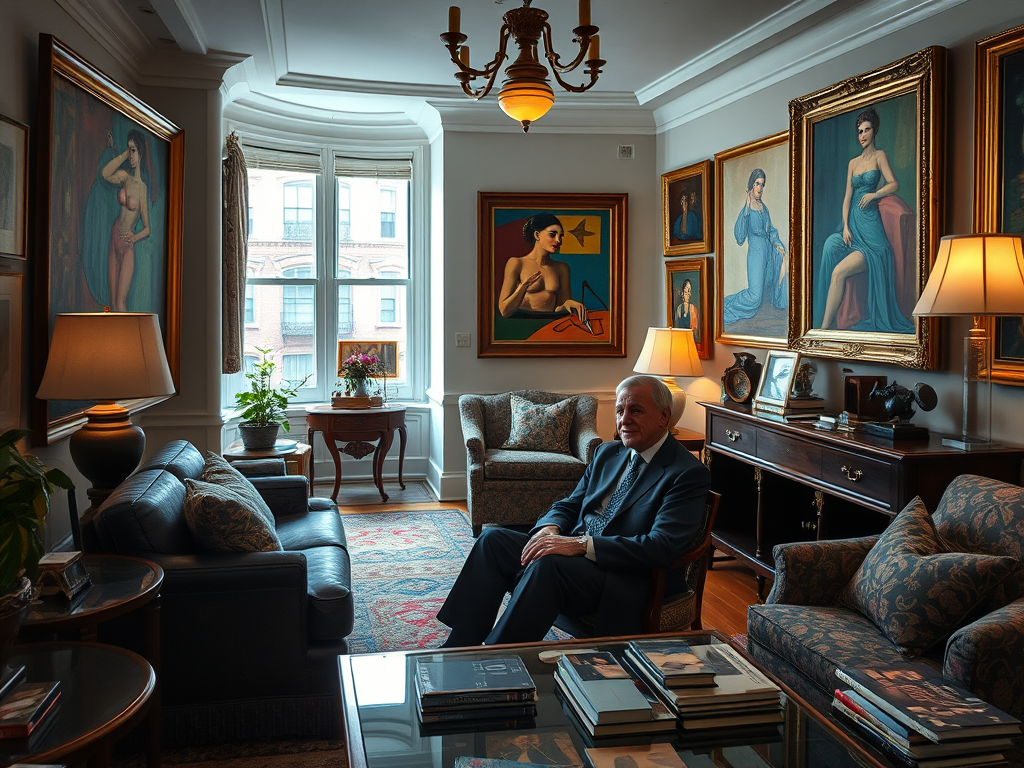

Buy, Donate, Repeat: At 91, Leonard Lauder Has More to Give

In the 1980s, while major collectors were focusing on acquiring works by Monet and Matisse, philanthropist and cosmetics heir Leonard A. Lauder was charting his own course by collecting Cubist art, including works by Picasso and Braque, the movement’s pioneers.

Long before his interest in fine art, Lauder was collecting hotel postcards from his travels, sending them to friends and family, a hobby that laid the foundation for his lifelong passion for collecting.
As other museum trustees were making substantial donations for new building projects, Lauder focused on boosting the endowment of the Whitney Museum of American Art, where he now serves as chairman emeritus.https://wordpress.com/

“I’m a bit unusual in this regard,” Lauder remarked over lunch at his Manhattan apartment, surrounded by Irving Penn photographs. “I don’t typically donate money for institutions’ ideas. Instead, I create my own.”

He continued, “While many collectors make a significant gift and consider it done, I never stop giving.”
It’s been 11 years since Lauder promised the Metropolitan Museum of Art 78 Cubist works, including paintings, drawings, and sculptures valued at over $1 billion. This gift instantly elevated the Met’s Cubist collection to rival those of world-renowned institutions such as the Museum of Modern Art in New York, the State Hermitage Museum in St. Petersburg, and the Pompidou Center in Paris.

At 91, Lauder’s passion for collecting remains as strong as ever. Since the initial donation, Lauder, who oversees the Estée Lauder Companies and whose fortune is estimated at $15.1 billion by Forbes, has quietly added another 12 major Cubist works to the Met’s collection, including pieces by Picasso, Léger, Gris, and Braque. In addition to these 20th-century masters, Lauder is also helping the museum strengthen its postwar and contemporary art holdings, with iconic paintings by Alex Katz, Roy Lichtenstein, and Larry Rivers.
During a recent visit, Lauder pointed to a work by the proto-pop artist Larry Rivers, recalling how Rivers’ work was underappreciated during his lifetime. “I bought another Rivers piece, ‘The Last Civil War Veteran’ (1960), for the Met because I realized they didn’t have a major work by him.”

Lauder’s generosity extends to the Met’s photography collection, where his acquisitions of Irving Penn’s images continue to grow. Less widely known are his donations of 19th-century literary posters, which he gave to the Met in 1984—his first full collection donation to the museum. Today, the collection has expanded to nearly 400 pieces.
“Lauder understands that museums are ultimately defined by their collections, not just their architecture or exhibitions,” Lauder remarked. Building a great collection, however, takes time, patience, and commitment. Lauder, together with Emily Braun, an art history professor who has been his curator for over 37 years, meticulously tracks down sought-after Cubist works, keeping a close watch on auctions and galleries. “It keeps me alive,” Lauder said. “I don’t want to stop.”

The pursuit of rare pieces can be long and uncertain. “Collecting requires study, travel, perseverance, mistakes, refinement, and, of course, buying,” he explains.
This passion for collecting runs in the family. His brother, Ronald S. Lauder, a prominent collector and trustee of the Museum of Modern Art, shares a similar dedication to art.

One particularly elusive acquisition for Lauder was Léger’s “Composition (The Typographer)” from the late 1910s. After first seeing it in the 1980s, he regretted not purchasing it. “I heard my mother’s voice in my head saying, ‘You only regret what you do not buy,’” Lauder recalls. In 1998, after the painting was auctioned by Christie’s, Lauder succeeded in acquiring it, though its large size required some logistical creativity, including removing windows to fit it into his home. The piece is now part of his promised gift to the Met.
Earlier, Lauder applied the same determination to transform the Whitney Museum of American Art into a world-class institution. Becoming a trustee in 1977, Lauder eventually became the museum’s leading benefactor. In 2008, rather than contributing to a new building project, he made a historic donation of $131 million to the Whitney’s endowment, the largest in the museum’s history.

Lauder also pioneered the idea of making headline-grabbing acquisitions for museums. In the 1980s, he led the acquisition of Jasper Johns’s “Three Flags” for the Whitney for $1 million, the highest price ever paid for a living artist’s work at the time. This established a model for transformative donations in the art world.
Since then, Lauder has helped the Whitney acquire nearly 50 works by Johns, including paintings, drawings, sculptures, and prints. In 2021, he secured “Painted Bronze” from the Philadelphia Museum of Art for the Whitney, as well as other significant Johns works in preparation for a major retrospective.

Lauder’s gifts are not only large in scale but also reflect his commitment to the technical and intellectual depth of artists’ work. Scott Rothkopf, the Whitney’s director, notes that Lauder’s focus on acquiring works that represent an artist’s deep exploration is what sets him apart.
Over the past decade, Lauder has added numerous key works to the Whitney’s collection, including sculptures by Frank Stella and Robert Rauschenberg and paintings by Wayne Thiebaud. One of his recent acquisitions, Charles Ray’s monumental sculpture “Jeff,” is considered a highlight of the museum’s collection.
Despite his extensive contributions, Lauder enjoys keeping much of his philanthropy under the radar. “I sell lipsticks,” he said with a playful grin, referencing his role at Estée Lauder Companies.
In recent years, he has refrained from discussing the financial aspects of his contributions, focusing instead on meeting the museum’s needs. Max Hollein, director of the Met, praised Lauder as a visionary partner who has broadened the Met’s horizons and transformed its collection.
Still, Lauder’s passion for collecting continues. He began his collecting journey with postcards, a hobby inspired by his childhood trips with his mother, Estée Lauder, a pioneer in the cosmetics industry. Over time, postcards became a symbol of popular culture for Lauder, and in 2002, he donated a collection of 20,000 Japanese postcards to the Museum of Fine Arts Boston.
The gift was part of a broader effort to preserve the cultural significance of postcards, which Lauder believes served as a precursor to modern social media. His collection continues to grow, with the Boston museum now holding over 100,000 postcards, including rare “Real Photo Postcards” capturing daily life in early 20th-century America.
Lauder’s passion for photography grew over the years, influenced by his marriage to Judy Glickman, a skilled photographer and collector. In the 1970s, Lauder commissioned Irving Penn to create iconic ads for Clinique, helping define the brand’s visual identity.
Lauder’s expertise and deep understanding of art and culture also led to the creation of the Leonard A. Lauder Research Center for Modern Art at the Met, where scholars focus on specific artists and their works. In 2021, Lauder donated a rare Joseph Cornell collage to the museum, one of the artist’s most important works.
Even as Lauder continues to make significant contributions, he remains an avid collector, constantly seeking out rare works to expand the Met’s collection. “Collecting is a journey,” he says. “One that requires patience and a discerning eye.”




Leave a Reply