
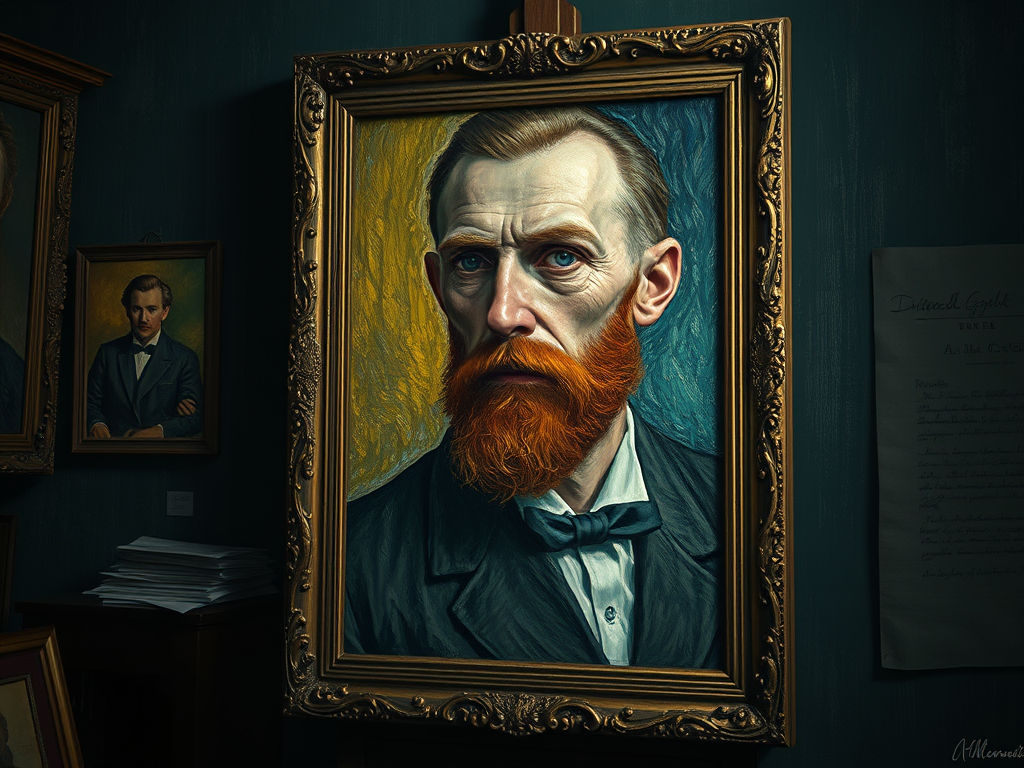

The Search for van Gogh’s Lost Masterpiece

On May 15, 1990, Vincent van Gogh’s painting Portrait of Dr. Gachet made headlines when it was auctioned at Christie’s in Manhattan for a record-breaking $82.5 million, making it the most expensive artwork ever sold at auction at that time. The buyer was a Japanese paper mogul.https://wordpress.com/

The painting, created in June 1890 in the garden of Dr. Paul-Ferdinand Gachet, van Gogh’s physician, was completed just weeks before the artist’s tragic suicide. Van Gogh himself described the work as capturing “the heartbroken expression of our time,” which he believed was reflected in the doctor’s melancholy demeanor. Often considered one of his masterpieces, some art experts today estimate its value could be as high as $300 million.

For much of the 20th century, Portrait of Dr. Gachet was displayed in major museums, including the Städel Museum in Frankfurt and the Metropolitan Museum of Art in New York, where it had been on loan from a private collector before its record-breaking sale in 1990.
However, since the auction, the painting has mysteriously vanished, and its current location remains one of the greatest enigmas in the art world. Despite several efforts by curators, including a dedicated podcast by the Städel Museum, to track it down, its whereabouts remain unknown.

Over the years, it has been confirmed that the painting’s 1990 buyer, who had been embroiled in a scandal, eventually sold it to a creditor after facing criminal charges. The Gachet was later acquired by an Austrian financier, Wolfgang Flöttl, who, unable to maintain it, sold it privately in 1998, and since then, the trail has gone cold.
While the art world thrives on secrecy and privacy, there are professionals who dedicate their careers to tracking ownership of valuable artworks. Journalists from The New York Times have investigated the 1998 sale and spoken to experts who follow the movements of high-profile art acquisitions. Their search has taken them from New York’s auction houses and galleries to the serene shores of Lake Lugano in Switzerland.

Many of those encountered during the investigation were unaware of the painting’s fate. However, some insiders speculate that the Portrait of Dr. Gachet is now owned by a wealthy European family, potentially one from Switzerland. The question has arisen as to whether wealthy collectors have an ethical responsibility to share such iconic works with the public, especially since museums often lack the financial means to outbid billionaires for artworks.

For art experts like Michael Findlay, who was involved in the 1990 auction, the notion of private ownership is clear: “People are allowed to own things privately,” he said. “Does it belong to everybody? No, it does not.”
Yet, the loss of the painting has left a significant void. Cynthia Saltzman, author of Portrait of Dr. Gachet, reflects on her past experiences with the painting, recalling how it once hung at the Met and how she had expected it to resurface at an exhibition or auction after its private sale. She likens its disappearance to the feeling one gets when a loved one dies unexpectedly—wishing one had paid closer attention to the last moments.

The history of Portrait of Dr. Gachet begins in the village of Auvers-sur-Oise, France, where van Gogh, in the last months of his life, painted not only the doctor’s portrait but also some of his most famous works, such as Wheat Field with Crows. Van Gogh’s intention was not to create a precise likeness, but rather to capture the emotional state of his subject, conveying the “longing and crying out” of the time.

The painting’s history is rich and complex, passing through several hands since van Gogh’s death. It was initially acquired by his brother, Theo, and later sold in 1897 for a modest sum. Over time, the painting’s fame grew, and by 1911, it was on display at the Städel Museum in Frankfurt. When the Nazis rose to power, the portrait was temporarily hidden but was eventually seized and sold to a German banker. It later ended up in New York, where it was frequently displayed at the Met.
In 1990, Ryoei Saito, a controversial Japanese businessman, purchased the work for a record price, but his financial troubles soon forced him to sell it. The Portrait of Dr. Gachet was then bought by Wolfgang Flöttl, an Austrian financier. When Flöttl faced his own financial difficulties, the painting was sold privately in 1998, and it has since disappeared from the public eye.

Although the identity of the current owner remains a mystery, speculation persists. Some believe it resides with a wealthy family in Switzerland, possibly the Invernizzi family, whose fortune comes from the production of cheese. Others have raised doubts, with some art insiders and auction house specialists pointing to different possible owners.
Despite all efforts, the Portrait of Dr. Gachet remains elusive. Wouter van der Veen, a van Gogh scholar working to restore Dr. Gachet’s home in France, expresses a shared sense of longing within the art world: “It is part of history, but it is also part of our lives now, and not knowing where it is is unbearable.”
As the mystery endures, experts like Teio Meedendorp from the Van Gogh Museum remain hopeful that, one day, the portrait will resurface. Whether that will happen remains uncertain, but for now, the Portrait of Dr. Gachet remains a symbol of art’s complexity and the shadows of its hidden treasures.




Leave a Reply