
A senior Russian military officer responsible for overseeing nuclear and chemical weapons defense forces was killed in a bomb attack on a Moscow street Tuesday, marking one of the boldest assassinations since Russia’s full-scale invasion of Ukraine nearly three years ago.

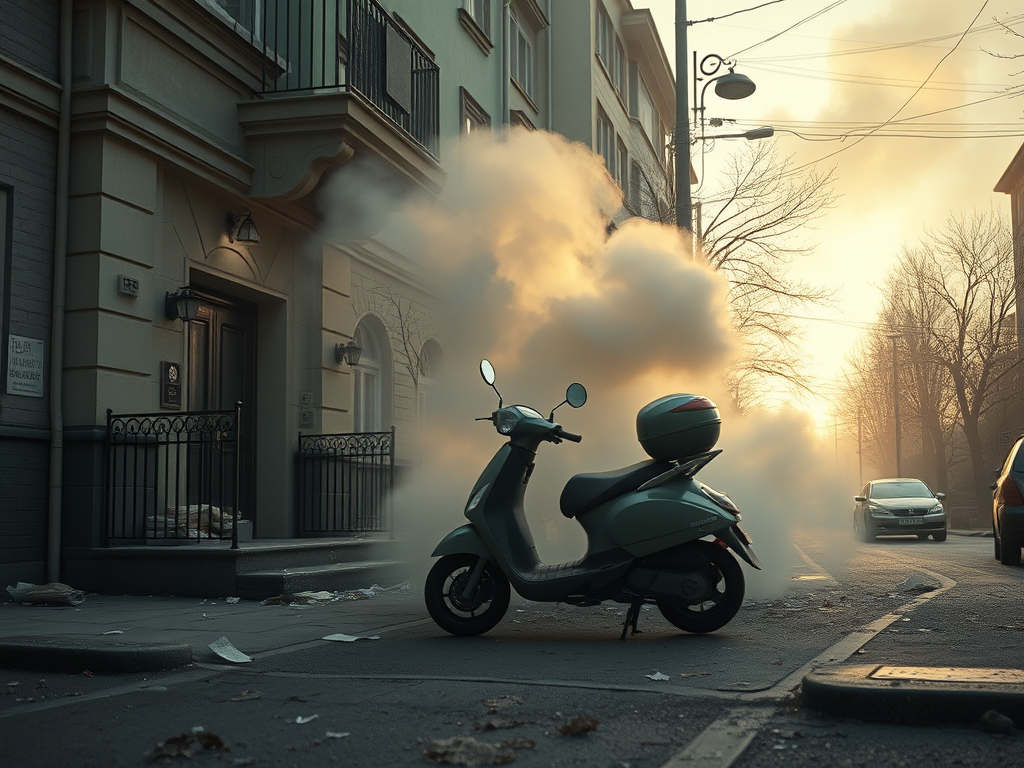
The general, Igor Kirillov, 54, and his aide were killed when an explosive device planted on a scooter detonated early Tuesday morning near the entrance of a residential building, according to a statement from Russia’s Investigative Committee, a law enforcement agency.
An anonymous official from Ukraine’s security service, the S.B.U., confirmed that Ukraine was behind the attack. This official, speaking on condition of anonymity, also verified the details of the assassination as reported by Russia.https://wordpress.com/
The S.B.U. considered General Kirillov a legitimate target, the official explained.
Just a day before the assassination, Ukraine had accused him of being involved in illegal activities, particularly his role in the “widespread use of banned chemical weapons” in Ukraine. The S.B.U. alleged that Russian forces had dropped toxic munitions on Ukrainian positions to push soldiers out of their trenches.
The division under General Kirillov’s command is tasked with specialized operations, including the defense of Russian troops when chemical and nuclear weapons are deployed, as well as offensive actions such as attacks with incendiary weapons.
Kirillov was in charge of Russia’s radioactive, chemical, and biological defense forces and played a role in developing the TOS-2 thermobaric rocket launcher, which the Russian military has frequently used in Ukraine, according to his biography published by RIA Novosti.
His assassination represents the highest-profile killing of a Russian military official within Russia since the invasion began in 2022. While other generals have died closer to the battlefield in Ukraine, Kirillov is the highest-ranking official to be killed inside Russian territory.
A former head of a Russian military academy, Kirillov was also known for his role in Russia’s propaganda efforts against Ukraine and the West. He frequently appeared in media, making unfounded claims, including one in 2023 in which he accused the United States of planning to use drones to spread infected mosquitoes.
Kirillov had also alleged the discovery of a Ukrainian chemical weapons laboratory near Avdiivka, a city captured by Russian forces in February. This accusation was part of Russia’s broader effort to falsely portray Ukraine as a hub for weapons of mass destruction at the behest of the West. Ukraine vehemently denied these claims.
The bomb that killed General Kirillov went off at approximately 6:12 a.m., and its force was so strong that windows on the third floor of a nearby building were shattered, as reported by the RIA Novosti state news agency.
Tass, another Russian news agency, reported that investigators had found a hidden camera in a car-share vehicle nearby, which had been used to monitor Kirillov.
In a video shared by the S.B.U. official with The New York Times, two people are seen leaving a building moments before the explosion. The footage, which was recorded from a short-term rental vehicle, matches the details of the location and time of Kirillov’s death. The video shows a scooter positioned near the building’s entrance, where the explosion is believed to have occurred.

The bomb was said to have the force of more than two pounds of TNT, according to Tass.
There was no immediate comment from the Kremlin following the assassination, though Russian state television quickly reported it as a “tragedy” in their daytime news coverage.
In Russia’s lower house of Parliament, Chairman Vyacheslav Volodin observed a moment of silence for Kirillov and described him as “not only a military leader but first and foremost a scientist.”
A senior U.S. official confirmed that the United States was not informed of the planned assassination, and expressed concerns it might provoke a severe reaction from President Vladimir Putin. U.S. officials have generally opposed sabotage and targeted killings within Russia for this reason.

Other American officials noted that while General Kirillov was not a key commander in the war, his death might not lead to significant escalation on the battlefield. They speculated that Russia might retaliate by targeting a similarly positioned Ukrainian officer.
The S.B.U., Ukraine’s primary domestic security agency responsible for counterintelligence and combating terrorism, has increasingly conducted covert operations targeting pro-Kremlin figures and military officials inside Russia. As the conflict on the front lines has become more protracted, Ukraine has carried out increasingly deadly sabotage missions, including taking credit for a car bombing that killed a senior Russian naval officer in Crimea last month.
This pattern of covert operations, according to analysts, helps Ukraine compensate for its disadvantages against a larger and better-equipped enemy.
John Foreman, a former British defense attaché in Moscow and Kyiv, suggested the assassination had two main objectives: first, to retaliate for Russia’s use of chemical weapons in Ukraine, and second, to send a strong message to Russian officials involved in the war that they too are vulnerable.

Despite these implications, Foreman believes the assassination is unlikely to significantly alter the dynamics on the battlefield. The Kremlin remains committed to fully occupying the four Ukrainian regions it has declared as its own, with no signs of backing down.
The S.B.U. stated that since the beginning of the war, Russian forces, under Kirillov’s orders, have used chemical weapons more than 4,800 times. Russia has denied these claims, though during a July meeting of the Organization for the Prohibition of Chemical Weapons (OPCW), it rejected the accusations.
Ukraine has specifically accused Russia of using combat grenades filled with CS and CN tear gases, which are banned in warfare under the Chemical Weapons Convention. The Conflict Intelligence Team, a Russian open-source research group, has also reported that Russian troops used these gases on the battlefield in violation of international conventions.
The U.S. State Department earlier this year confirmed the use of chloropicrin, a choking agent, by Russian forces, as well as tear gas. In response, Britain imposed sanctions on General Kirillov in the fall for his role in deploying chemical weapons in Ukraine.
The OPCW described the chemical situation in Ukraine as “volatile and extremely concerning” in May, though it stated that evidence supporting claims of chemical weapon use was insufficiently substantiated.


Leave a Reply