
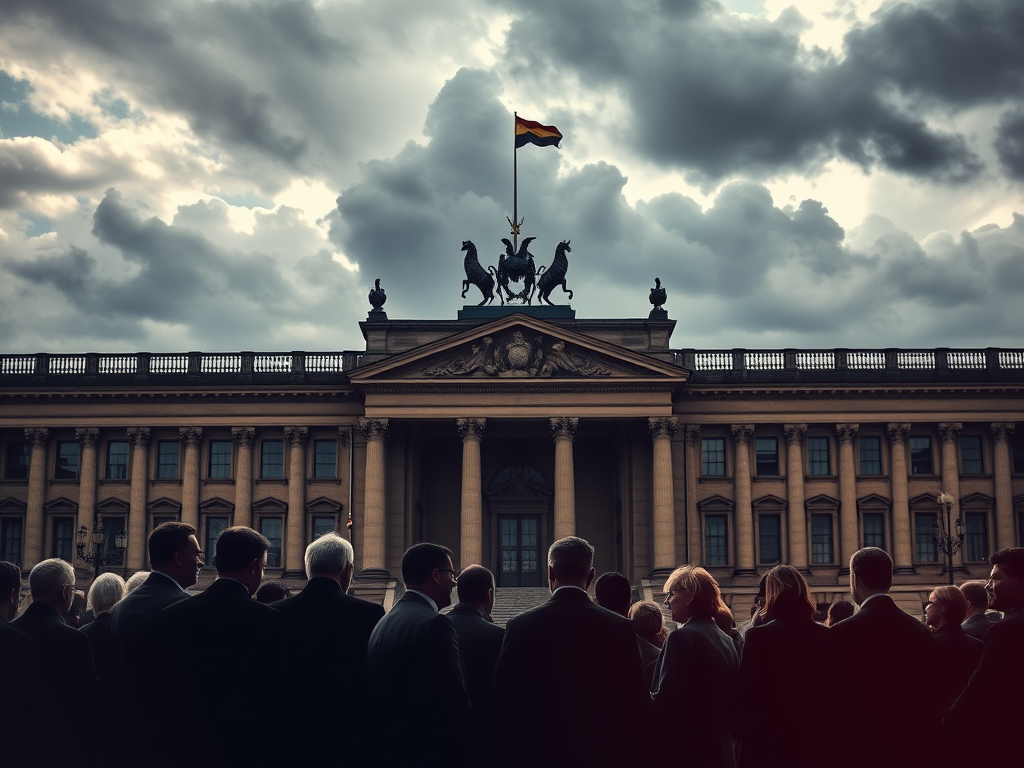

The German government collapsed on Monday after Chancellor Olaf Scholz lost a confidence vote in Parliament, intensifying a leadership crisis across Europe amid rising economic and security challenges.
The war in Ukraine has intensified, with Russia issuing increasingly severe threats against Kyiv and its allies. Meanwhile, President-elect Donald Trump is poised to take office in the U.S., raising concerns about Europe’s trade relations and military security. Earlier this month, France—Germany’s key partner in leading Europe—also saw its government fall.https://wordpress.com/
Now, Europe’s largest economy faces a caretaker government as it prepares for elections early next year.
On Monday, German lawmakers voted to dissolve the current government, with 394 in favor, 207 against, and 116 abstentions.
This vote, coming just nine months before the scheduled parliamentary elections, marks a rare and unprecedented moment for Germany. The elections, now expected on February 23, will be only the fourth snap election in Germany’s 75-year history. This development signals a new era of more unstable and fragmented politics in a country once known for its durable coalitions and consensus-driven approach.
Scholz had little choice but to call the confidence vote after his three-party coalition fractured in November, following months of internal strife, leaving him without a parliamentary majority to pass legislation or budget proposals.
Political instability is expected to persist for at least a month, as parties must negotiate a coalition government, which may not be formed until April or May.
Seven parties are expected to vie for seats in the upcoming election, with some, especially on the political right, poised to make strong gains according to polls. Scholz is widely expected to be ousted, with the conservative Christian Democrats likely to emerge as the leading party, far ahead of Scholz’s Social Democrats.
The election campaign is likely to be dominated by a range of issues that have plagued Europe in recent years. Both Germany and France are grappling with economic stagnation, growing social divides, concerns over immigration, and the need to strengthen national defense.
Europe’s leaders are also keeping a wary eye on Russia, where President Vladimir Putin has escalated nuclear threats amid the ongoing war in Ukraine.
At the same time, the economic relationship with China is a source of concern. Although China has become a formidable competitor in several industries, it has not lived up to expectations as a major consumer market for European products.
Adding to Europe’s uncertainty is the impending start of Trump’s new presidential term, with his threats of a trade war and a possible end to the U.S.’s commitment to NATO, which has been essential to Europe’s security for 75 years.
These combined challenges have created political turbulence. In France, President Macron appointed his fourth prime minister this year and faces increasing pressure to step down. Macron has pledged to remain in office and address the internal divisions in his government, particularly over the 2025 budget.
Scholz’s government has faced similar budgetary challenges, along with rising concerns about rebuilding Germany’s military in the face of an aggressive Russia and Trump’s criticism of NATO.
The German economy has stagnated, narrowly avoiding recession this fall. The political parties are set to spend the campaign debating how best to revive the economy, with disagreements over the budget—particularly on whether to raise government borrowing or impose further austerity measures—fueling tensions within Scholz’s government before it disintegrated.
The timing of these developments is disastrous for Germany, which now faces an exhausting election campaign during a politically unstable period.
“The timing is absolutely terrible for the EU—these multiple crises are hitting at the worst possible moment, as Germany and France, traditionally the EU’s engines, are mired in domestic turmoil,” said Jana Puglierin of the European Council on Foreign Relations.
The war in Ukraine and the need to strengthen Germany’s military will be among the most pressing issues during the campaign, alongside concerns over the economy, immigration, crumbling infrastructure, and the rise of political extremism.
With polling numbers significantly behind, Scholz plans to focus on his cautious approach to supplying weapons to Ukraine, especially advanced offensive weaponry. Under his leadership, Germany became the largest European donor of military aid to Ukraine, but Scholz has emphasized his decision not to send the long-range Taurus missile system, which could provoke further tensions with Russia.
In a speech to lawmakers before the vote, Scholz reiterated his commitment to supporting Ukraine but stressed that Germany would not take actions that could jeopardize its own security. “We do nothing that jeopardizes our own security,” he said. “That’s why we do not supply cruise missiles, a long-range weapon that could strike deep into Russia.”

This strategy appears to have gained some traction, as Scholz’s personal approval ratings have risen slightly since the collapse of the coalition. However, his party remains at around 17 percent in the polls, half of what the conservatives are expected to secure.
Scholz faces an uphill battle to convince voters to give him another chance. For now, the leader of the Christian Democratic Union, Friedrich Merz, is widely seen as the most likely candidate for chancellor, given his party’s strong lead in the polls.
Merz criticized Scholz’s government, accusing it of failing to manage the country through one of its greatest postwar economic crises. “You are leaving the country in one of the greatest economic crises in postwar history,” Merz told Scholz in Parliament.
Other major parties are led by familiar faces, including Christian Lindner, head of the pro-business Free Democrats, and Robert Habeck, the economic minister and Green Party candidate. However, in Germany’s fragmented political landscape, no single party is expected to secure an outright majority, which could lead to complex coalition negotiations to form a stable government.
All mainstream parties have ruled out forming a coalition with the far-right Alternative for Germany (AfD), which is under surveillance by domestic security services due to its potential threat to the constitution. Nonetheless, the AfD is polling at around 18 percent and is gaining momentum.
In state elections in eastern Germany earlier this year, the AfD and the far-left Sahra Wagenknecht Alliance saw strong performances. While these parties are less popular nationally, they have complicated coalition-building efforts at the regional level.

These developments may foreshadow messy negotiations in Berlin after the parliamentary vote, although the political fringes remain less influential nationally than in eastern Germany.
Given the current polling, many observers expect a return to the grand coalition of the Christian Democrats and the Social Democrats, which governed Germany for much of the past two decades.

Leave a Reply