
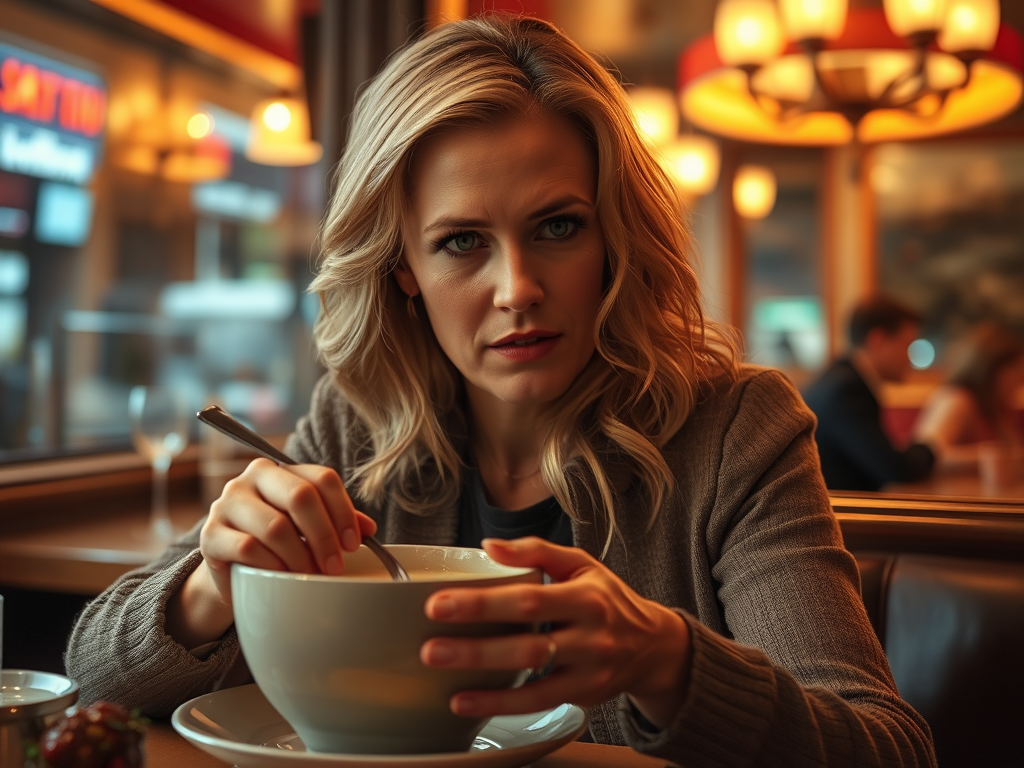
Nicole Kidman’s eyes grew large as she inquired, “Have you never visited the Rockettes? I make it a point to go annually. Indeed, I’m enamored with it!”
Sex, Death, and Nicole Kidman

During a meal of celery root soup at the Empire Diner in Manhattan the previous week, the 57-year-old Academy Award recipient shared anecdotes about the extravagant Christmas show, which she had recently enjoyed with her family and husband, musician Keith Urban. “I was asking my husband, ‘What is it that draws us to it so strongly?’ He replied, ‘It’s the nostalgia. It’s reconnecting with the child within you.’”
Recently, Kidman has been reflecting on such experiences, mapping out her life and professional journey as a continuous thread. Her latest film, “Babygirl,” represents such a connection: despite her recent appearances in prominent streaming series like “The Perfect Couple” and “Lioness: Special Ops,” this film signifies a return to the daring, director-driven cinema for which she was once celebrated.
“Babygirl,” directed by Halina Reijn, features Kidman as Romy, a composed CEO with a loving husband (Antonio Banderas) but a lackluster sex life: Reluctant to pursue her desire to be dominated, Romy finds her preference met by a young intern (Harris Dickinson), leading to a tempestuous affair. “It’s incredibly revealing,” Kidman confessed about the film’s sexual intensity. When she first watched it with an audience, she felt so exposed and vulnerable that she hid her face in Reijn’s chest.https://wordpress.com/
“Babygirl” could potentially earn Kidman her sixth Oscar nomination and has already awarded her the esteemed Volpi Cup for best actress at the Venice Film Festival in September, although Kidman was unable to attend the ceremony due to the passing of her mother, Janelle, at 84. The two were very close, and her loss has put Kidman in a contemplative state: Throughout our discussion, she touched not only on “Babygirl” but also her mother’s unfulfilled dreams and the challenges that hinder female fulfillment, addressing these subjects in an unexpectedly candid manner.
“The essence of being an actor is the ability to remain unencumbered, open, and vulnerable,” she shared with me. “Maintain that state, shed your defenses: Here I am.”
The following are excerpts from our conversation, edited for clarity.
What kind of feedback have you received for “Babygirl”?
A range of responses. I’ve become akin to a sex therapist, yet I’m thinking, “I’m not qualified!” Yet, people are captivated, eager to discuss it, aroused by it, or unsettled by it.
With a film centered on sex, some people measure its success by whether it arouses them or not. However, there’s much more to this film than that.

It’s about an existential crisis. Yes, it involves [sex], but it’s also about a woman asking, “Who am I?” She’s in a state of turmoil because she’s uncertain of her identity or her true desires, which is a very relatable sentiment. Although it’s through the female gaze, it’s also gender-neutral: Many friends who’ve seen it, men, comment, “It’s about secrets,” or “It’s about having to stay in the closet,” or “It’s about never being able to express myself.” There’s a liberating aspect to it.
How was your connection with Halina? You’ve done some sexually explicit films before, like “Eyes Wide Shut” and “The Paperboy,” but this time you’re tackling such material with a female director.
It feels incredibly safe, as if you’re with your dearest friend. Halina and I are so close, and it’s actually a rather dreadful feeling now because she’ll likely move on to someone else. It’s disheartening as an actor because you think, “Oh no, I won’t be your muse anymore. You won’t be bestowing your affection on me.”

I’ve always wondered how that feels for actors. You have these intense experiences with directors and cast members, then suddenly part ways. It’s like the end of summer camp.
But it is! No one ever discusses that. You never know: Maybe paths will cross again, you hope. But you have to be chosen once more, and now that she’s so in demand, it’ll be like, “No, I’m done with you.” [Laughs.]
How does a director gain your trust to make a film like “Babygirl”?
I have an innate sense of trust. My mother would always say, “You trust too much, Nicole, stop it,” but I keep trusting until I get hurt, and then I start again. I cherish intimacy, which is probably why I’m reluctant to let go of Halina now: You form these friendships with people that transcend work. With actors as well: You’re looking into another person’s eyes, you’re truly there. When you’re being held and experiencing something, you’re going through it together. That’s a genuine, real connection.
And your body is genuinely feeling it?
And my heart, and my mind. It’s all there, and I’ll stop doing it if that stops. It’s the beautiful part of our profession.
Does that ever take a toll on you? “Babygirl” requires you to be very exposed.

It’s exhilarating, ultimately. People say, “It was a brave choice to do this.” I say, “No, it would have been devastating not to do it.” It would have been a very, very destructive thing for me not to do it.
It’s not easy to remain so vulnerable, though.
I’m probably too permeable and too accessible — my husband says I don’t have enough defenses. My nature is somewhat shy, but as I’ve grown, I’ve had very, very deep conversations. Watching my mother live the last 10 years of her life — a highly intellectual woman, enduring the deterioration of her body but not her mind — it was an extraordinary journey to accompany her through that. I was her eldest daughter and confidante, so it was a profound experience to be a mother to young girls [she has two daughters with Urban and an older daughter and son with her ex-husband, Tom Cruise] and to have my mother experience the last decade of her life, being very vocal about it.
What did she share with you?
It was frustrating as her body failed at different times and she couldn’t do what she wished. The late-night calls were the most intriguing because they were at 3 a.m. and we sometimes talked for two hours about what it means to age, the beauty of that and the pain. She was very aware of what it entailed and had a lot of frustration and anger. You know the poem, “Do not go gentle into that good night?” That was very much her.

Were you in Venice when you found out she had passed?
I had just arrived there, and it all hit like an avalanche. As Halina says in “Babygirl,” the avalanche is coming. Well, my mother’s avalanche arrived.
Mortality frequently emerges when I discuss this film with people. When I asked your co-star Harris Dickinson if he was concerned about how he would be perceived after “Babygirl,” he said, “Why would I? We’re all going to die someday.” That puts things into perspective.
That’s the youth speaking. And then Antonio is fascinating because you have the opposite: He had a significant heart attack and survived, so he has an extraordinary outlook on life. Talk about vitality! He is so present and emotional. I want to praise Antonio because he showed up on set so open, willing, and supportive of Halina. We have incredible men in this film, which should be celebrated because it’s not guaranteed. Could there have been men who didn’t want to do it? Probably, because it’s very sexual, and that’s confronting.
Was it confronting for you?
Yes, because it’s incredibly profound. I feel like I’ve revealed a part of myself that’s very private.

Have you felt that way in the past with material that had a sexual element?
Not as much as this. “Big Little Lies,” at times, because those scenes were very harsh, and I was bruised and battered. With this, my heart is onscreen. It’s different. I had to go to another place to do it, where I just thought, “Don’t think of this being seen by anyone, think of it as deeply intimate and only here now.”
I heard that you were so deeply into this role that during one scene, you unexpectedly hailed a cab while in character.
And got in! The first A.D. [assistant director] was like, “Get her back.”
If you’re able to surprise yourself while performing, does it also surprise you to watch the performance later?

Mm-hmm. In a confronting way. But I always say I’m not the judge of my performance. There is no judge, there’s no right or wrong.
The film is about liberating yourself from shame. How are you able to do that as an actress who ventures into risky or explicit territory in her work?
I’ve always had this intense commitment. I found my place in the world through literature and theater when I was younger: I would go to the theater on weekends and express many different emotions that were brewing within me. It’s been my comfort, my savior, and my solace. It’s saved my life. So with the loss of my mom, I think, “Where does all this emotion go?” I can put it into a little box or I can actually channel it




Leave a Reply