

Netanyahu Finally Takes the Stand in His Corruption Trial

Outside the courtroom, Benjamin Netanyahu holds one of the most influential positions in the Middle East, overseeing Israel’s military operations in Gaza, its control of southern Lebanon, and recent airstrikes in Syria.https://wordpress.com/
However, on Tuesday morning, as he entered a cramped, sweltering underground courtroom in Tel Aviv, Israel’s longest-serving prime minister was no longer a leader at the helm of his country; he became the defendant in Case 67104-01-20, facing charges of bribery, fraud, and breach of trust.
After eight years of investigation and four years since his trial began, Netanyahu was finally on the stand to address accusations of corruption that have plagued Israeli politics for nearly a decade.
Rivka Friedman-Feldman, one of the three judges overseeing the case, reminded him: “Like anyone brought to the witness stand, you are required to speak the truth, the whole truth, and nothing but the truth.”
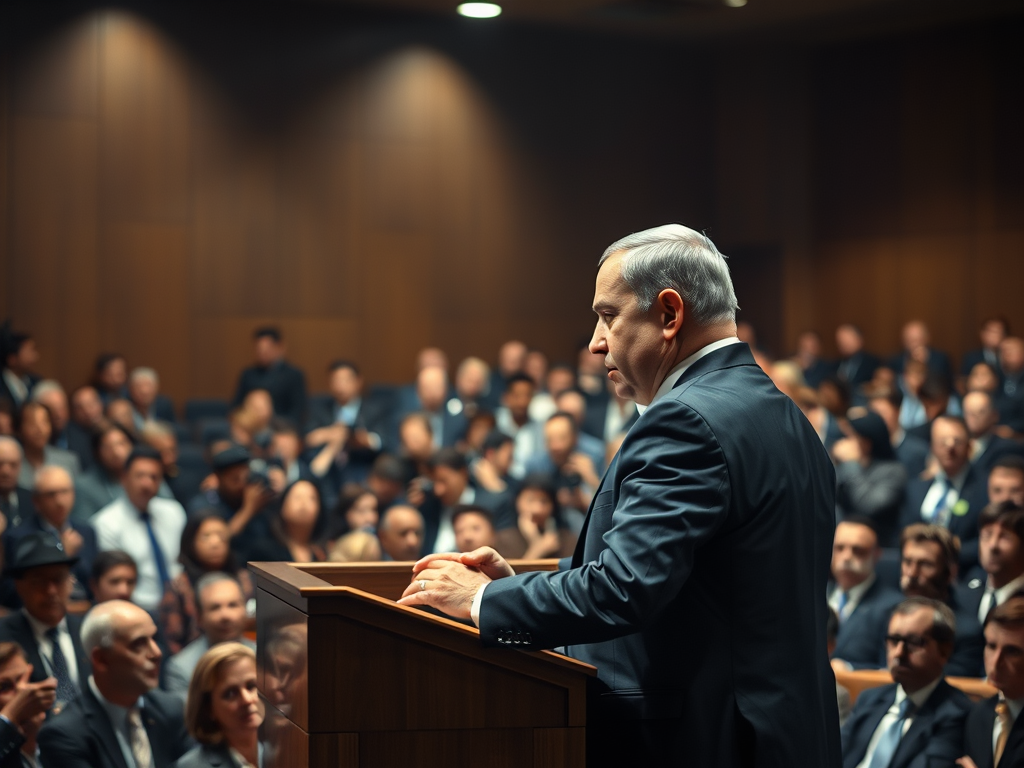
A crowd of about 100 journalists, lawmakers, government officials, and lawyers crowded the courtroom, straining to hear his response.
“I’ve waited eight years for this moment — to tell the truth, the truth as I remember it,” Netanyahu declared, gripping the sides of the lectern as he stood beside the judges.
It was a humbling moment: a sitting prime minister compelled to address corruption allegations in front of a courtroom full of his peers. Yet, Netanyahu appeared determined to rise above it.
“I am shocked by the magnitude of this absurdity,” he stated. “I am the prime minister. I am running a country, managing a war. I’m not preoccupied with my future, but with the future of the State of Israel.”
The corruption charges against Netanyahu have divided Israel for nearly a decade, leading to continuous political instability. The nation has been split almost evenly over whether he should continue in office while standing trial, fueling a political deadlock that has resulted in five elections over just four years.
Aside from a brief court appearance in 2021 to plead not guilty, Netanyahu’s daily schedule had largely remained unaffected by the trial. For years, the focus had been on interviewing witnesses, with little involvement from the defendant himself. The hearing on Tuesday, 1,661 days into the trial, marked Netanyahu’s first full day in court.
Though it was a significant moment in the judicial process, it felt somewhat anti-climactic to many Israelis. The corruption charges against Netanyahu had been so entrenched in the public conversation for so long that the sight of a sitting prime minister in the defendant’s chair no longer seemed as shocking.
“The public has completely normalized the idea of having a sitting prime minister who has been investigated, indicted, and is now on trial — even in the midst of a war,” said political analyst Dahlia Scheindlin, who attended the hearing. “What would have seemed unimaginable a decade ago is now taken for granted.”
Netanyahu faces bribery, fraud, and breach of trust charges in three separate but related cases. These accusations allege that he granted regulatory favors and diplomatic support to prominent businessmen in exchange for gifts, such as cigars and Champagne, and favorable media coverage.
The trial is expected to drag on for years, and Netanyahu will likely testify multiple times each week over the coming months.
To Netanyahu’s critics, this trial represents a crucial test for Israeli democracy — an opportunity to hold a sitting prime minister accountable for alleged crimes committed while in office.
To his supporters, the trial is seen as an attack on democracy — a politically motivated effort by Israel’s liberal establishment to remove Netanyahu after failing to oust him at the ballot box.
“A disgrace,” shouted Tally Gotliv, a lawmaker from Netanyahu’s party, before the hearing began.
“Persecution,” declared Itamar Ben-Gvir, one of the ministers who attended in support of Netanyahu.
Netanyahu had initially sought to delay his testimony, citing the disruption caused by his involvement in the war campaign. However, the court allowed only a brief delay.
In recognition of the heightened security concerns surrounding Netanyahu’s role as a wartime prime minister, the judges permitted the hearing to take place in a more secure underground courtroom in Tel Aviv rather than the usual venue in East Jerusalem.
Throughout much of the day, Netanyahu was questioned by his lawyer, Amit Haddad. The prosecution will cross-examine him in the coming weeks.
Haddad’s opening questions allowed Netanyahu to explain how, as a busy prime minister, he had little time for corrupt activities or for focusing on the trial.
“Sometimes I indulge in a cigar, though I can’t even finish it all at once because I’m constantly in meetings and briefings,” Netanyahu explained.
To emphasize his point, Netanyahu’s aides approached the stand several times to hand him notes, presumably about state matters. At one point, the trial had to pause so that Netanyahu could address what he described as an urgent issue.
“There needs to be a balance between the necessities of the trial, which I respect, and the necessities of the country,” Netanyahu remarked as he dealt with the notes.
Despite this, neither Netanyahu nor his lawyer seemed eager to address the core allegations of the prosecution. For over an hour, Haddad asked open-ended questions about Netanyahu’s life and political beliefs, allowing him to elaborate extensively on his achievements. At times, Netanyahu’s responses seemed more like a political speech aimed at his right-wing supporters than testimony in a courtroom.
He discussed his policies as finance minister in the 2000s and his efforts to resist Palestinian sovereignty in the 2010s, which he said brought him into conflict with both the Obama administration and the Israeli media.
“I worked to strengthen Israel’s security, to strengthen Israel’s economy, to transform it into a free market,” he said. “That is what I have devoted my life to, resisting pressures both at home and abroad.”
As the day went on, Netanyahu began addressing the specific corruption charges. In one case, prosecutors allege that he granted regulatory benefits to Israeli telecom magnate Shaul Elovitch in exchange for favorable coverage on Elovitch’s news site, Walla. Elovitch is also on trial and has denied the accusations.
Netanyahu dismissed Walla as a “negligible news site,” scoffing at the idea that he would try to influence its content. “It’s a site for dogs and cats,” he remarked.
He also denied that he authorized regulatory changes specifically to benefit Elovitch, claiming that he simply signed off on documents presented to him by civil servants.
“Often, you don’t even know what you’re signing,” Netanyahu said. “It comes from the bureaucracy, so you just sign it.”
The focus of the trial remained rooted in these domestic allegations, while far grander accusations have been leveled against Netanyahu by the International Criminal Court in The Hague, which has issued an arrest warrant accusing him of war crimes during the ongoing conflict in Gaza.
Outside the courthouse on Tuesday, a group of left-wing demonstrators held signs calling for a ceasefire, serving as the only reminder of the broader conflict playing out in Gaza.



Leave a Reply