
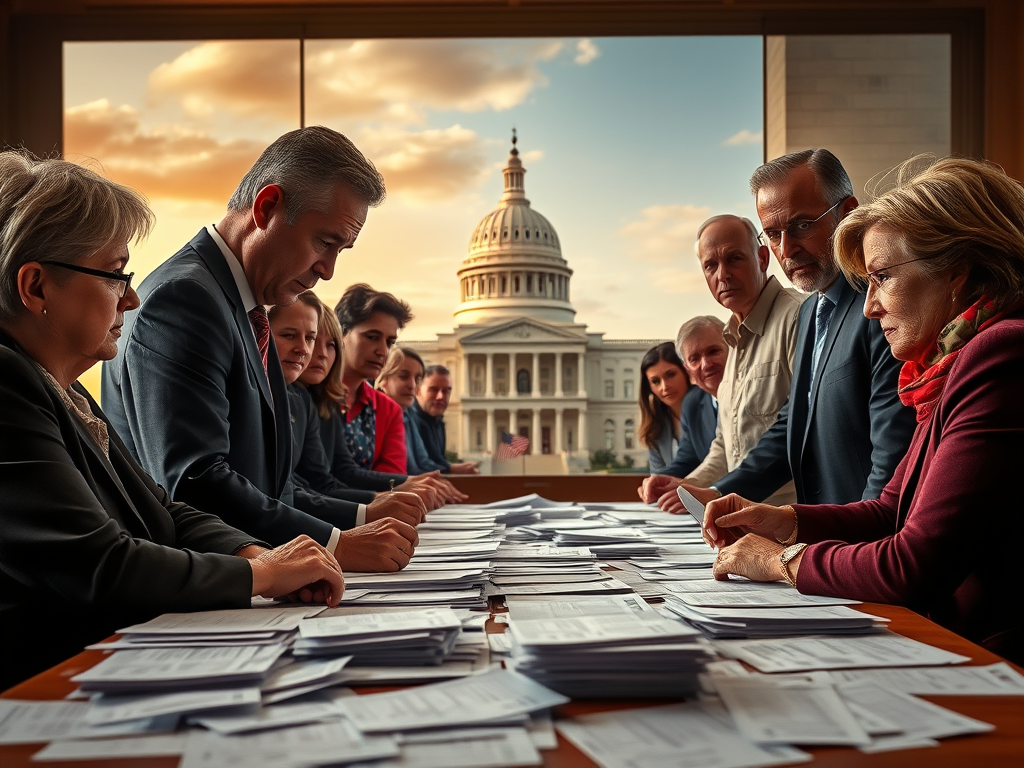

North Carolina Election Recount
North Carolina has long served as a testing ground for various political strategies aimed at consolidating power, from voter ID laws to the manipulation of district maps and judicial decisions. In recent years, Republican efforts have notably altered state laws and election regulations to limit the influence of Democrats.

A recent election recount in the state has underscored these tactics, showcasing how political maneuvering is being used to tip the scales in favor of one party. The recount, which involved over 5.5 million ballots from the November election, concluded with Allison Riggs, a Democratic incumbent on the state Supreme Court, holding a narrow 734-vote lead over Jefferson G. Griffin, a Republican judge from the Court of Appeals.https://wordpress.com/
However, Judge Griffin has not accepted the outcome. He is challenging the results with the State Board of Elections, claiming that many voters were ineligible to vote. This approach is reminiscent of an unsuccessful attempt by a Democratic chief justice to contest a similarly close race in 2020.
Griffin’s protest is more sweeping, as he calls for the disqualification of approximately 60,000 voters. The dispute stems from issues with voter registration forms, which were approved in a 2004 law by Democratic legislators. These forms were supposed to require voters to provide their driver’s license or Social Security numbers, but the forms did not enforce this, leading many voters to unknowingly submit incomplete applications.
Griffin’s protest argues that these incomplete registrations should invalidate the votes, including those cast by Riggs’s parents. In addition to Griffin, three Republican state legislators who narrowly lost their own local races have joined the protest.
The protest to the elections board includes more than 300 separate challenges filed last month across all 100 counties in North Carolina. In response, the state Democratic Party has filed a federal lawsuit, seeking to prevent the state elections board from discarding the contested ballots.
Riggs’s legal team has called Griffin’s protest an outrageous attempt to overturn the results, likening it to a request for a “do-over.” They argue that a close race doesn’t justify changing the rules mid-game.
Republicans in North Carolina argue that the state’s election system, which they claim is overly permissive and insufficiently secure, is to blame for the current situation. They point to the Democratic control of state and county election boards and suggest that this creates a partisan imbalance. In response, Republican lawmakers are preparing legislation to transfer the power of appointing election board members from the governor to the state auditor, who is a Republican.
Dallas Woodhouse, a conservative columnist and former state Republican Party leader, accused Democrats of obstructing citizen oversight of the system. Meanwhile, Gerry Cohen, a veteran of North Carolina elections, called Griffin’s protest demands unprecedented and said they appeared far-fetched.
Despite the skepticism, the protest is not being dismissed outright. The ultimate goal of Griffin’s legal challenge is to disqualify enough votes to erase his 734-vote deficit, triggering a state law that mandates a new election. The elections board is scheduled to discuss the protest on Wednesday.
Griffin’s legal team has urged a state court to expedite the process, accusing the elections board of “decades of lawlessness” for not enforcing the voter registration requirements established in 2004. They argue that when the board realized its mistake in 2023, it failed to compel voters to correct their registration forms.
The state Democratic Party’s lawsuit highlights that federal law prevents states from discarding ballots simply because registration forms are missing a driver’s license or Social Security number.
Earlier this year, Republican lawyers brought a similar claim in a state lawsuit seeking to purge up to 225,000 voters from the rolls. However, that case was moved to federal court, which ruled that its outcome, when it comes, should not affect this election.
The future of Griffin’s protest may ultimately depend on state courts, particularly the state Supreme Court, where Riggs serves as one of two Democratic justices, with a sharp ideological divide between her and the five Republican justices.
As Duke University professor and former Democratic consultant Pope McCorkle III noted, the real question is whether Republicans can turn this challenge into a case with enough legitimacy to potentially overturn the election. If they succeed, Riggs could lose her seat.




Leave a Reply