
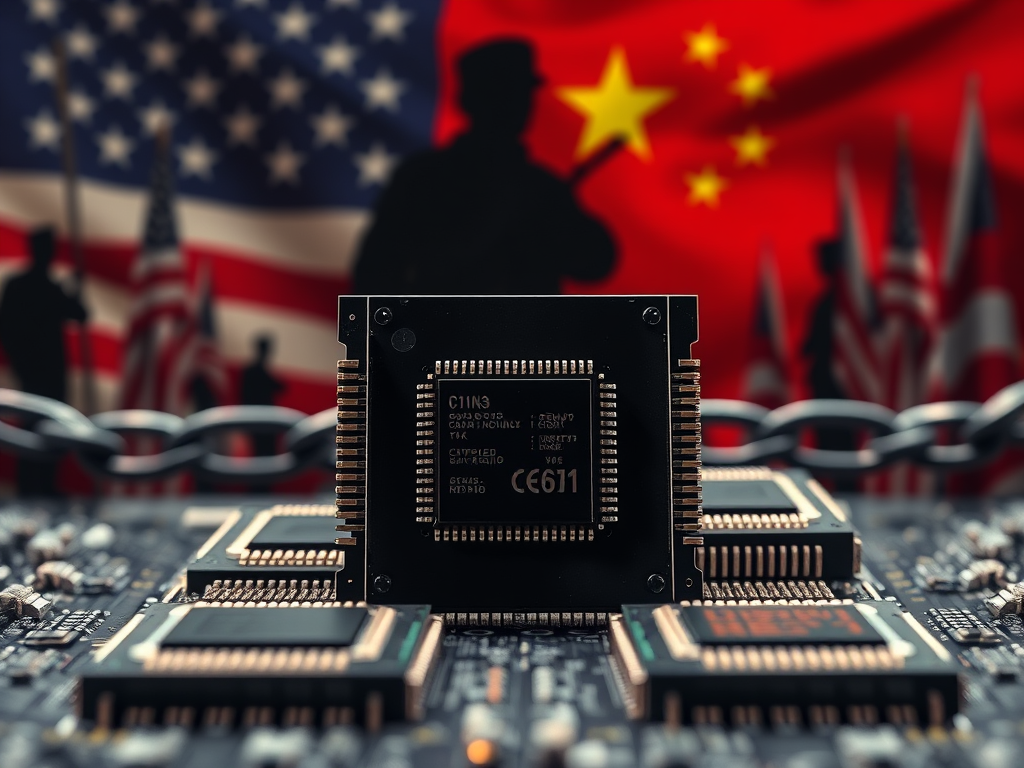

The Commerce Department has traditionally focused on advancing U.S. business interests and boosting exports abroad. However, in recent years, it has taken on a more national security-oriented role, particularly by imposing restrictions on the export of America’s most advanced computer chips to safeguard the country’s security.
Commerce Dept. Is on the Front Lines of China Policy

While the Trump administration may overhaul much of the Biden administration’s economic policy, with a renewed emphasis on tariffs, it’s unlikely to reverse the Commerce Department’s shift towards a security-focused mandate.https://wordpress.com/
“I’m not overly concerned that the Trump administration will undo the progress we’ve made,” said Commerce Secretary Gina Raimondo in a recent interview. “Firstly, this is fundamentally about national security, which I think we can all agree on. Secondly, this is the direction they were already heading in.”
Raimondo pointed out that the Trump administration laid the groundwork for this shift when it placed the Chinese telecommunications giant Huawei on the “entity list” — a move that restricted technology transfers to companies deemed a national security threat.
Raimondo, who took office with a focus on addressing the China challenge, has overseen a significant expansion of U.S. economic and technological restrictions on China. The Biden administration has built on and systematized the Trump-era approach, implementing more comprehensive export controls, particularly targeting advanced technology shipments to China.
The department now restricts the export of critical artificial intelligence chips to slow China’s military advancements. It has also been involved in scrutinizing apps and software for potential security risks, banning Chinese electric vehicles over data collection concerns, and regulating AI to prevent the spread of misinformation.
This expanded role reflects the growing intersection between economics, intelligence, and defense. Raimondo noted that much of the national security establishment is still stuck in a Cold War mentality, particularly when it comes to Russia. To tackle China, she argued that the U.S. must integrate military, intelligence, and economic strategies more closely.
“One of the most important lessons I’ve learned during my time in the cabinet is the need to broaden our understanding of national security,” Raimondo said.
She was speaking at the Reagan National Defense Forum in California, where she also discussed the importance of rebuilding America’s semiconductor industry through the $39 billion in federal funding authorized by the 2022 CHIPS and Science Act.
The Commerce Department has faced criticism about its ability to regulate national security threats effectively, with some questioning whether it is the right agency to enforce these controls. A report from last year cited concerns that the Bureau of Industry and Security (BIS) — which handles export controls — struggles to fulfill its national security mandate because it operates within the Commerce Department, whose primary mission is to promote exports.
Some critics have urged the Biden administration to take even more aggressive actions against China, arguing that the country’s access to advanced chips for AI, encryption, and weapons development poses a significant threat. Certain analysts have pointed out that the Biden administration’s recent export controls may still allow U.S. companies to sell certain products to Chinese firms involved in developing advanced chips.
Raimondo acknowledged the challenge of balancing the promotion of exports with the need to restrict those critical to national security. However, she emphasized the importance of aligning export controls with allies who may have similar technology, ensuring that American businesses are not isolated from global trade if other nations continue to export to China.
“We should view export controls as a precision strike,” she said. “Just as we wouldn’t enter battle without our allies, export controls are only effective when coordinated with them.”
Raimondo’s argument that economic policies are at the core of national security is increasingly accepted in Washington. China’s dominance of global supply chains for critical minerals gives it leverage over the U.S., while its progress in areas like AI and supercomputing could potentially outpace America in certain military technologies.
Though the specifics of Trump’s second-term approach to China remain unclear, many of his potential appointees are known to be strong critics of Beijing.
A recent policy brief from the Peterson Institute for International Economics highlighted the significant increase in U.S. export controls in recent years. The Trump administration added three times as many Chinese entities to national security-related lists as the previous 16 years combined, and the Biden administration has added even more, the brief stated.
One of the most impactful moves the U.S. can make to get China’s attention is restricting its access to high-end chips. In diplomatic meetings, Chinese officials have repeatedly asked the U.S. to relax these controls, but the Biden administration has remained firm, maintaining that while it is open to trade cooperation, it will not compromise on high-end AI chips.
Raimondo agreed with this stance, emphasizing that artificial intelligence has fundamentally shifted the strategic landscape. America’s technological edge in AI over China is a crucial advantage, she said. The goal is to ensure that the U.S. and its allies retain control over the most dangerous technologies and deny them to China — at least temporarily.
“You can’t make deals that undermine our national security,” she asserted. “That would be reckless and incredibly dangerous.”



Leave a Reply