

South Korean General Gives a Confused Account of a Failed Crackdown

In the 1970s and 1980s, South Korea’s military was notorious for its role in instilling fear and violence. Over the decades, the military worked hard to reform its image, striving to be seen as a modern, disciplined force by the people. However, this image was severely undermined last Thursday when General Park An-su, who oversaw a brief and chaotic martial law declaration earlier in the week, was questioned in Parliament. His testimony revealed a military that appeared unprepared, disorganized, and caught off guard.https://wordpress.com/
General Park, the Army chief of staff, admitted to the parliamentary committee, “We were not militarily prepared because it was enacted in a hurry. There was confusion.” His statement marked the first public opportunity for lawmakers to probe the military’s handling of the martial law order, which had been declared by President Yoon Suk Yeol on Tuesday night. The decree triggered widespread outrage, leading to large protests across the country, and Yoon quickly reversed his decision after just six hours.
In his testimony, General Park insisted that he had no prior knowledge of the martial law plan, learning about it only when the president announced the decision publicly. When questioned about the military’s follow-up announcement, which banned political activities, rallies, and placed restrictions on media, Park claimed that he had not seen the document until it required his signature.

Describing his reaction as commander during the crisis, Park explained how his team was at a loss for what actions to take, saying, “We were military people, some of the best I know, but we didn’t know much about martial law.” His comments seemed aimed at distancing the military from its previous brutal reputation, but they failed to calm the anger of many protesters, some of whom had lived through the violent era of military rule.
In the 1970s and 1980s, South Korea’s military used martial law to suppress anti-government protests, with troops invading towns and campuses and killing hundreds of demonstrators. The military also censored the media and tortured journalists. South Koreans fought back fiercely, using stones, firebombs, and large-scale protests. By the 1990s, many of the generals who had come to power through coups were imprisoned, and the military vowed to stay out of politics.
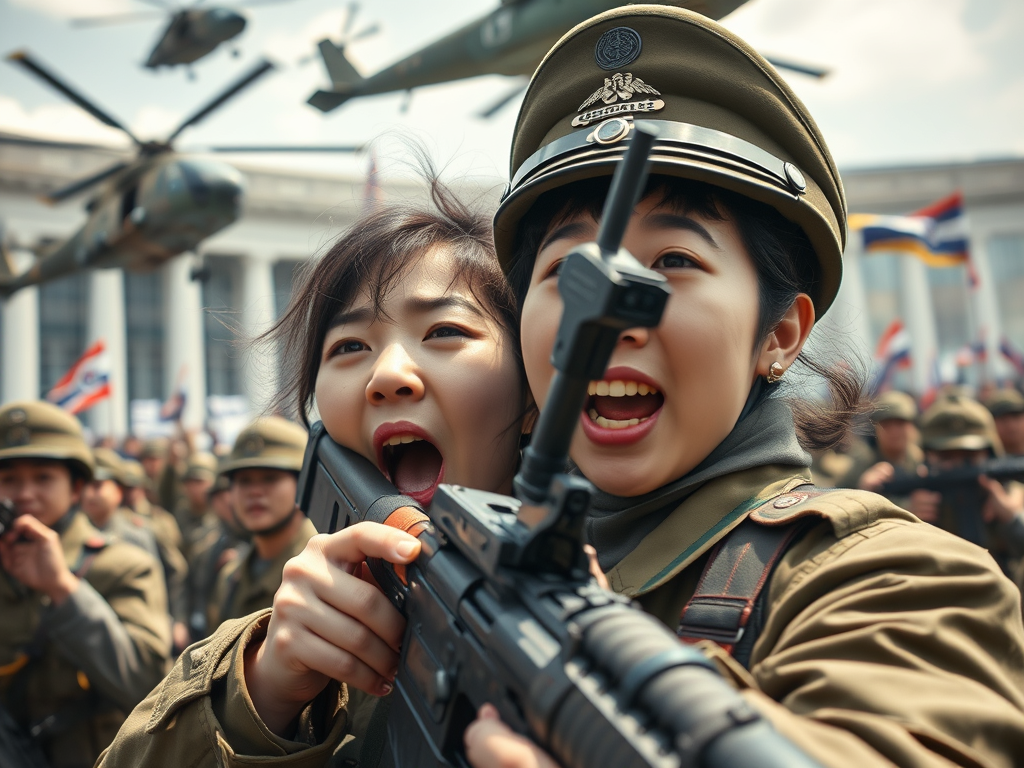
That history makes the events of this week particularly shocking. Footage of military helicopters dropping elite troops to take over the National Assembly stunned the nation. One powerful image showed a young woman, An Gwi-ryeong, holding onto the barrel of a paratrooper’s rifle outside the Assembly, shouting: “Shame on you!” An had rushed to the scene after hearing about the martial law declaration, fearing that troops would prevent lawmakers from voting to annul the decree. “I thought we had to stop them no matter what,” she said. “If they broke in, we had no future.”

An, who grew up in a democratic South Korea, had only learned about martial law from history books and films. When some lawmakers warned that President Yoon might use martial law to silence his critics, An recalled wondering if such a move could actually happen. “When it happened, it felt unreal, like something from the past,” she said. “There’s a lot of blame for the military, but the real person to blame is Yoon Suk Yeol, who had his military turn its guns on its own citizens.”
The hearings on Thursday sought to uncover why and how the martial law order was issued. The questioning, at times heated, revealed confusion within the military leadership. General Park stated he still didn’t know who had ordered the troops to storm the National Assembly, a remarkable claim for someone supposedly in charge of the operation. Some lawmakers called for Park’s resignation, and the general replied that he had already offered to step down.
Deputy Defense Minister Kim Seon-ho testified that the Defense Minister, Kim Yong-hyun, had been the one to order the troops, although he had opposed the decision. Kim Seon-ho expressed regret over his inability to prevent the military’s actions. The defense minister, a former bodyguard to President Yoon, resigned before the hearings and did not testify.
An opposition lawmaker, Park Sun-won, revealed that his party had been tipped off about the military’s actions ahead of time, allowing them to rush to the National Assembly to vote against martial law before the military could intervene.
The botched attempt to take over the Assembly has become a central element in the opposition’s case for impeaching President Yoon for “insurgency.” While Yoon has not made a public appearance since the early hours of Wednesday, he has defended the martial law as necessary to protect the country from an “anti-state” opposition that he claims paralyzed his administration.

The National Assembly is set to vote on whether to proceed with impeachment on Saturday. Although the opposition holds a majority, a two-thirds vote is required to pass the motion, which will depend on support from members of Yoon’s own party. Demonstrations scheduled for Saturday are expected to add pressure to the vote.
Yoon has struggled with low approval ratings for months, and a recent poll revealed that over 70% of South Koreans support his impeachment. Despite his backing from military veterans due to his hardline stance on North Korea and military ties with the United States, he faces growing opposition. On Thursday, former Marine veterans rallied near the presidential offices, calling Yoon the “mastermind of insurgency.” The protests continued to grow throughout the evening, with people of all ages joining in, chanting for Yoon to resign.
Kim Sung-hwan, 67, who participated in martial law enforcement during the 1980s, attended the protests, explaining, “I came because things should never be like that again.”

Leave a Reply