
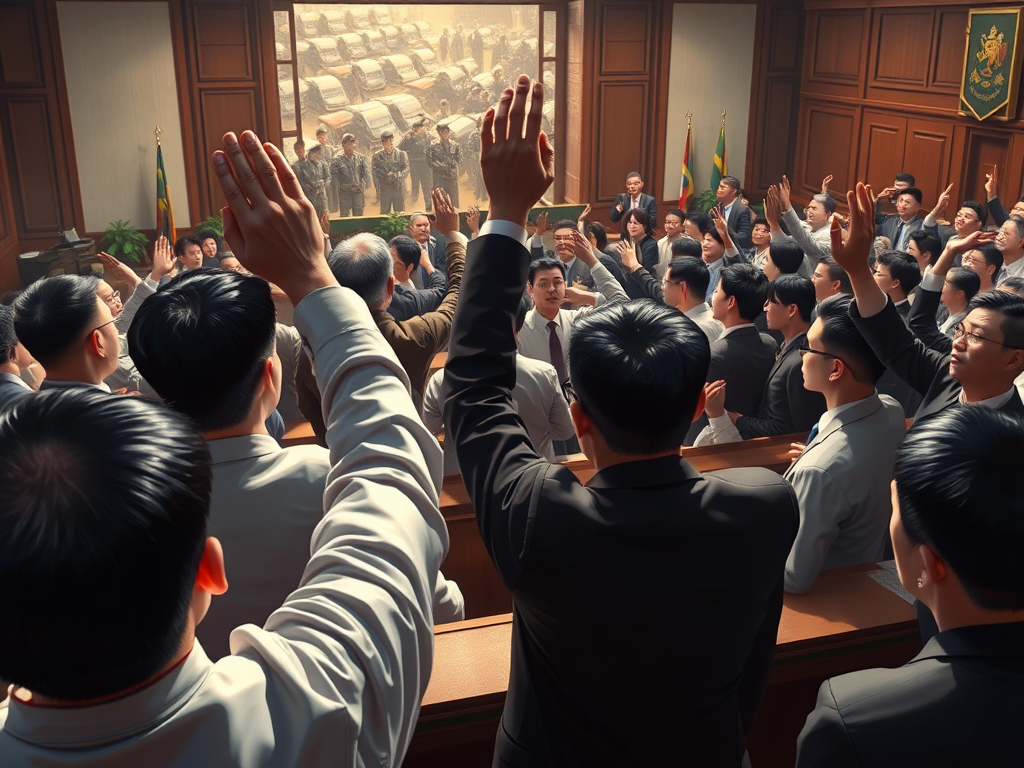

Following their strong opposition to military rule, members of South Korea’s political opposition took decisive action on Wednesday by moving to impeach President Yoon Suk Yeol, after his sudden martial law declaration failed disastrously.
Lawmakers Move to Impeach South Korean Leader After Failed Martial Law Bid

Several opposition parties, energized by the thousands of protesters who flooded the streets in protest, jointly submitted the impeachment motion. This motion could be put to a vote as early as Friday. While these parties hold a dominant majority in the National Assembly, it remains uncertain whether they will secure the necessary two-thirds vote to impeach the president.https://wordpress.com/
Mr. Yoon’s unexpected martial law announcement on Tuesday evening, marking the first attempt to impose military rule in over 40 years, triggered chaos in one of America’s closest allies and reignited memories of the dictatorial regimes that once ruled South Korea until the 1980s.
This bold move was an attempt by the president to break the deadlock between a largely progressive assembly and a conservative executive that has hindered his presidency over the past three years.
However, the martial law lasted only six hours. It backfired when lawmakers, defying heavily armed troops stationed to seal off the assembly building, rushed inside. The 190 lawmakers present, out of 300 total, unanimously voted to revoke the military rule — including 18 members of Mr. Yoon’s own party.
As of Wednesday night, the president’s whereabouts were unknown, and his position appeared increasingly precarious. Members of his own party had condemned the martial law declaration and voted to overturn it. Reports from South Korean media indicated that the defense minister and several top presidential aides, including his chief of staff, had resigned.
If two-thirds of the assembly votes to impeach Mr. Yoon, he would be suspended from office, with Prime Minister Han Duck-soo, a career civil servant, stepping in as interim president. The fate of the president would then be decided by the Constitutional Court, which could either uphold the impeachment and remove him from office or reject it and reinstate him.

The opposition parties hold 192 out of the 300 seats in the National Assembly, just short of the required two-thirds majority. For impeachment to succeed, at least eight defections would be needed from Mr. Yoon’s People Power Party, which controls 108 seats.
The martial law declaration on Tuesday night marked the shortest and most bizarre episode of military rule in South Korea’s history, a nation that has witnessed several coups and periods of military rule before transitioning to a vibrant democracy in the late 1980s.
Among the most striking images from the six hours of turmoil were the hundreds of paratroopers arriving by helicopter to secure the assembly, while opposition lawmakers scaled the walls of the building and barricaded themselves inside to cast votes against the martial law.
Thousands of protesters also took to the streets overnight, chanting “Impeach Yoon Suk Yeol!” and clashing with troops attempting to block their access to the assembly.
A military decree had outlawed all political activities and public gatherings, placing all media under the control of the martial law command. The decree also warned that those spreading “fake news” could be arrested without a court warrant.

However, South Korean media outlets, spanning the political spectrum, rejected the decree. Even right-leaning publications that have traditionally supported Mr. Yoon condemned the move, standing in unity against any attempt to curb press freedom.
An editorial in Chosun Ilbo, one of South Korea’s largest newspapers and often sympathetic to Mr. Yoon, described the president’s actions as an international embarrassment. The editorial demanded that the president answer to the public about how he planned to take responsibility for the situation.
Before entering the 2022 presidential race and securing a narrow victory, Mr. Yoon was a political outsider — a prosecutor known for his role in prosecuting corruption cases, including those against two former presidents. His victory was largely seen as a reaction to dissatisfaction with his predecessor, Moon Jae-in. From the outset, Mr. Yoon set ambitious goals, aiming to reshape the country’s political landscape and leave his mark as a reformer.
He championed policies promoting nuclear energy, sought to improve relations with Japan, and strengthened military cooperation with both the U.S. and Japan while adopting a tougher stance on North Korea.
Domestically, however, his agenda struggled to gain traction. His opponents gained even greater control in the assembly during this year’s parliamentary elections. His administration was accused of using criminal investigations to intimidate opposition figures and crack down on news media outlets accused of spreading “fake news.”
Mr. Yoon’s approval rating plummeted to around 20 percent, particularly after his repeated vetoes of opposition demands for independent investigations into allegations involving his wife, Kim Keon Hee. The opposition has successfully blocked many of his bills, amended his budget proposals, and pushed for the impeachment of several cabinet members accused of corruption and abuse of power. Meanwhile, thousands of doctors have staged nearly a year-long strike against his proposed health care reforms.

Political analysts are increasingly skeptical about Mr. Yoon’s future. Sung Deuk Hahm, a political science professor at Kyonggi University, stated that “the best option” for Mr. Yoon would be to resign. He added that the events of the past 24 hours underscored the strength and resilience of South Korea’s democracy.
Professor Hahm, who has known Mr. Yoon since before his election, noted that the president appeared to be mentally exhausted and demoralized in recent months, particularly as scandals involving him and his wife escalated and political pressure from the opposition mounted.
A former aide to Mr. Yoon, speaking anonymously, described the president as surrounded by a small, insular group of advisers, including ex-military officers, who rarely questioned his decisions. This tight circle raised concerns about how thoroughly Mr. Yoon had prepared for his declaration of martial law.
The aide recounted that upon hearing the martial law announcement, he immediately reached out to contacts within Mr. Yoon’s office and other government branches, only to learn that they too had been blindsided. Even top leaders of Mr. Yoon’s own party claimed to have learned of the declaration through media reports.



Leave a Reply