
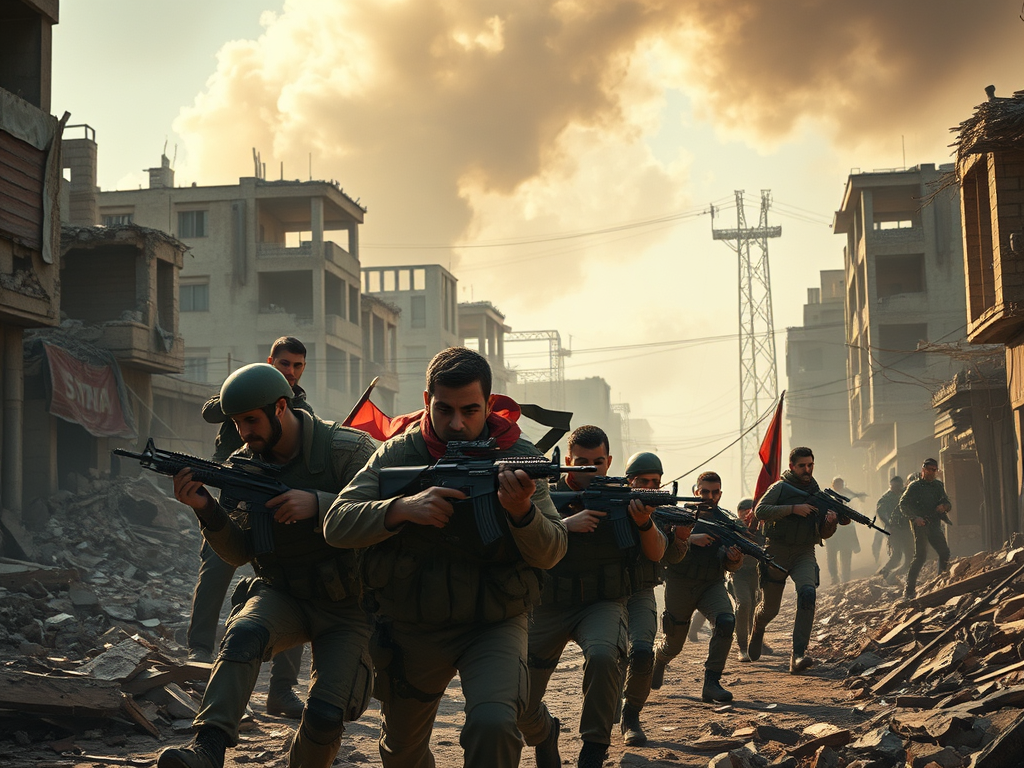

Following the recent signing of a deal to end hostilities between Israel and Hezbollah in Lebanon, another conflict erupted just a short distance away in Syria.go to google
Syrian rebels

Syrian rebels launched widespread assaults on President Bashar al-Assad’s forces in northwestern Syria, seizing significant territory, including much of Aleppo. They also compelled Russian forces to abandon a base near Aleppo and Iranian-backed militias to relinquish control of Tel Rifaat, a town near the Turkish border, as reported by Syrian humanitarian and research groups.
The rebels’ sudden advance and the setback for al-Assad and his allies have fueled longstanding geopolitical rivalries in Syria, where a democracy uprising in 2011 spiraled into a full-blown rebellion. The developments also highlight how quickly violence can spread across a region already fraught with instability, made even more unpredictable by competing international interests.
For years, Iran and Russia have supported al-Assad’s regime, providing crucial military assistance. Russian airstrikes have targeted rebel positions, while Iranian-backed militias, including Hezbollah, have fought alongside Syrian government forces.
Turkey and the U.S. have also deployed troops in Syria, supporting rival rebel factions—Turkey in the northwest and the U.S. in the northeast.
The recent offensive, which began last week, saw several Syrian rebel groups unite under the leadership of Hayat Tahrir al-Sham, a former Al-Qaeda affiliate. This group had already controlled much of northwestern Syria held by opposition forces.
Mouaz Moustafa, executive director of the Syrian Emergency Task Force, an American organization focused on democracy in Syria, explained that the rebels had seized the opportunity presented by the weakened positions of the Syrian government, Russia, and Iran, all stretched thin by other conflicts. He also noted that the rebels had closely observed recent Israeli airstrikes on Hezbollah and Iran’s military leaders in Syria, which signaled the right moment for their own assault.
Moustafa suggested that the rebels were also motivated by a desire to strike a blow against Russia, a common adversary. He said he had been aware of plans to coordinate the offensive, but was surprised by how quickly they took control of Aleppo, within just two days.
This surge in fighting has raised questions about the rebels’ potential and the strength of al-Assad’s hold on power. It may also disrupt the trend of growing international acceptance of his regime and the resumption of diplomatic relations with Syria, especially among Arab states and some European countries.
While Russia and Iran have pledged their support for al-Assad, their immediate capacity to provide assistance is in doubt. Russia has carried out airstrikes on rebel-held Idlib and Aleppo, but analysts question how effective this will be in the short term.

Arab states have expressed concern about Syria’s sovereignty, indirectly criticizing Turkey’s ongoing support for rebel groups, driven by its own interests. Hassan I. Hassan, a Syrian journalist, noted the increasing concern among countries like the UAE, Saudi Arabia, Jordan, Iraq, and Israel regarding the potential collapse of al-Assad’s regime and Turkey’s growing influence in Syria.
Israeli airstrikes have also hampered Iran’s military activities in Syria, targeting weapons supplies, militia groups, and leaders of the Islamic Revolutionary Guards Corps (IRGC), creating tensions between Iran and its Syrian allies.
The rebels’ success in capturing key military points around Aleppo, including a military academy, has strengthened their control and potentially set the stage for further offensives, according to the Omran Center for Strategic Studies.

Russia is facing increasing challenges in adapting to the rapidly changing battlefield, making it harder to support the Syrian regime effectively, the center added.
Turkey and the U.S. both support armed groups in Syria opposing those backed by Russia and Iran. Turkey has long focused on creating a buffer zone along its southern border to guard against Kurdish militants, while also planning to resettle refugees from Syria. The U.S., meanwhile, supports Kurdish forces through the Syrian Democratic Forces to combat the Islamic State.
Despite their differing views on the Kurdish issue, Turkey and the U.S. have avoided direct clashes in Syria, coordinating to ensure that Kurdish forces withdraw from contested positions without conflict.

Moustafa pointed out that there has been coordination between the rebels and Ukraine, particularly in combating Russian disinformation and providing medical aid. Both nations share a common struggle against tyranny and foreign occupation.
While Ukrainian officials have not commented on the Syrian offensive, Kyrylo Budanov, head of Ukraine’s military intelligence, has reiterated that Ukraine’s forces would target Russian troops anywhere globally.
Syrians observing the situation from abroad view this latest offensive as different from previous phases of fighting, with many doubting the government’s ability to reclaim lost territory swiftly due to low morale and poverty within government-controlled regions. Analysts suggest these factors contributed to the rapid collapse of Syrian government forces.




Leave a Reply