
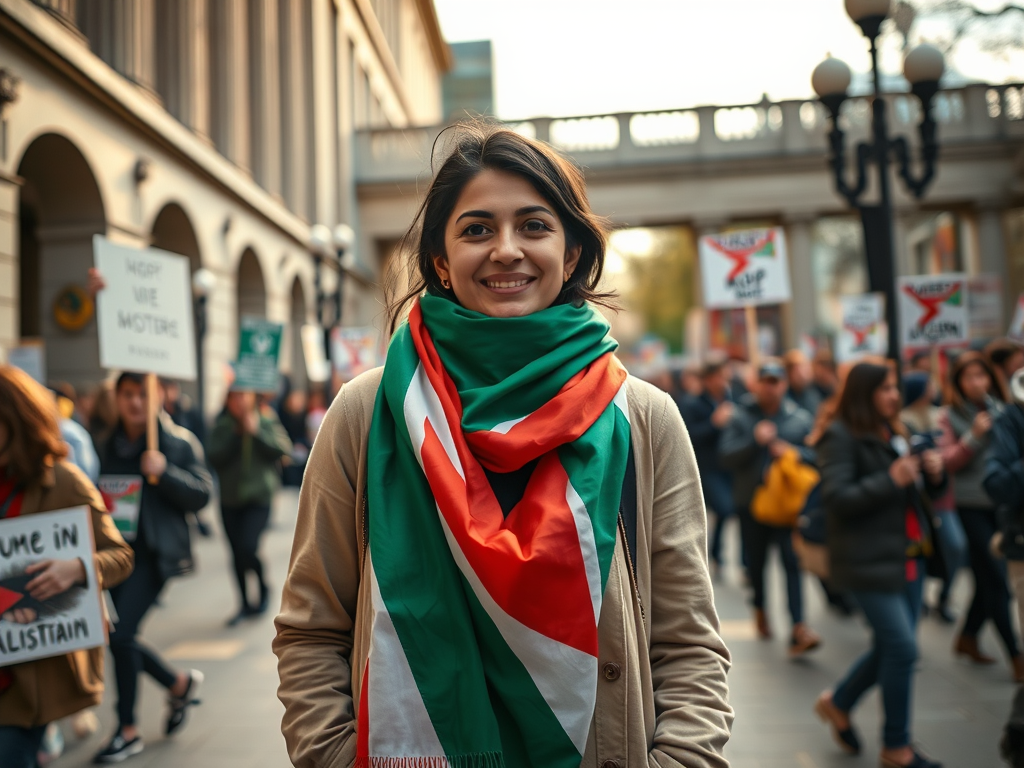

Jasleen Kaur,She is an artist
Jasleen Kaur, an artist whose recent work explores her childhood experiences in a Sikh community in Scotland, was awarded the prestigious Turner Prize on Tuesday.http://go to google

The announcement was preceded by a vocal pro-Palestinian protest outside Tate Britain, the London art museum hosting the ceremony.
As the award event began, around 100 demonstrators gathered outside the museum, listening to speeches demanding that Tate sever its ties with Israel, particularly criticizing high-profile donors like Anita and Poju Zabludowicz. In an online letter, the activists claimed the Zabludowicz family had “well-documented financial and ideological connections” to the Israeli government through their real estate investment company, Tamares Group.
The letter was signed by Kaur, as well as two other Turner Prize nominees, Claudette Johnson and Pio Abad.
During her acceptance speech, Kaur, wearing a scarf in Palestinian colors, expressed solidarity with the protesters, calling for Tate to end its connections with Israel. “This is not a radical demand — it should not endanger an artist’s career or safety,” she stated before adding, “Free Palestine,” to the cheers of the crowd.
Tate Britain’s director and Turner Prize jury chair, Alex Farquharson, had previously stated he would not comment on the protesters or their demands, preferring to focus on Kaur’s work.
The Zabludowiczes declined to comment but had expressed their dismay over the ongoing conflict in Israel and Gaza in a statement last year, affirming their support for a two-state solution.
The protestors also called for Tate to cut ties with Candida Gertler, another donor accused of having “problematic ties” to the Israeli state. Gertler, who is Jewish, resigned from her positions at several British museums, including Tate, stating that the protests were part of an “alarming rise in antisemitism” that museums had failed to challenge.
The protests surrounding the Turner Prize announcement reflect the art world’s ongoing struggle to navigate the polarizing views on Israel’s actions in Gaza and Lebanon. Since the October 2023 Hamas attacks, many artists have condemned Israel’s retaliation in Gaza as genocide, while Jewish and Israeli donors have felt increasingly targeted by the rhetoric.

Kaur, 38, hails from Glasgow and grew up in the city’s Sikh community. She studied silversmithing and jewelry at the Glasgow School of Art and the Royal College of Art in London. Though she has primarily exhibited in group shows, she was nominated for “Alter Altar,” an exhibition featuring elements of her upbringing, including a car stereo and a mechanically operated harmonium, held at the Tramway arts venue in Glasgow.
Farquharson praised Kaur’s ability to create environments from “often very throwaway items” that speak to larger personal, political, and spiritual issues. Her work, currently part of an exhibition at Tate Britain running until February 16, is described as both irreverent and reverent.
Established in 1984, the Turner Prize is one of the most prestigious awards in the art world. Previous winners, such as Wolfgang Tillmans, Steve McQueen, and Lubaina Himid, have gone on to achieve global recognition. Last year’s recipient, Jesse Darling, received widespread critical praise, marking a shift after years of criticism of the prize’s tendency to prioritize political views over artistic merit.
The other nominees this year were Claudette Johnson, known for her portraits of Black figures in pastels and watercolor; Pio Abad, a Filipino artist whose sculptures include jewelry once stolen by Imelda Marcos; and Delaine Le Bas, a Romany artist renowned for her colorful installations and paintings.
While British critics were divided on who should win, many argued in favor of Kaur, who will receive a cash prize of £25,000 (approximately $31,700).
Alastair Sooke, writing for The Daily Telegraph, noted that Kaur’s work brought “energy and effervescence” to a list of nominees that otherwise felt conventional. In The Guardian, Adriane Searle described Kaur’s cloth-covered car as the “laugh-out-loud totemic image” of the prize and praised her installation for its “texture, humor, and complexity.”




Leave a Reply