
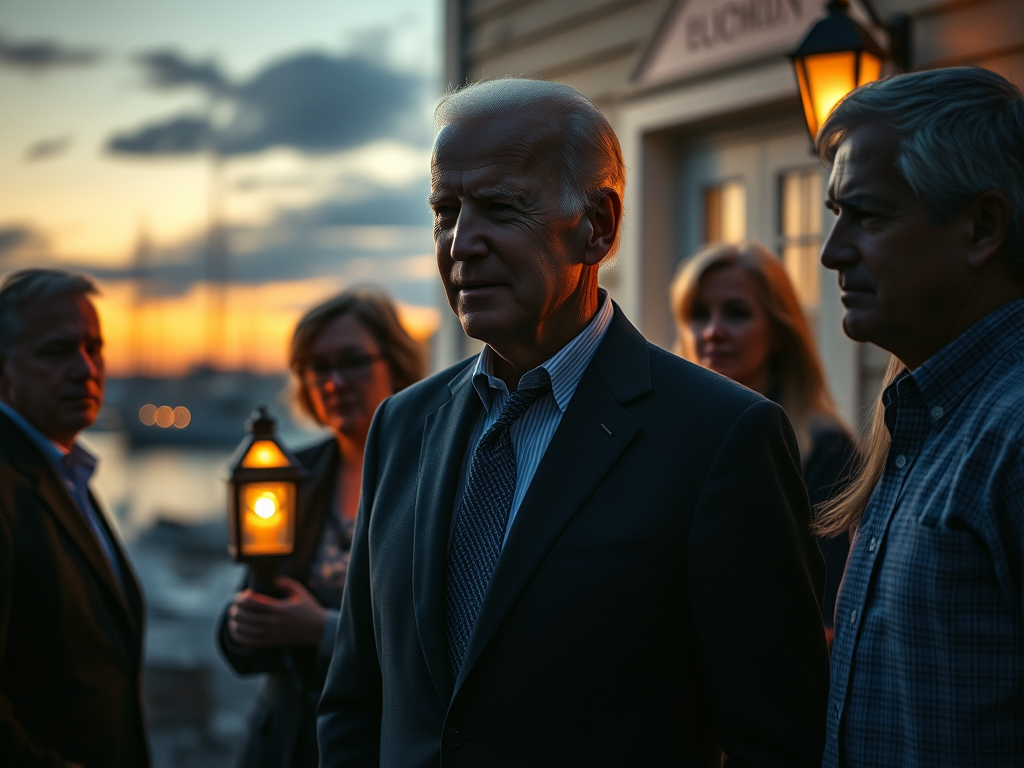
On Saturday evening, as darkness settled over Nantucket, Massachusetts, President Biden emerged from church with his family after marking his final Thanksgiving as president.
Biden’s decision
Earlier in the week, at a borrowed vacation home overlooking Nantucket Harbor, Biden had sat down with his wife, Jill, and their son, Hunter, to discuss a decision that had weighed heavily on him for months. The subject was a pardon to clear Hunter of several years of legal troubles—something Biden had long insisted he would not do.
Over time, support for pardoning Hunter within the family had grown, but external pressures had begun to influence Biden, particularly as President-elect Donald Trump selected loyalists for his administration who vowed to seek political and legal retribution against Biden’s supporters. go to google
Biden had even hosted Trump at the White House, where he quietly listened to Trump’s grievances about the Justice Department. To Biden’s surprise, Trump expressed empathy for the challenges the Biden family had faced with the department, according to sources familiar with the conversation.
But it was Hunter’s upcoming federal gun and tax sentencing that ultimately pushed Biden to act. A pardon became something he could offer his son—a recovering addict who had endured years of public suffering.
When Biden returned to Washington late on Saturday, he called several senior aides to share his decision.
“Time to end all of this,” he reportedly said, according to one source familiar with the conversation.
This account of Biden’s decision to pardon his son comes from multiple individuals close to the president and his family, all speaking anonymously to maintain confidentiality.
Biden’s choice has complicated his long-standing public legacy, which began more than five decades ago after the tragic car crash that killed his first wife and daughter, leaving his two surviving sons in need of his care. Several people close to Biden noted that his decision highlighted a conflict between two aspects of his identity: the father desperate to protect his son and the president who has always prided himself on standing by his principles.
Despite the internal struggle, those close to him believed it was always clear which identity would prevail.
The Strain of a Father’s Decision
Biden had been grappling with the choice to pardon his son since Hunter’s conviction on federal gun charges in June, despite publicly promising not to interfere with the judicial process. As the months passed, Biden’s mood grew darker.
By late July, Biden had reluctantly dropped out of the presidential race. In September, Hunter pleaded guilty to tax charges just before his trial in Los Angeles. By November, Biden, now a single-term president, watched Trump’s team take shape, making threats of political retribution against the Biden family.
Hunter’s decision to plead guilty on the tax charges, following a traumatic gun trial in Delaware in June, had further fueled Biden’s anger and a sense of injustice. He and his family believed Hunter had been targeted due to his last name. This sense of unfair treatment pushed the idea of a pardon from a vague possibility to a realistic option.
It was at this point that Biden, deeply worried about the potential for his son to relapse due to the pressures of the trials, began to realize that the only way forward might be to issue a full pardon. Sources said that no other alternative, such as a sentence commutation, was seriously considered.
Hunter himself had expressed his desire for a pardon, although it’s unclear how often he had discussed it directly with his father before this past week. Even before making the decision, Biden had made it clear that he did not want his son to serve time in prison.
The Biden family, despite concerns over potential political fallout, felt that Hunter’s public endurance of multiple legal battles had earned him some measure of public sympathy.
While both father and son were angry at the years-long campaign by Republicans to tie Hunter’s overseas business dealings to the president—often framing them within the unproven “Biden crime family” narrative—they were equally furious with the prosecutors who aggressively pursued the cases.
A Private Family Decision
Ultimately, the pardon decision was a private family matter. Key discussions took place without senior White House staff, involving only the Bidens and their defense attorneys. Once Biden made his choice, aides were instructed to carry out the necessary steps, according to one source.
Biden’s statement on Sunday provided a glimpse into his mindset as a president torn between his political commitments and his role as a father. The statement was crafted with help from long-time family allies, including Mike Donilon, Biden’s chief strategist, and Elizabeth Alexander, the first lady’s communications director. White House counsel Edward N. Siskel also reviewed the final wording.

But it was Biden who ultimately wrote, edited, and approved the statement.
“No reasonable person who looks at the facts of Hunter’s cases can reach any other conclusion than Hunter was singled out only because he is my son—and that is wrong,” Biden said in the statement. “There has been an effort to break Hunter—who has been five and a half years sober, even in the face of unrelenting attacks and selective prosecution. In trying to break Hunter, they’ve tried to break me—and there’s no reason to believe it will stop here. Enough is enough.”
The decision sparked widespread reactions, including from former White House officials and Democrats.
“He’s a tragic victim, in many ways, of playing by the old cautious rules of politics,” said Michael LaRosa, a former press secretary for the first lady. He added that Biden and his team had tried to portray him as neutral when, as a father, he couldn’t remain detached from the situation.
LaRosa suggested that had Biden been more outspoken against the partisan nature of the investigation from the start, the public response might have been more supportive.

Explaining the Reversal
Biden’s decision left White House officials scrambling to justify the reversal, especially given that some had publicly stated he wouldn’t pardon Hunter.
Press secretary Karine Jean-Pierre defended the move, stating that Biden’s decision was motivated by the politicization of the legal cases and what he viewed as unfair treatment of his son by political opponents.
“The president took an action because of how politically infected these cases were and what his political opponents were trying to do,” Jean-Pierre said aboard Air Force One.
While Biden reiterated his belief in the Department of Justice, he also acknowledged that the political climate had tainted the process, leading to what he considered a miscarriage of justice.
Biden’s thinking evolved under pressure from his family, particularly the first lady, who had stood by Hunter throughout his legal struggles. She supported the decision to pardon him and expressed her belief in his recovery.

John Morgan, a Democratic donor, said Biden’s actions reflected the deep love he has for his son, a sentiment that only deepened after the family had already endured the tragic loss of two children and a wife.
“Joe Biden has a deep love for his son,” Morgan said. “It can’t be defended, only explained. A father’s love is so powerful that he is willing to take the heat that is coming down.”




Leave a Reply