
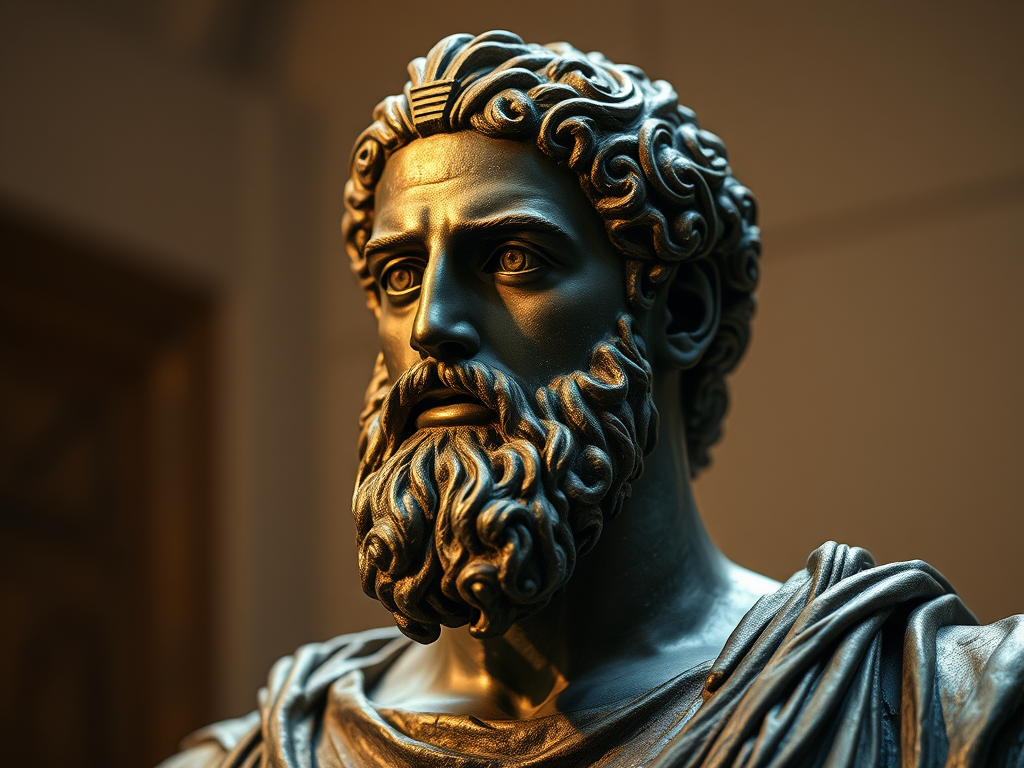

An ancient bronze sculpture, believed to be a representation of the Roman emperor Septimius Severus, will soon be reunited with its long-missing torso after a Danish museum acknowledged that the sculpture of the bearded man’s head had likely been looted and should be returned to Turkey.
The torso, which had been displayed for years in the Roman Court at the Metropolitan Museum of Art in New York, was returned to Turkey in 2023 after investigators determined it had been illegally removed. Since then, Turkey has been requesting the return of the 2,000-year-old head from the Ny Carlsberg Glyptotek in Copenhagen to complete the statue. Last week, the museum confirmed that after conducting extensive research, it had concluded the head, which had been part of the collection since 1970, was likely looted from Bubon, an archaeological site in southwestern Turkey. Investigators have stated that Bubon was heavily pillaged in the 1960s.
The Danish museum explained that its decision followed thorough research. “Strong scientific arguments and documentation are needed to separate an item from the museum’s collection,” said Gertrud Hvidberg-Hansen, the museum’s director. “In this case, both conditions were met.”
Septimius Severus was a strategic general who defeated four rivals to become emperor, ruling Rome from 193 A.D. until his death in 211 A.D. His complete statue was part of a collection of bronzes believed to have been set up around 2,000 years ago as a tribute to the imperial cult in Bubon, a part of the Roman Empire at the time, where emperors were revered as gods.
The site was eventually buried but became a target for looters in the 1960s, who stole and sold artifacts in violation of Turkey’s cultural property laws. Investigators are unsure whether the head was separated from the torso during the illegal excavation or if this separation occurred much earlier, perhaps during turbulent times in history.
The Danish museum’s statement noted that “archival research, archaeological studies, and technical analyses” of the head of Severus led to the conclusion that it had been looted. It stated that the head “likely belongs to a larger collection of bronze sculptures representing the Roman imperial family, thought to have come from the Sebasteion— a Roman imperial cult shrine in Bubon.”
Turkey has welcomed the return of the emperor’s head. Hakan Tekin, the Turkish ambassador to Denmark, praised the museum for making the right decision. “This development sets an important precedent for institutions and collectors worldwide, including in Denmark, by affirming that all artifacts acquired through questionable means must be returned to their rightful owners,” he said.
For decades, the Glyptotek claimed its ancient head was part of the statue’s complete form, exhibiting both the head and torso together in Copenhagen in 1979. However, in recent years, museum officials have expressed doubts about the exact match, admitting in 2023 that the evidence linking the two pieces was “circumstantial and weak.”

The Met had never fully embraced the idea that the torso depicted Severus. During the 12 years it held the sculpture, the museum referred to it as simply a “bronze statue of a nude male figure.”
The Glyptotek stated that while its recent research suggests the head probably came from Bubon, its experts were not ready to definitively claim that it belonged to the torso taken from the Met. “The Glyptotek’s researchers have not been able to examine the possible connection between the bronze head and the bronze torso,” it said. “Therefore, it is not possible to comment on the relationship between these two artifacts.”
The Danish museum bought the head in 1970 for 365,500 Swiss francs (around $85,000) from Robert Hecht, an American antiquities dealer who would later become infamous for his involvement in the trafficking of both looted and legitimate artifacts.
In addition to the torso at the Met, investigators from the Manhattan district attorney’s Antiquities Trafficking Unit have recently returned several other items believed to have been looted from Bubon, including statues of emperors Lucius Verus and Caracalla.




Leave a Reply