
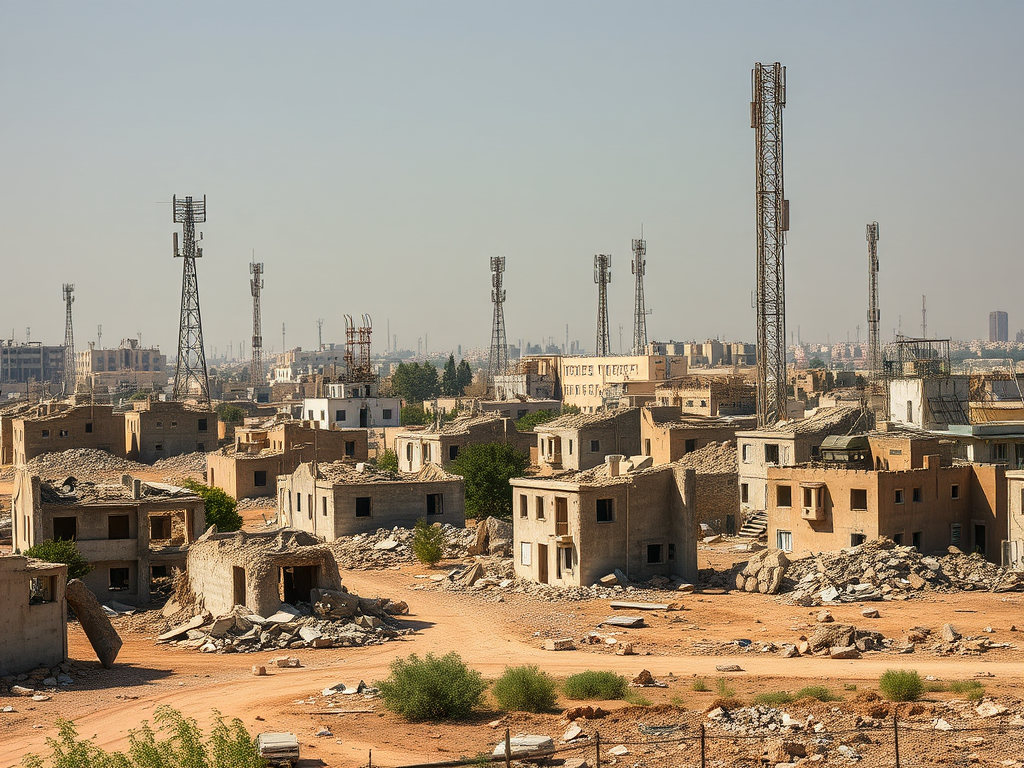
The Israeli military has been intensifying its presence in central Gaza in recent months, building up military bases and demolishing Palestinian structures, according to both Israeli officials and satellite images. This expansion indicates that Israel may be preparing to establish a long-term presence in the region.
Since the early stages of the war, Israeli forces have occupied a key four-mile stretch of road, known as the Netzarim corridor, that divides Gaza. This corridor has been used to prevent hundreds of thousands of displaced Palestinians from returning to northern Gaza. Over time, this control has expanded into an 18-square-mile area, according to the Israeli military and an analysis of satellite footage by The New York Times.

In the past three months, more than 600 buildings have been demolished in an apparent attempt to create a buffer zone. Additionally, a network of military outposts has been rapidly developed, featuring communication towers and defensive fortifications.
This buildup suggests a shift in Israeli strategy, as the country had previously avoided maintaining direct control over Gaza’s territory, allowing Hamas to regain control in some areas. The Israeli military has stated that these moves are for operational reasons.
The expansion has raised questions about Israel’s long-term intentions for Gaza. Israeli leaders have pledged to maintain security control in Gaza after the conflict ends, though they have been unclear about what this might involve. Military analysts suggest that the new infrastructure in the Netzarim corridor may be part of these plans.
Control of the corridor, which extends from the Israeli border to the Mediterranean, allows Israel to regulate movement across Gaza, keeping displaced Palestinians confined to the southern part of the enclave. The military has also extended its control over the territory on either side of the corridor, about 4.3 miles wide and 4.3 miles long, to make it easier for Israeli forces to maintain their hold on the area, according to Lt. Col. Nadav Shoshani, a military spokesman.
Israel occupied Gaza in 1967 during the Arab-Israeli war, maintaining settlements and military bases there until 2005 when it withdrew its troops and settlers. Some Israeli ministers have suggested that military control could pave the way for renewed Jewish settlement, though Prime Minister Benjamin Netanyahu has ruled out this possibility for now. The former Israeli settlement of Netzarim, which the military corridor is named after, is within the area now fully controlled by Israel.

Satellite images analyzed by The New York Times show that Israel has established at least 19 large military bases throughout the area, with the pace of construction accelerating since September. Many of these bases are paved and walled, featuring barracks, access roads, and parking for armored vehicles, and are surrounded by defensive ditches and obstacles to hinder enemy movement.
Colonel Shoshani has emphasized that the expansion is for operational purposes and that any infrastructure built can be dismantled quickly. However, the extent of the fortifications suggests that Israel may be preparing for a prolonged military presence in Gaza. Avi Dichter, an Israeli government minister, stated that Israel plans to remain in Gaza for the long term, adding that there is still much work to be done.
Amir Avivi, a retired brigadier general, suggested that Israel’s military leadership now believes that withdrawal and separation are no longer viable options, explaining the ongoing construction efforts. He argued that the facts on the ground are clear, implying that Israel intends to maintain control of the region.
In November, Prime Minister Netanyahu visited the Netzarim corridor, praising the work of Israeli troops and reaffirming Israel’s goal of preventing Hamas from ruling Gaza.

The Biden administration has expressed opposition to long-term Israeli control of Gaza, which it views as an obstacle to the establishment of a future Palestinian state. Meanwhile, President-elect Donald Trump has urged Israel to “finish up” the war but has not specified conditions for a postwar Gaza.
One of the largest Israeli military bases, located at the intersection of the Netzarim corridor and the main north-south highway, has expanded steadily throughout the year. It now features two communication towers and a large checkpoint, according to satellite footage.
Between September 3 and November 21, the Israeli military demolished over 600 buildings in the area, including residential structures and greenhouses. Soldiers from Israel’s 749th Combat Engineering Battalion posted videos of the demolitions on social media, and The New York Times verified 11 of these videos. The footage, taken by drones, provides a bird’s-eye view of the area south of Gaza City, showing the extensive efforts to reshape the geography.
Colonel Shoshani stated that some of the demolished buildings had been used by militants as lookout points and hiding places. By flattening much of the area, the Israeli military hopes to make it more difficult for Hamas fighters to ambush Israeli forces in the Netzarim corridor or in nearby outposts.
Since late last year, Israeli forces have been paving and fortifying the Netzarim corridor. The military’s ground invasion of Gaza began after the October 7, 2023, Hamas attacks, in which Israel reports that approximately 1,200 Israelis were killed and 250 taken hostage. By June, the area within a half-mile of the corridor had been cleared, creating what Israel considers a buffer zone.


The village of Al Mughraqa, located nearly four miles south of Gaza City, was one of the hardest hit during this period. Before the war, it was home to over 10,000 residents and surrounded by orchards and fields. By August, the village had been largely destroyed, leaving only a few buildings standing. According to Israel, Hamas had entrenched itself in the area, making the construction of “defensive infrastructure” necessary.
Palestinian residents who fled the village, like Bashir Abu Kmeil, are now left with little hope of returning to their land. Mr. Abu Kmeil, who fled with his family, recalls that while Palestinians were initially allowed to visit their homes, they soon feared that approaching the ruins would be too dangerous. Now, he says, the land is nothing but devastation.




Leave a Reply