
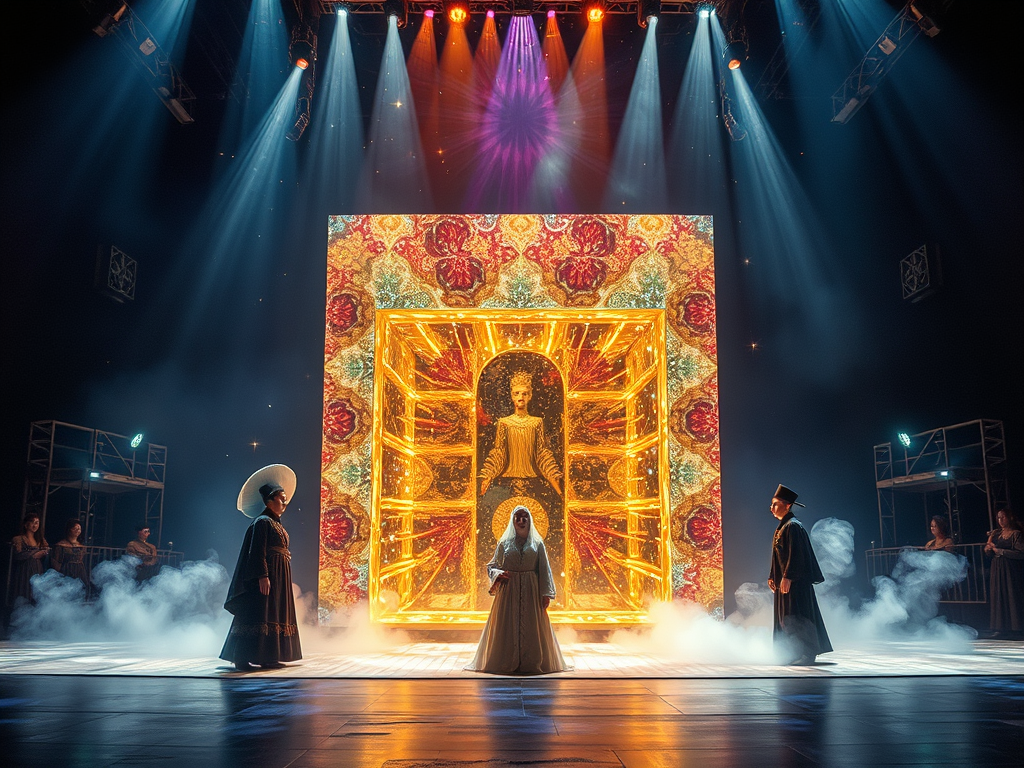

Making Die Frau Ohne Schatten sound enticing isn’t an easy task. Believe me, I’ve tried. But whenever you attempt to describe the most extravagant collaboration between Richard Strauss and Hugo von Hofmannsthal — which returned to the Metropolitan Opera on Friday in a rare, resplendent revival — the opera invariably comes across as dense and daunting.
Even the title, The Woman Without a Shadow, hints at its complexity. In this fantastical tale, the absence of a shadow symbolizes not only a literal state but also the inability to bear children. As the story unfolds across layers of fantastical worlds — featuring a singing falcon, a choir of unborn children, and a looming prophecy of an emperor turning to stone — its distinctive symbolism only grows more intricate. The narrative follows two couples, one human and one semi-divine, who navigate temptations and trials to reach enlightenment, happiness, and yes, fertility.
A four-hour allegorical meditation on pregnancy might sound unappealing at first. But trust me: you should give it a chance.
With its formidable length and demanding vocal, instrumental, and staging requirements, Die Frau Ohne Schatten is often compared to Wagner’s Ring cycle, a clear influence. Both works risk appearing overwrought and heavy-handed in summaries. Yet, like the Ring, this opera transforms into something profoundly engaging when performed. Its blend of royalty and commoners, magical flourishes, and overt symbolism becomes emotionally resonant and surprisingly relatable. Hofmannsthal’s refined and poetic text — for some, a bit too contrived — gains warmth and compassion through Strauss’s music.
The opera, last staged at the Met 11 years ago, has always been a major event for the company. Its Met premiere, conducted by Karl Böhm in 1966, was a landmark of the theater’s inaugural season at Lincoln Center. Nathaniel Merrill and Robert O’Hearn’s grand production fully utilized the new venue’s technical capabilities and was only replaced in 2001 by Herbert Wernicke’s modern but equally majestic vision.
Wernicke’s production begins in a mirrored box that floods the stage with a kaleidoscope of shimmering color, reflecting the world of the Emperor and the half-divine Empress. This crystalline realm stands in stark contrast to the human world, depicted as a grim, contemporary warehouse. The Empress, aided by her sinister Nurse, descends to this earthbound sphere to claim a shadow from Barak’s dissatisfied wife before the Emperor is doomed to stone.

Yannick Nézet-Séguin, the Met’s music director, delivers a fluid and nuanced interpretation of the opera’s elaborate score. Rather than overwhelming the audience with opulence, he carefully balances the grandeur with moments of restraint, drawing comparisons to the more intimate style of Ariadne auf Naxos, Strauss and Hofmannsthal’s prior collaboration. While the lush beauty of Der Rosenkavalier and the raw explosiveness of Elektra are evident, Nézet-Séguin maintains an agile pace, keeping the orchestra light and supportive of the singers.
This production’s success also hinges on a stellar cast. Elza van den Heever’s soprano is both pure and piercing as the Empress, her high notes soaring even if her lower range occasionally lacks depth. Russell Thomas brings steady elegance to the Emperor, while Michael Volle’s tender baritone makes Barak deeply moving. Lise Lindstrom portrays Barak’s wife with a sympathetic edge, more fearful than abrasive, though the demanding role tests the limits of her steely reserves.
Nina Stemme, as the menacing Nurse, brings gravitas to the role despite some signs of vocal wear. The production opts for a slightly trimmed version of the opera, following the cuts initiated by Böhm and approved by Strauss himself. These adjustments, particularly in the final act, make the performance more accessible without losing its dramatic impact.
By the glowing finale, as the characters embrace life, love, and all its messiness, any minor flaws feel insignificant. The opera transcends its individual parts, delivering an experience both luminous and life-affirming. Two months into the Met’s season, this is undoubtedly its first must-see production.rau Ohne Schatten,” quibbles often feel like exactly that. By the radiant ending, as the characters embrace all the messiness of life, love and childbearing, the opera feels, as usual, like more than the sum of its parts. Two months into the Met’s season, this is the company’s first must-see show.




Leave a Reply