
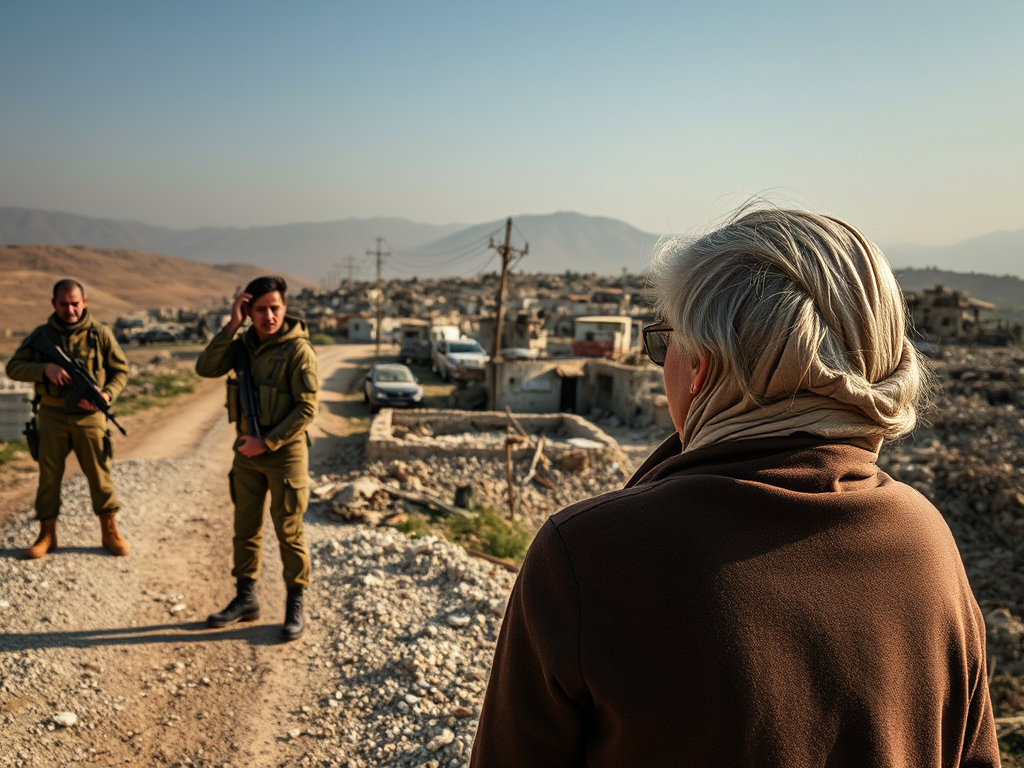

The fragile ceasefire between Israel and Hezbollah largely held through its second day in Lebanon on Thursday, though Israel carried out an airstrike it claimed targeted militants breaching the terms of the ceasefire agreement.
This Israeli strike marked the first since the U.S.-brokered ceasefire went into effect early on Wednesday. However, despite mutual accusations from Israel and Lebanon over violations of the truce, neither side seemed eager to escalate into full-scale combat.
The Israeli military stated that the airstrike, near the southern Lebanese border, targeted two militants heading to a Hezbollah rocket site used to fire on Israel. Lebanon’s army, which plays a key role in enforcing the ceasefire, accused Israel of breaching the truce “several times” on Thursday afternoon. Hezbollah did not provide an immediate response.

Additionally, Israel’s military claimed to have stopped militants from advancing into southern Lebanon. “We will enforce the agreement with the same strength that secured it,” stated Lt. Gen. Herzi Halevi, Israel’s military chief, in a video message. He also warned that Israel would respond “with fire” to any breaches of the agreement.
Despite the tense situation, the regions along the Lebanon-Israel border were quiet for much of Thursday. Israeli communities near the border enjoyed a second day without rocket sirens, while displaced people in Lebanon began returning to areas like Beirut’s southern suburbs, which Hezbollah controls and where Israeli airstrikes had been frequent.

Hezbollah, despite suffering significant losses in Israel’s offensive, has continued to adopt a defiant stance. Hassan Fadlallah, a Hezbollah lawmaker, stated that the group would defend itself if attacked by Israel but emphasized that it was still respecting the ceasefire.
The conflict had displaced over a million Lebanese, about a quarter of the population. Since the ceasefire began, many have started returning to their homes, though the situation remains uncertain. Hundreds of thousands in southern Lebanon remain unable to return, as Israeli forces still occupy parts of the region. The ceasefire agreement stipulates that Israeli forces will gradually pull out over the next two months.
Meanwhile, the Israeli military has warned displaced Lebanese not to return to southern Lebanon, imposing a curfew in the area. Lebanon’s army has started deploying troops to Hezbollah strongholds and setting up checkpoints to aid the return of displaced people.
Among those returning is Taflah Amar, a 79-year-old woman who returned to her home in Baalbek after two months in Beirut. She found her neighborhood devastated and expressed sorrow over the destruction, asking, “What did I do to deserve this?”
The towns along Lebanon’s border with Israel, long under Hezbollah’s influence, were some of the hardest hit. These towns had served as launch points for Hezbollah’s rocket attacks on northern Israel, which began in October 2023, following Hamas’s conflict with Israel in Gaza. The Israeli bombardment displaced tens of thousands in Israel, although many of those who fled appeared hesitant to return immediately.

“We have no intention of going back home yet,” said Gal Avraham, a resident of Margaliot, a village close to the border. She and her husband visited their house for the first time in over a year, only to find it in disrepair with rotting food and extensive damage. Avraham was uncertain about the truce’s durability, citing an overnight siren in a nearby border town as a reminder of the ongoing instability.
The conflict, which escalated in September 2023 and saw a ground invasion in October, claimed the lives of approximately 3,800 Lebanese and 100 Israelis, according to official figures.
Under the ceasefire, both Israel and Hezbollah are committed to a 60-day truce. During this period, Israeli forces are to gradually withdraw from southern Lebanon, while Hezbollah fighters are expected to pull out, allowing the Lebanese army to take control of the area. A U.N. peacekeeping force will monitor the situation.
However, the full implementation of the agreement remains uncertain. Israel has indicated that its actions will depend on developments in Lebanon, noting that a previous ceasefire between Israel and Hezbollah in 2006 was never fully enforced.



Leave a Reply