
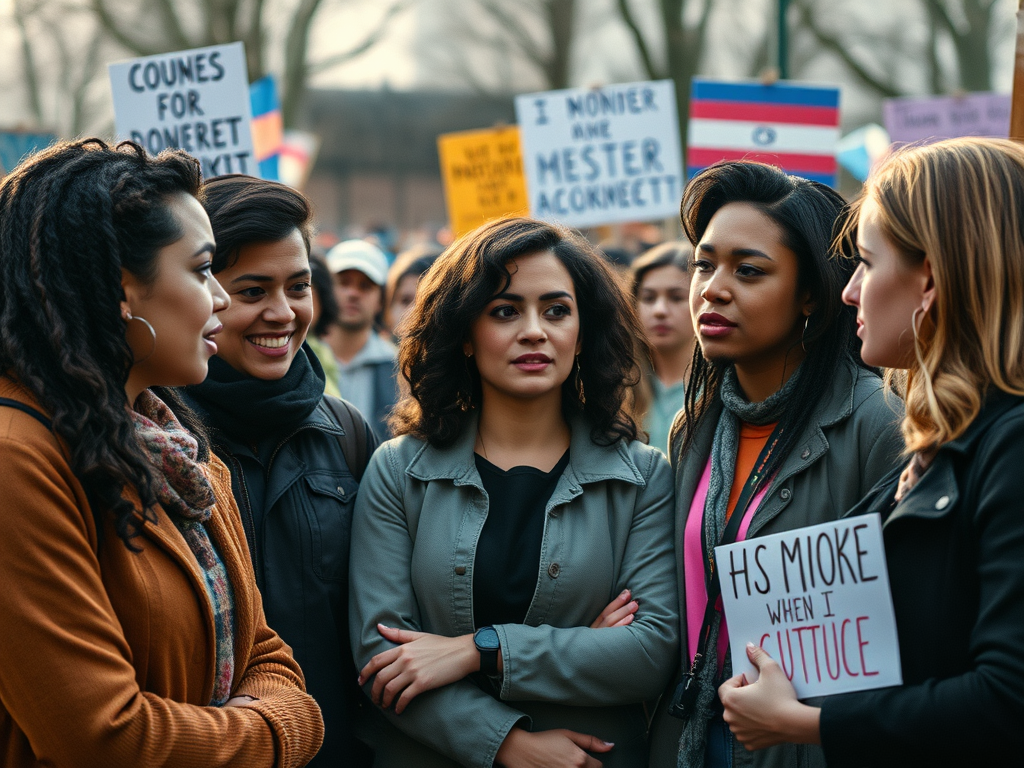

Transgender activists who oppose certain viewpoints often face intense backlash and criticism.
For example, when a Democratic congressman expressed support for parents concerned about transgender athletes competing against their daughters, a local party official and ally equated him to a Nazi “cooperator,” while a group called “Neighbors Against Hate” organized a protest outside his office.
Similarly, when J.K. Rowling stated that denying the connection between sex and biology was “deeply misogynistic and regressive,” a leading LGBTQ+ group accused her of betraying “true feminism,” and some angry critics even posted videos of themselves burning her books.
When the Biden administration consulted LGBTQ+ allies last year on new restrictions for transgender student-athletes, one activist on the call angrily accused the administration of being complicit in a “genocide” of transgender youth, according to sources familiar with the incident.
Now, some activists argue it’s time to reassess their confrontational approach and push back against the more extreme voices within their movement.
“We need to make it acceptable for people to change their minds,” said Rodrigo Heng-Lehtinen, executive director of Advocates for Transgender Equality. “We can’t vilify them for not agreeing with us. Nobody wants to join that side.”
Activists point to tactics, particularly on social media, that have become common among staunch supporters of the cause: efforts to police language (e.g., removing terms like “male” and “female” from discussions of pregnancy and abortion), labeling the misidentification of a transgender person as violence, and demanding that everyone specify their preferred pronouns.
Some LGBTQ+ activists have pressured liberal candidates to adopt their positions, sometimes with unintended consequences. For instance, Republicans hammered Vice President Kamala Harris with ads this year, criticizing her responses to a 2019 questionnaire from the American Civil Liberties Union (ACLU) — one of the groups advocating for transgender rights. The questionnaire asked Harris to commit to ensuring transgender people in federal custody, including those in prison and immigration detention, could access gender-transition surgery.
Heng-Lehtinen, who grew up in a prominent Republican family in Florida and came out as transgender after college, said that while Donald Trump’s election was painful for many transgender people, the movement should consider treating skeptics as potential allies, rather than enemies.
This self-reflection comes as Democrats wrestle with whether their push for social and racial justice in recent years has sometimes come across as too judgmental, contributing to the perception that their party has lost touch with the issues Americans care about.
Republicans have spent millions of dollars on ads accusing Democrats of being “woke,” exploiting the public’s limited understanding of transgender issues to create distorted narratives of indoctrination in schools and predatory behavior in locker rooms.
LGBTQ+ activists now face a more hostile political environment. Over two dozen states have restricted access to transition-related healthcare, and just last week, House Republicans pledged to prevent transgender women from using women’s restrooms in the Capitol — a direct challenge to Sarah McBride of Delaware, who recently became the first openly transgender person elected to Congress.
McBride, who has emphasized that she represents all her constituents and not just the transgender movement, stated that she would abide by House rules even if she disagreed with them.
This kind of conservative targeting — which transgender people often see as personal and pervasive — makes many activists hesitant to adopt a more conciliatory, traditional political approach. Some believe that McBride’s calm response suggested a surrender to the right.
If activists seem impatient, it’s because they are.
“We’re facing fundamental injustice — and that’s not coming from people who are open to compromise or debate,” said Gillian Branstetter, a communications strategist with the ACLU who focuses on transgender advocacy. “These are people who feel threatened by the existence of transgender people. And, more importantly, they’re trying to scapegoat us.”
The ACLU’s 2019 questionnaire, for example, posed 19 questions on various topics because it believed voters needed to make informed distinctions among candidates.
Democrats, too, are grappling with disillusionment over the national conversation on transgender rights, which they feel can often sound rigid and intolerant.
“Here we are, calling Republicans weird, while we’re the ones forcing people to include pronouns in their email signatures,” said Representative Seth Moulton of Massachusetts. Moulton sparked protests after voicing concerns that transgender athletes might have an unfair advantage or disadvantage other athletes.
Nevertheless, Moulton and other Democrats still want to protect transgender individuals from discrimination. “Reasonable restrictions for safety and fairness in sports seem to be, empirically, a majority opinion,” he said. “But should we strip civil rights from transgender people, so they can be fired for being who they are? No.”
Transgender rights were not a top priority for most voters in the last election. According to Gallup, voters ranked transgender rights lowest among 22 national issues in terms of importance for their voting decisions.
Public support for transgender causes does not appear to be growing. Recent polls show fewer Americans now support some of the rights that LGBTQ+ activists advocate for, such as allowing children to undergo gender transition treatment, according to the Public Religion Research Institute. Many Americans also believe that advocacy for transgender rights has gone “too far.”
This shift is troubling for many longtime LGBTQ+ activists, especially those who fought for the acceptance of gay and lesbian people over the past several decades.

Some activists argue that the LGBTQ+ movement is undergoing a difficult transition, applying lessons from the same-sex marriage campaign to the ongoing fight for transgender equality.
Evan Wolfson, the founder of the pro-same-sex marriage group Freedom to Marry, explained that early victories in the same-sex marriage fight often came in the form of smaller, less rewarding steps, like civil unions. “We always said, ‘We’re not asking for civil unions, but we’ll accept them as a stepping stone,’” he said.
Though Wolfson faced criticism from all sides, with some gay rights activists dismissing civil unions as inadequate and many Democrats blaming electoral losses on the push for same-sex marriage, this incremental approach eventually led to the landmark 2015 Supreme Court ruling legalizing same-sex marriage.

The conversation around transgender rights, Wolfson noted, is “still relatively new and evolving. That conversation will take time.”
Mara Keisling, founder of the National Center for Transgender Equality, recalled an adage she used 20 years ago: “You can’t say ‘Don’t fire them’ until you can say ‘Don’t kill them,’” meaning that advocates should first focus on measures that affirm the humanity of transgender people, like hate-crime protections. Only after that can they push for anti-discrimination laws.
Keisling believes that many activists today are distracted by counterproductive debates, such as boycotting J.K. Rowling’s Harry Potter books or insisting that there are no valid concerns about transgender women in high-level sports.
She also pointed out that LGBTQ+ activists lost credibility when they accused people of bigotry over sports issues. “We looked unreasonable,” she said. “We should be talking about the 7-year-old who just wants to play soccer with her friends.”
Keisling acknowledges that the right has directed animosity toward her personally, noting that her image was used in a Trump campaign ad attacking Democrats on transgender rights.

Heng-Lehtinen agrees that the movement needs a more compelling message on sports issues. He argued that school districts and athletic associations should be the ones addressing the concerns around transgender athletes, not Republican legislators.
“I don’t think we’re best served by imposing a one-size-fits-all solution,” he said, stressing that broad and blunt bans on transgender athletes are misguided.
Advocates suggest that effective messaging should recognize that most Americans aren’t familiar with the lives of transgender individuals and reinforce the message that transgender people simply want the same things as everyone else: fairness, respect, and love.
“It’s our job to break down misinformation and say, compassionately, ‘It’s perfectly understandable that you have questions,’” Heng-Lehtinen said. “That’s not yelling at someone.”




Leave a Reply