
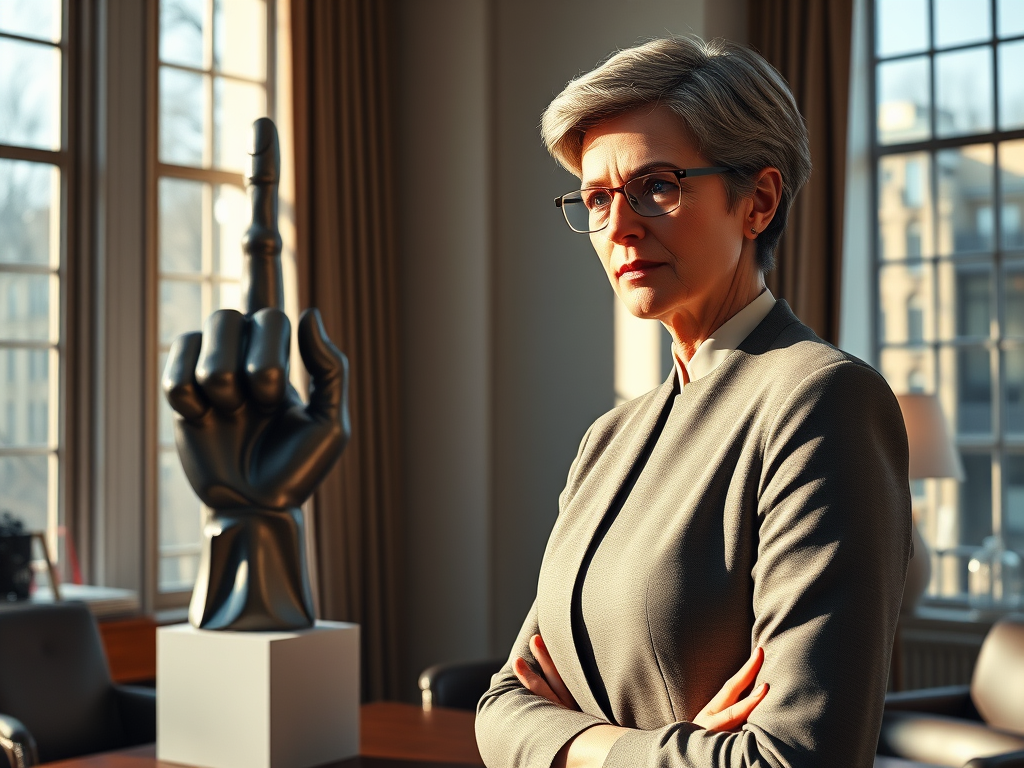

Margrethe Vestager, the European Union’s top antitrust enforcer and one of the most vocal critics of the tech industry, recently found herself reflecting on the decade she spent in her role as she prepared to step down at the end of the month. As she walked through her office in Brussels, she stumbled upon a sculpture of a hand giving the middle finger. Pausing, she wondered aloud, “What should I do with this?” She had previously said the sculpture served as a reminder not to let critics get her down.
At 56, Vestager, a Danish politician, has become a globally recognized figure, rare for an EU official. Since taking office in 2014, she boldly challenged the dominance of tech giants like Google, Apple, and Amazon, bringing cases and imposing fines for anti-competitive practices. At the time, these companies were rapidly expanding and highly admired for their innovations, but Vestager faced fierce backlash. Critics claimed her actions were harming Europe’s economy and scaring away potential startups. Former President Donald Trump even reportedly said she “really hates” America.
However, as her tenure comes to a close, the regulation of tech companies has become a global norm. Europe is now regarded as the leader in implementing strict tech laws, and other nations, including the U.S., South Korea, Australia, Brazil, and Canada, have followed suit by taking action against the same tech giants.
Vestager expressed her satisfaction with these developments, telling The New York Times that she cried after the European Union’s highest court delivered an unexpected victory in a long-running tax avoidance case against Apple in August. “People thought we were crazy because 10 years ago, Big Tech was untouchable,” she said. “They were the most admired, the most innovative, the most promising companies.”
In Washington, her reputation has shifted from outsider to pioneer. During a final visit to the U.S. Justice Department in September, Vestager was met with a standing ovation from staff members. Jonathan Kanter, head of the department’s antitrust division, described her as a “transformational figure” and praised her for elevating the conversation around digital gatekeepers. Kanter even keeps a framed picture in his office of a cartoon mouse giving the middle finger as a tribute to Vestager.
As she prepares to transition to a new role at a university in Denmark, Vestager reflects on her legacy. Her successor, Teresa Ribera Rodríguez, is set to take over as the EU’s chief antitrust regulator.
Despite her achievements, Vestager acknowledged the challenges she faced. Some critics within the tech industry argue that her aggressive stance hurt Europe’s own tech sector and cemented its image as a hub for overbearing bureaucracy. On the other hand, some of her former colleagues feel the region’s regulations haven’t gone far enough, pointing out that companies like Google, Apple, and Amazon have only grown more powerful in the past decade.
“Have we moved the dial? Only at the margins,” said Tommaso Valletti, a former top economist under Vestager, who praised her persistence in the face of adversity. “Did we change Big Tech? My answer is no.”
Vestager herself admitted that while she was proud of her work, she wished her office could have acted more swiftly. She expressed a desire to see companies face more substantial structural changes, rather than just financial penalties. “Regulators everywhere need to be bolder,” she said.
Although collaboration with U.S. regulators had been strong during her time, Vestager warned that things could change under the leadership of Donald Trump. She noted that tech leaders were quick to congratulate Trump after his election, reflecting hopes that the regulatory environment would shift.
Vestager also addressed the online abuse she and other women in politics face. She shared how toxic online comments had a chilling effect on democracy, particularly for women. “The purpose is clear: ‘You, woman, shut up. Go home. Keep quiet,’” she said, describing how many young women are deterred from entering politics because of such abuse.
On the issue of social media regulation, Vestager emphasized the increasing importance of overseeing platforms like X and Telegram. She pointed to the new European law, the Digital Services Act, which grants authorities more power to regulate harmful content. She argued that platforms failing to address issues like hate speech and terrorist content were in violation of the law.
“I find it completely legitimate that, for example, my home country, Denmark, passes a law that makes hate speech illegal,” she said. “What I find not legitimate is the refusal to respect those laws.” She also voiced concern over the influence of tech moguls like Elon Musk, especially as Musk’s companies, including X, are under investigation by the European Commission. “One of the fundamentals of the European model is the rule of law and equal treatment, and that must apply to everyone,” she concluded.



Leave a Reply