
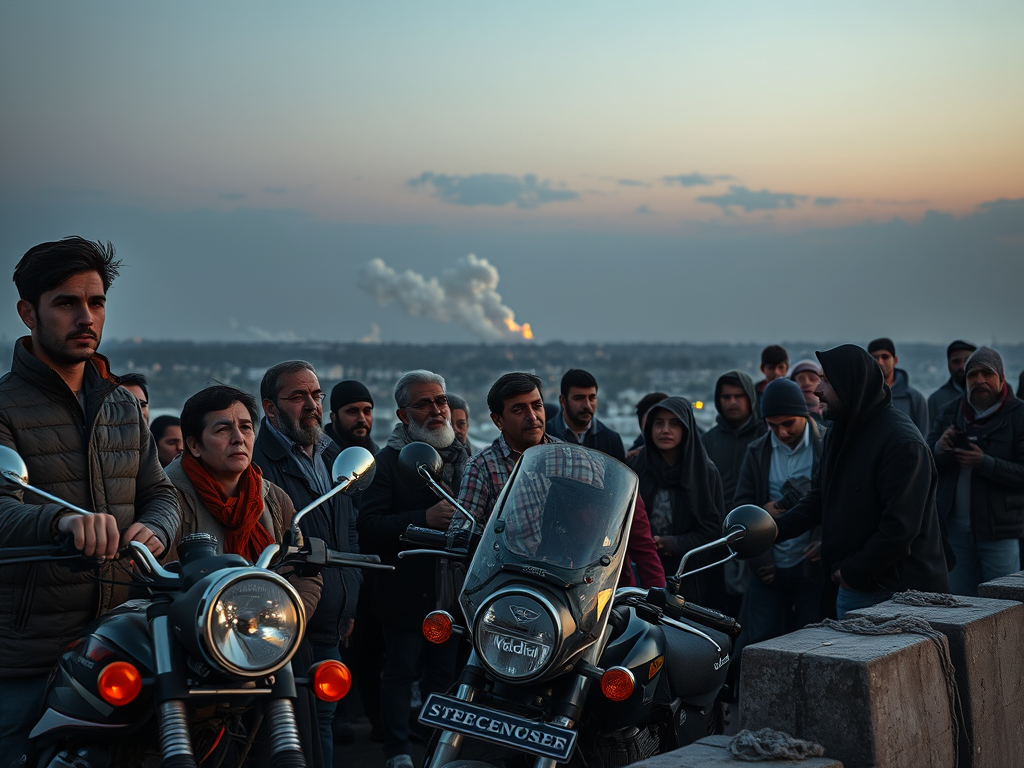

Every evening, crowds gather on a scenic hillside on the outskirts of Beirut, drawn by the unobstructed view of Dahiya—an area south of the city devastated by Israeli airstrikes over the past two months. The scene is a mix of young men, elderly couples, and local journalists, all watching closely as the conflict unfolds before them.
As dusk falls, people on motorcycles and perched atop cement barriers eagerly wait for the next airstrike. The thunderous sound of Israeli bombings triggers a frantic search for plumes of white smoke rising into the sky, offering the first hint of what may have been hit.
“Look, look, there’s something on the balcony over there. Do you see it?” Osama Assaf, 43, pointed out one evening, his eyes fixed on the horizon.
“Where? By the highway?” a young man standing next to him asked.
As the war between Hezbollah and Israel intensifies, this hillside in Baabda, a mountainous suburb on the southeastern edge of Beirut, has become a nightly gathering spot. In peacetime, the area was a popular picnic spot where locals would relax, smoke fruit-flavored tobacco, and watch the sun set over the Mediterranean. But these days, it offers a grim window into the war-ravaged Dahiya.
The Dahiya is a dense, urban area mainly populated by Shiite Muslims and controlled by Hezbollah, the Iran-backed militant group. Israeli officials say their airstrikes target Hezbollah’s military facilities, but the result has been the destruction of an entire neighborhood, now a bombed-out ghost town, covered in ash and littered with rubble.
Initially, the hillside was a gathering place for local TV reporters providing updates on the conflict. Soon, Dahiya residents who had fled the area began showing up, hoping to learn if their homes would survive another day of bombardment. Some were driven by fear, while others were simply bored, their daily routines shattered by the war. On rare occasions, young Christian men from nearby areas came to watch the destruction, reflecting Lebanon’s ongoing sectarian tensions.
But for most, the draw was a morbid curiosity—a need to witness the violence firsthand, to hear the rumbling booms and see the plumes of smoke, as if doing so might make the war feel real.

“Look, there’s more smoke rising from where it hit,” Hussein Qazem, 56, remarked one evening, pointing to the aftermath of an airstrike that had just struck the Dahiya. Checking his phone, he reviewed maps issued with Israeli evacuation warnings for neighborhoods in Dahiya. “This must be the al-Hawraa strike,” he muttered.
Just an hour earlier, Mr. Qazem had been sharing a late lunch with his family in an apartment they had rented after fleeing the Dahiya. The evacuation alerts had become an almost daily occurrence since the war escalated. But this time, one of the maps showed the exact apartment he had spent 30 years working to afford through his business in Saudi Arabia.
His 17-year-old nephew, Wael Wahab, suggested they return to say goodbye to the apartment one last time. The pair rushed back into the neighborhood, speeding past the shops they once frequented, now shattered, their storefronts reduced to jagged glass. It was a brief visit—uncertain how much time they had before another strike—but it gave them a fleeting sense of closure.
They arrived at the hillside as a bluish haze settled over the city. “A plane’s coming,” Mr. Wahab remarked, pointing at a commercial flight landing at Beirut’s international airport—a strange reminder of everyday life continuing despite the war. Moments later, an Israeli warplane zoomed overhead, followed by the unmistakable boom of another airstrike.
“That must be the one hitting our street,” Mr. Wahab said, his voice tinged with worry.
They paused for a moment. “Okay, it’s gone,” Mr. Qazem sighed, and they turned their attention back to the unfolding chaos.

A little farther up the hillside, several local TV crews had gathered, their tripods lined up along the curb, the hum of generators powering satellite dishes filling the air. The sidewalk was scattered with cigarette butts and empty energy drink bottles—fuel for the long nights of reporting.
Mohammad Farhat, 68, a Dahiya resident, paced behind the reporters, nervously flipping his car keys. Alongside his wife, Leila Farhat, 65, they came here almost every night. It was the best way to get the latest news from the frontlines, directly from the journalists.
“Here, we survive on hope—and information,” Mr. Farhat said.
As he spoke, his wife rummaged through their car’s trunk, pulling out a bag of mixed nuts and a bottle of 7-Up. She handed the snacks to her husband and poured soda into plastic cups for others in the crowd. “It’s like the new Corniche,” she joked, referencing Beirut’s famous seaside promenade.
The Farhats had been married for nearly 50 years. Leila fled the south during Lebanon’s civil war and later met Mohammad in the Bekaa Valley. “I saved her the drive back to her village,” Mr. Farhat quipped.
The couple had moved to the Dahiya 20 years ago, witnessing its destruction once before during the 2006 conflict between Hezbollah and Israel. Back then, Hezbollah rebuilt the neighborhood with millions of dollars in aid from Iran and Qatar, emerging from the war with a sense of invincibility. Mr. Farhat was confident that once this conflict ended, Hezbollah would rebuild again—but it would be a long, painful process. He was weary from years of turmoil and crises in Lebanon.
“We’re retired now; we’re supposed to be relaxing. It’s our time to rest,” he said. “I’ve seen retired people in Germany, in the Netherlands—they go on vacations, not thinking about drones overhead,” he added, gesturing at the relentless hum in the sky.

“The drone never stops, it never gets tired,” Ms. Farhat interjected, half-joking. “It stays in the sky for 30 hours straight.”
As the sun dipped below the skyline, the dark outline of the Dahiya became visible—an expanse of destruction with empty buildings and power lines severed by the airstrikes. The de facto boundaries of the neighborhood were lit up by the distant glow of Beirut’s city lights and the runway of the international airport.

A short distance away, Iman Assaf, 46, unloaded a foam mattress from her car onto the sidewalk, preparing to spend the night with her husband and son.
The Assafs were among the tens of thousands of Shiite Muslims who fled the Dahiya as the airstrikes spread into other parts of Beirut. This movement of refugees had shifted the city’s demographic landscape, once defined by sectarian divides.
Ms. Assaf, however, had felt relatively welcome in Baabda, a predominantly Christian town. Though, occasionally, young men with Christian crosses around their necks and alcohol in hand would shout taunts from their motorcycles as they passed by, egging on the destruction of the mostly Shiite neighborhoods.
“Yalla, yalla, yalla!” — “Let’s go, let’s go, let’s go!” they would shout, a harsh reminder of Lebanon’s sectarian tensions. Ms. Assaf brushed off the hostility, as if dismissing it would help erase it.
“The people are united—it’s war against all of us,” she said, settling onto the mattress. She placed a kettle on her small stove, staring out at the war unfolding before her, praying for its end.




Leave a Reply