
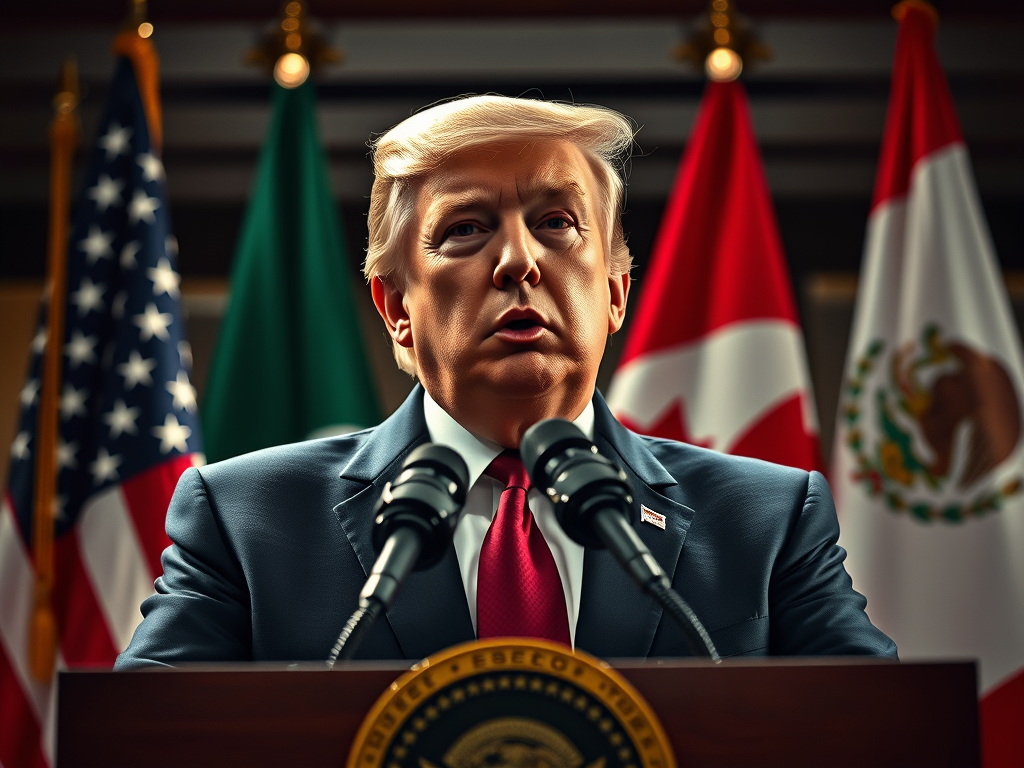
President-elect Donald J. Trump announced on Monday that, upon taking office, he would enact a 25 percent tariff on all goods entering the United States from Canada and Mexico. This move would disrupt North American supply chains and place significant financial burdens on businesses throughout the continent.
In a post on Truth Social, Trump linked the tariff proposal to a caravan of migrants traveling from Mexico to the U.S., stating that he would implement the tariff by executive order and keep it in place until the flow of illegal drugs and migrants across the border stopped.
“This Tariff will remain in effect until the invasion of our country ceases—until drugs, especially fentanyl, and illegal immigrants no longer cross our borders!” Trump wrote.
He further added, “Mexico and Canada have the full authority and ability to resolve this longstanding issue easily. We demand that they take action, and until they do, they will pay a very heavy price!”
In another post, Trump threatened to impose a further 10 percent tariff on all Chinese goods, accusing the country of exporting illegal drugs into the U.S.

“Chinese officials promised to impose the death penalty on drug dealers involved in this trade, but they have not followed through. As a result, drugs, particularly fentanyl, are flooding our country, mostly through Mexico, at unprecedented levels,” he said.
The proposed tariffs could have far-reaching consequences for U.S. industries, including automotive manufacturers, farmers, and food processors, all of which rely on cross-border trade for parts, materials, and finished products.
For sectors that depend on a tightly integrated North American market, the 25 percent tariff could make many goods prohibitively expensive, threatening to cripple trade and leading to higher prices and potential shortages for consumers in the U.S. and beyond.
During his first term, which began in 2017, Trump imposed a range of high tariffs, including a 25 percent tax on global steel and aluminum imports and various products from China.
In 2019, he threatened to impose tariffs on all Mexican goods and even considered closing the border entirely unless Mexico took stronger action to curb illegal immigration. However, he eventually backed down from these threats.
While campaigning for re-election, Trump escalated his tariff rhetoric, floating the idea of a 60 percent tariff on Chinese products and tariffs ranging from 10 to 20 percent on goods from other nations.
In 2022, the combined exports from Mexico, Canada, and China accounted for $830 billion, making them the U.S.’s three largest trading partners.




Leave a Reply