

Colleges and universities have introduced stricter regulations around protests, locked campus gates, and imposed harsher penalties following the disruptions caused by pro-Palestinian demonstrations and encampments last spring.
These measures appear to be effective.
So far this semester, universities have reported nearly 950 protest events, a significant decrease from the 3,000 recorded last semester, according to the Nonviolent Action Lab at Harvard University’s Ash Center. Around 50 people have been arrested at campus protests this academic year, compared to more than 3,000 last semester, according to The New York Times.
When protests have occurred this fall, university administrators have largely enforced — sometimes rigorously — new rules put in place after last spring’s protests. This has resulted in scenes that would have been unimaginable in the past, particularly at institutions with a history of student activism.
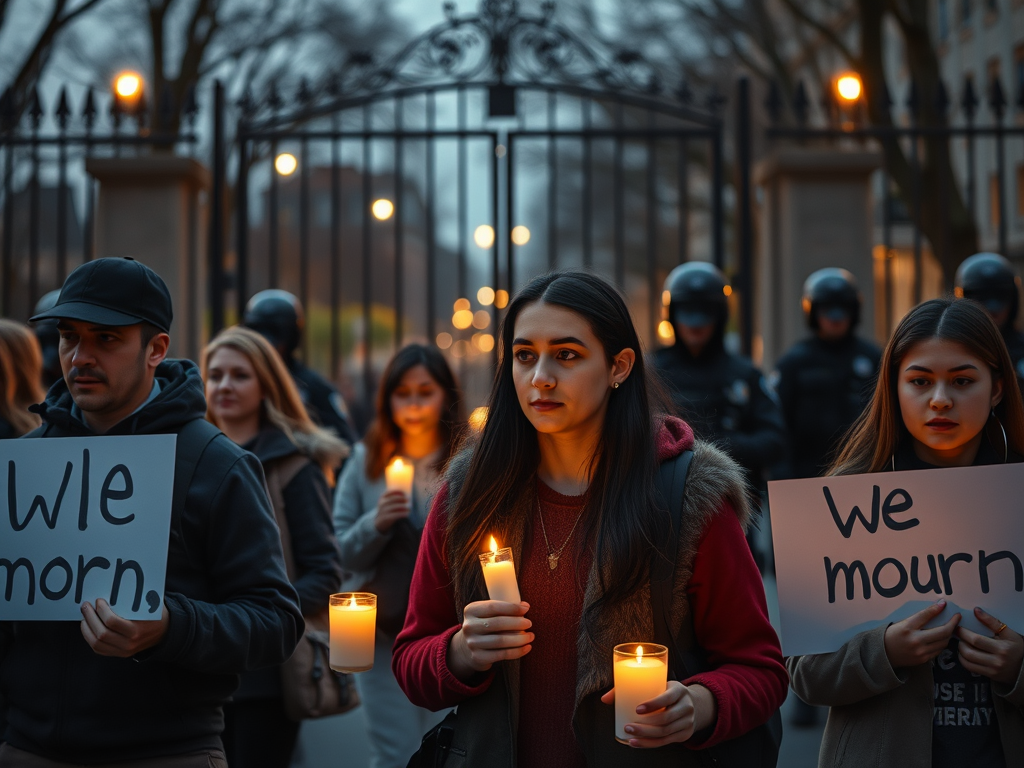
For instance, Harvard temporarily banned dozens of students and faculty members from libraries after they participated in silent “study-ins” — protests where participants sit at library tables holding signs against the Gaza war. A similar protest in December 2023 did not result in any disciplinary actions. At Indiana University Bloomington, students and faculty members who attended late-night candlelight vigils were disciplined under a new rule prohibiting expressive activities after 11 p.m. At the University of Pennsylvania, police and campus officials told vigil participants to disperse after they failed to reserve the space according to new regulations.
At Montclair State University in New Jersey, police officers have often outnumbered participants in a weekly protest where demonstrators hold up photos of children killed in Gaza, with the words “We mourn.”
“They say it’s to keep us safe, but I think it’s more about controlling us,” said Tasneem Abdulazeez, a student in the teaching program.
These changes come after federal civil rights complaints, lawsuits, and intense congressional scrutiny accusing universities of tolerating antisemitism, particularly after some protesters expressed support for Hamas and called for violence against Israelis.
Some students and faculty have welcomed the calmer campus environment, while others view the relative quiet as a result of a crackdown on pro-Palestinian expression. They fear that President-elect Donald Trump, who called on universities to “vanquish the radicals” during his campaign, could increase pressure on campuses.
Universities are enforcing rules they put in place before the academic year began. These rules generally limit where, when, and how protests can take place.
Todd Wolfson, president of the American Association of University Professors and an associate professor of media studies at Rutgers University, said the new restrictions have caused people to feel like they are under constant surveillance.
“They feel like they’re being watched,” Wolfson said. “There’s a strong sense of self-censorship taking place.”
However, Jewish students who felt targeted by some protests have praised these rules for restoring order and safety. Naomi Lamb, director of Hillel at Ohio State University, noted that the new protest policies seem to be working effectively.
“I appreciate the response of administrators to ensure that there is as little antisemitic action and rhetoric as possible,” she said.
Some protest tactics from last semester have been met with stricter responses this year. At the University of Minnesota, 11 people were arrested after occupying a campus building. Last academic year, some universities allowed protesters to occupy buildings for extended periods.
At Pomona College, the president used “extraordinary authority” to bypass the standard disciplinary process and suspend or ban pro-Palestinian protesters who occupied a building on October 7. A college spokesperson justified the move, citing property damage, safety concerns, and disruption to classes, and emphasized that students were given opportunities to respond to the allegations.
Some protesters have adapted their tactics to challenge the new restrictions.

“Study-ins” like those at Harvard have also taken place at Ohio State University, Tulane University, and the University of Texas at Austin. Students typically wear kaffiyehs and tape signs to their laptops with messages such as “Our tuition funds genocide.”
“It’s kind of designed to put the administration in this bind of either you ignore it, or you enforce rules but look like a jerk,” said Jay Ulfelder, a research project manager at Harvard’s Nonviolent Action Lab.
Harvard administrators have made it clear that demonstrations are not permitted in libraries or academic areas, according to a January 2024 statement.
During the Jewish holiday of Sukkot, members of the anti-Zionist group Jewish Voice for Peace set up “solidarity sukkahs” at about 20 campuses, including Northwestern and UCLA, adding signs reading “Stop Arming Israel.” These sukkahs were removed at nine universities due to new rules prohibiting unauthorized structures.
At Northwestern, when workers arrived to dismantle a sukkah, JVP members objected, arguing that it was wrong to remove the structures before the holiday ended.

“They do not care about our ability or right to practice our religion,” said Paz Baum, a senior. “They only care about limiting Palestinian speech.”
While the new restrictions likely contributed to the decline in protest activity this semester, some protest groups have adopted more violent rhetoric — such as praising Hamas’s October 7 attack on Israel — alienating some students who previously supported their cause.
However, one issue that remains unresolved is the definition of a “safe” campus and when criticism of Israel crosses the line into antisemitism.
At Montclair State, where pro-Palestinian demonstrators have criticized the presence of police officers at their events, President Jonathan Koppell said he is trying to strike a balance between competing priorities.
In an interview, Koppell explained that the officers are necessary to protect everyone on campus, including the protesters. He noted that the protests have been peaceful, and participants have “engaged responsibly.”

While some community members have called for a total ban on pro-Palestinian demonstrations, Koppell has resisted.
“You have some people who want absolute freedom of speech, no restrictions, and others who want a complete ban on protests,” Koppell said. “Neither side will be satisfied.”
Even as universities tighten regulations, administrators and faculty acknowledge that the federal government under Trump could push for even further changes to campus policies.
It remains uncertain what the future holds, particularly since Trump’s pick for Secretary of Education, Linda McMahon, has less experience in education policy than previous officials and has remained largely silent on the issue of campus protests.
Abed A. Ayoub, executive director of the American-Arab Anti-Discrimination Committee, argued that universities are already intensifying their crackdown on anti-Israel speech, regardless of Trump’s administration.
“Are they going to continue cracking down on anti-Israel speech? I think they will,” Ayoub said. “That’s not because Trump is in office. They started this. It’s been happening.”




Leave a Reply