
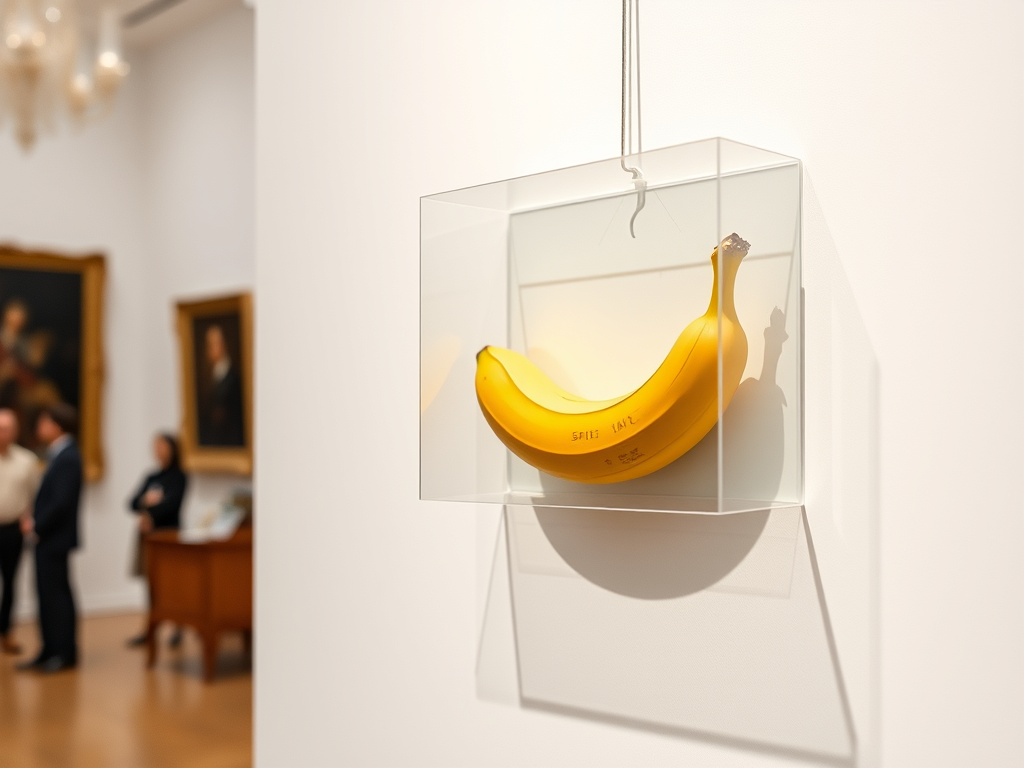

Over the past week, auction houses showcased approximately 1,600 works spanning Impressionist, modern, and contemporary art. However, the standout moment came not from a traditional masterpiece but from a conceptual work: a $6.2 million banana. Comedian, created by Maurizio Cattelan, turned into an unexpected spectacle at Sotheby’s, drawing a crowd of over 300 and earning the dubious honor of being the world’s most expensive fruit. Meanwhile, more conventional artworks often struggled to garner even a single bid.
Despite the overall lukewarm atmosphere, there were moments of note. Hedge fund billionaire Kenneth C. Griffin was identified by art-market insiders as the buyer of René Magritte’s 1954 Surrealist painting The Empire of Light, which sold for an impressive $121 million. Griffin’s representative declined to comment on the purchase. Another high-profile sale included Claude Monet’s serene water lilies painting from the 1910s, fetching $65.5 million, with its consignor a prominent figure in the beauty industry. While smaller auctions with lower estimates occasionally sparked competitive bidding, the broader market mood remained subdued.
This cautious tone reflects a deeper decline in the auction market, which has struggled to regain its peak momentum from 2022. That year’s fall sales were propelled by a pent-up supply of masterpieces delayed by the pandemic, resulting in a record $3.2 billion in sales. By comparison, this year’s combined revenue from Sotheby’s, Christie’s, and Phillips reached $1.3 billion—a 40% drop from November 2023 and a stark 60% decline from the 2022 peak.

The slowdown is largely attributed to a shrinking supply of high-value works. Collectors are hesitant to sell amid economic uncertainty during an election year, and the pandemic-driven sales boom left fewer exceptional pieces in circulation. By the end of the week, art analysts acknowledged the results as underwhelming yet not catastrophic.
Roman Kräussl, a professor at London’s Bayes Business School specializing in art markets, summarized the situation: “For over a decade, the art market has remained stagnant, independent of changes in stock prices, interest rates, or inflation. It seems to have lost its energy, its hype, and its must-have allure.”
The week’s auctions offered a revealing glimpse into the current dynamics of the art world. Here are four key takeaways:

The ‘Trump Bump’ That Didn’t Happen
Some experts anticipated a surge in art market activity following the U.S. presidential election, similar to the rally observed in stocks, cryptocurrencies, and the dollar after Donald Trump’s previous victory. However, these hopes largely fell flat.
Although there were highlights, such as Sotheby’s and Christie’s estate sales for Sydell Miller and Mica Ertegun, bidding generally remained restrained, with most artworks selling within expected ranges. A notable disappointment was a Henri Matisse portrait from the 1920s, which failed to attract a single bid despite a $12 million low estimate.
The presidential election’s influence on the art market appeared minimal, though the cryptocurrency market’s rally did inspire interest in certain pieces. Maurizio Cattelan’s banana drew seven bidders, including the eventual buyer, 34-year-old entrepreneur Justin Sun, and other crypto investors. One underbidder, Bob Liu, cited his investment group’s recent gains as motivation for participating.
Despite these pockets of enthusiasm, traditional art-world insiders noted little evidence of a broader market boost. “Stock prices had already accounted for expected rate cuts under Biden,” said Wendy Cromwell, an art adviser. “Buyers remain selective, gravitating toward standout pieces while others see lackluster results.”
Masterpieces Shine, Others Struggle
Amid market uncertainty, sellers were cautious, resulting in fewer blockbuster offerings. Only seven works exceeded $20 million, compared to 24 in the same period last year.
Philip Hoffman, founder of the Fine Art Group, explained, “The current climate makes sellers wary. I wouldn’t advise anyone to sell unless they urgently need liquidity.”

Sotheby’s faced challenges in securing top-tier consignments due to a recent overhaul of its commission structure, which, while beneficial to buyers, limited specialists’ ability to offer favorable terms to sellers. This allowed Christie’s to secure the top consignment of the week: Magritte’s The Empire of Light. Its $121 million sale marked a historic moment for Magritte, making him the 16th artist to break the $100 million threshold at auction after a fierce 10-minute bidding war.
Another success for Christie’s was Ed Ruscha’s iconic 1964 gas station scene, which achieved $68.3 million—a new record for the artist.
Surrealism and Whimsy Take Center Stage
Auctions not only measure market health but also highlight shifting tastes. This week, surreal and playful works outperformed established powerhouses like Pablo Picasso and Jeff Koons. Late-period Picasso pieces, long considered overvalued by some, saw disappointing results, while several Koons sculptures fell short of their estimates or went unsold.

Conversely, whimsical and imaginative pieces gained traction. The French duo Les Lalanne, renowned for their animal-inspired sculptures, continued to captivate collectors. Their work, blending fine art and design, has grown in popularity since Claude Lalanne’s estate sale exceeded expectations in 2019.
Jodi Pollack, Sotheby’s co-head of 20th-century design, commented, “Les Lalanne’s creations are resilient to market corrections. Their work resonates deeply, offering a unique connection to humanity.”
This rephrased version retains the original ideas while using varied expressions and sentence structures.rket. “Speculators have stepped back,” said Caroline Sayan, an art adviser and former auction executive. Market veterans, she said, “felt there needed to be a recalibration in pricing. We’re definitely getting that.”




Leave a Reply