
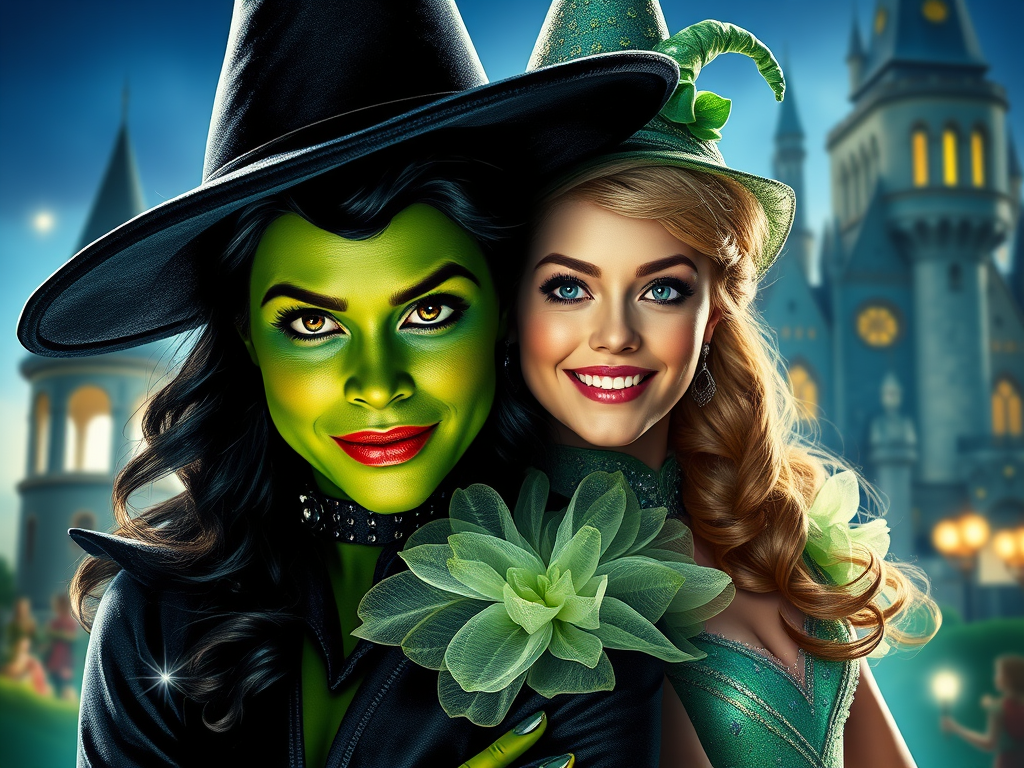

For over a century, The Wizard of Oz has captivated audiences with its enchanting elements, like flying monkeys and magical shoes. It has become a quintessential American myth, intertwining themes of good and evil, the comfort and monotony of home, the allure and freedom of the road, the dangers of power, and the desire for transformation. The 1939 film starring Judy Garland is especially iconic, leaving a lasting imprint on American cinema. It has inspired filmmakers such as Martin Scorsese, David Lynch, Spike Lee, and John Waters, who famously described the Wicked Witch as “every bad little boy’s and girl’s dream of notoriety and style.”
One wonders how Waters would react to Wicked and its earnest, green-skinned heroine, Elphaba. Portrayed by Cynthia Erivo, Elphaba delivers a standout performance, serving as the emotional core of this vibrant yet uneven adaptation. The film is the first half of a two-part retelling of the Broadway musical, which debuted in 2003 and remains a powerhouse at the Gershwin Theater. The second installment is set to hit theaters in November 2025.
Much like the stage version, Wicked—with music and lyrics by Stephen Schwartz and a screenplay adapted by Winnie Holzman and Dana Fox—focuses on Elphaba and Glinda (short for Galinda), played by Ariana Grande with cheerful energy. The film opens after Elphaba, known as the Wicked Witch of the West, is declared dead. Dorothy is notably absent, but Glinda the Good leads with the song “No One Mourns the Wicked” before diving into a flashback of their shared history, centered on their time at Shiz University, a picturesque campus reminiscent of a Disney castle.
Based on Gregory Maguire’s 1995 novel, the story reimagines Elphaba as a misunderstood figure rather than the villain she’s believed to be. Her journey reflects themes of alienation and acceptance, desire and morality. It begins in Munchkinland, where Elphaba grows up as the result of her mother’s infidelity and her father’s resentment. Her childhood, marked by isolation and her unique green complexion, shapes her into a brilliant yet melancholic figure.

Directed by Jon M. Chu, whose credits include Crazy Rich Asians and In the Heights, the film opts for grandeur with elaborate sets, numerous musical numbers, and dynamic visuals. However, the frenetic pace and visual overload can sometimes overshadow the story’s subtler moments. Despite these excesses, the film finds balance when Elphaba and Glinda begin to connect, their initial animosity giving way to an unlikely friendship. Grande brings humor to Glinda’s shallow, self-absorbed character, though her portrayal leans into stereotypes rather than subverting them.
The film’s charm lies in its connection to The Wizard of Oz. Familiar characters and vibrant musical sequences provide moments of delight. A subplot about talking animals, including Peter Dinklage as a goat professor, adds depth, and Elphaba’s heroic journey grows increasingly poignant. Erivo and Grande’s chemistry anchors the narrative, evolving from lighthearted banter to a moving tale of respect and friendship. While Dorothy had her loyal companions, Elphaba and Glinda find strength in each other.
Erivo’s portrayal of Elphaba is particularly compelling. Her character’s struggle with rejection and self-acceptance is captured through both her understated physicality and her emotionally rich singing voice. Early scenes, such as her spirited performance of “The Wizard and I,” highlight both her longing and resilience, evoking comparisons to Judy Garland’s wistful Dorothy.

At Shiz, Elphaba’s magical talents flourish under the guidance of Madame Morrible (Michelle Yeoh), and her bond with Glinda deepens. They both vie for the affections of Fiyero (Jonathan Bailey), a less-than-charismatic prince. In a pivotal moment, Glinda publicly embraces Elphaba, transforming the ridicule of their peers into admiration. While intended as an uplifting depiction of empathy, some may question Glinda’s motivations.
The original Wizard of Oz remains a masterpiece of Hollywood’s Golden Age, blending simplicity with cinematic brilliance. While its predominantly white cast reflected its era, subsequent interpretations, like The Wiz, reimagined the story with a more inclusive lens. This Wicked, however, leaves such discussions to the audience. As Ben Brantley noted in his 2003 review of the Broadway show, the story wears its political themes openly, and the film continues this tradition, setting the stage for the concluding chapter.




Leave a Reply