
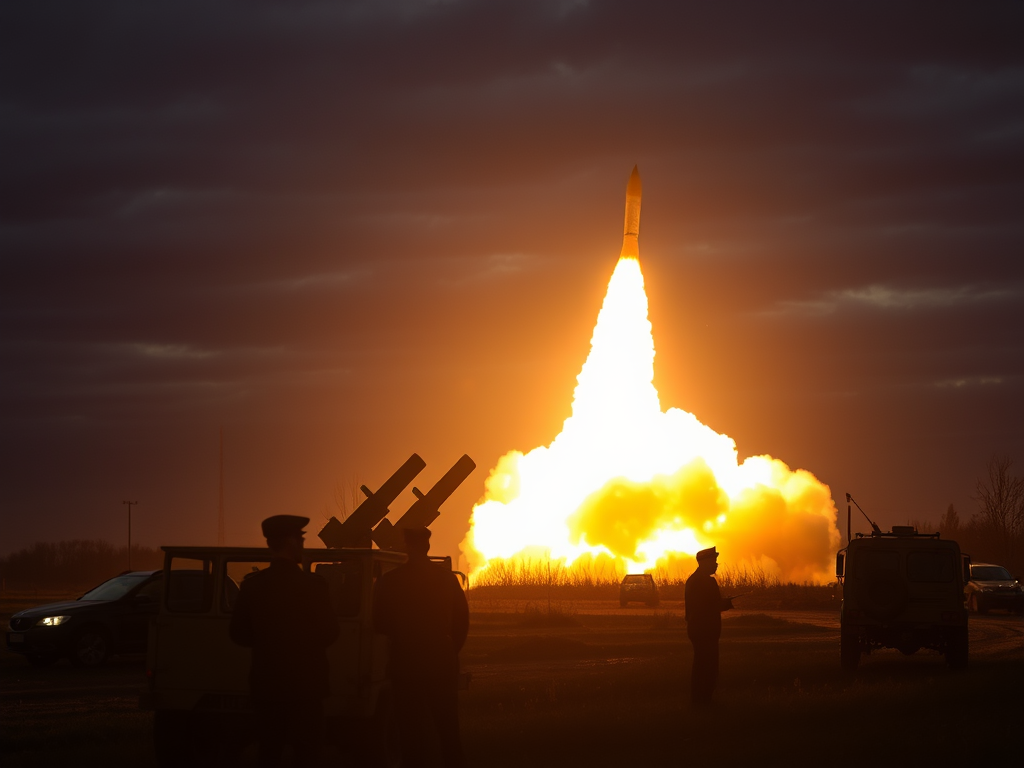

Ukraine employed American-made ballistic missiles on Tuesday to strike Russian territory for the first time, as confirmed by senior U.S. and Ukrainian officials. This significant move follows President Biden’s recent approval, signaling a major shift in U.S. policy.
The attack, which occurred before dawn, targeted an ammunition depot in Russia’s Bryansk region, according to Ukrainian sources. Russia’s Ministry of Defense reported that six Army Tactical Missile System (ATACMS) missiles were used in the strike. Senior American and Ukrainian officials, speaking anonymously due to the sensitive nature of the operation, confirmed the use of ATACMS.
This strike showcases Ukraine’s capability and determination to weaken Russia’s combat power, demonstrating to Western allies the value of supplying advanced weaponry. The timing coincided with President Vladimir Putin’s announcement of lowering Russia’s threshold for nuclear weapon use—a move seemingly aimed at signaling Moscow’s readiness to respond to such escalations.

Throughout the conflict, the Kremlin has leveraged the threat of nuclear deployment to deter Western nations from providing Ukraine with advanced arms. On Tuesday, Russian Foreign Minister Sergei Lavrov described the missile attack as an “escalation signal,” attributing it to Ukraine’s Western supporters.
Despite the high stakes, Ukrainian officials emphasize that no single weapon can decisively change the course of the war. Analysts suggest that the impact of this U.S. policy shift will depend on the number of missiles Ukraine receives.

Ukrainian President Volodymyr Zelensky had long requested the use of ATACMS for strikes inside Russia. The Biden administration’s approval came after months of deliberation, reportedly influenced by Russia’s bolstering of its forces with up to 10,000 North Korean troops.
The decision also comes just two months before President-elect Donald J. Trump assumes office, raising uncertainties about the continuity of U.S. military support for Ukraine. Trump has expressed intentions to seek a swift resolution to the conflict, potentially altering the current trajectory of U.S. policy.
On the battlefield, Ukraine faces challenges from Russia’s superior air power, artillery, and manpower. By targeting logistical hubs like the Bryansk depot, Ukraine aims to disrupt supply chains supporting Russian advances in southeastern Ukraine. The strike at 2:30 a.m. reportedly destroyed ammunition warehouses, causing secondary explosions, according to Ukraine’s General Staff.
Andrii Kovalenko, of Ukraine’s National Security and Defense Council, specified that the depot housed North Korean artillery shells, guided aerial bombs, and other munitions. Russia, however, claimed it intercepted five of the missiles and reported no casualties, though these accounts remain unverified.

Russia’s robust air defense systems, such as the S-400 and S-500, have been effective in countering similar threats. However, Ukraine has targeted these systems in occupied territories, including Crimea, using limited supplies of ATACMS with varying success.
As the war continues, both sides adapt to each other’s advancements. Security expert Jake Mezey noted that Russia is likely to improve its defenses against ATACMS over time. The missiles, initially supplied in October 2023 with limited range, were later provided with an extended range of 190 miles under strict usage conditions. Ukraine has simultaneously developed its own long-range capabilities to strike within Russia.

The Bryansk depot lies over 70 miles from Ukraine’s border, making it vulnerable to ATACMS strikes. Mykhailo Samus, a defense analyst, highlighted the potential of these missiles to target key Russian assets, including command centers and ammunition depots. However, he stressed that their effectiveness depends on the quantity and speed of delivery.
Despite these advancements, Ukraine’s military remains outgunned and faces ongoing shortages of artillery ammunition. The European Union recently met its goal of supplying one million rounds to Ukraine, albeit eight months behind schedule. Josep Borrell Fontelles, the EU’s foreign policy chief, noted that while substantial aid has been provided, Ukraine still receives only “just enough to hold.” Meanwhile, Russia continues to mobilize its economy for war, with support from allies like North Korea and Iran.



Leave a Reply