
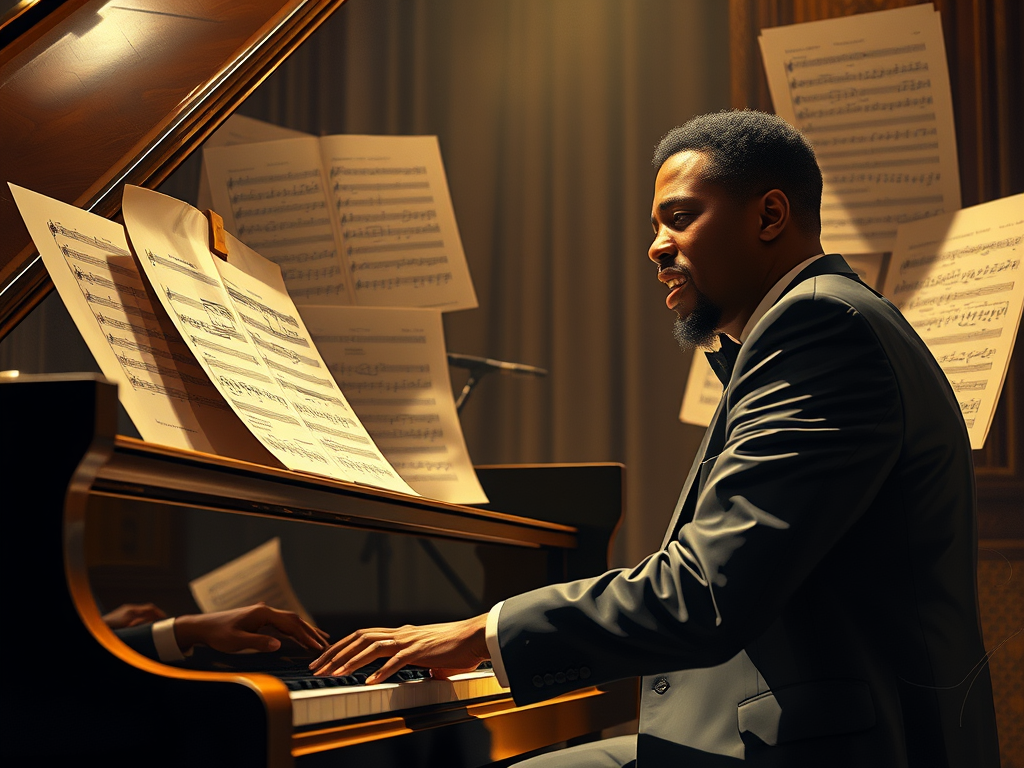

Before Jon Batiste became a celebrated bandleader, television personality, and Grammy- and Academy Award-winning artist, he was first a classical piano student.
Growing up in Metairie, Louisiana, he spent Saturday mornings at his teacher Miss Shirley’s house, practicing scales, arpeggios, and pieces by composers like Bach and Debussy.
“I wasn’t the kind of student who practiced much at home,” Batiste admitted. “I’d leave my books in the foyer and only touch them during the next week’s lesson. The true beauty of the music didn’t resonate with me until much later.”

Now, at 38, Batiste is reconnecting with his classical roots through his new album, Beethoven Blues. The album showcases his unique improvisations on iconic works like Für Elise and Beethoven’s Fifth Symphony, alongside original compositions inspired by Beethoven, such as Dusklight Movement and Life of Ludwig.
For Batiste, the album is deeply personal. Recorded in just a day and a half at his Brooklyn home, it reflects his early experiences in New Orleans, where he began blending the works of Chopin and Bach with his own creations as a teenager, performing at venues like the Maple Leaf Bar.
“This is my life,” Batiste explained. “Living with music, exploring it, and having a dialogue with both the music and its composers.”
During a recent session at Electric Lady Studios in Greenwich Village, Batiste joyfully improvised on classics like Debussy’s Clair de Lune and Chopin’s Fantaisie-Impromptu. When he turned to Beethoven, he added touches of gospel and blues to the Moonlight Sonata. “This one’s profound,” he remarked.
In a recent interview, Batiste reflected on his beginnings as a pianist, Beethoven’s connections to African rhythms, and the sometimes restrictive nature of classical music. Here are highlights from the conversation:
On discovering classical music:
Born into a family renowned for New Orleans jazz, Batiste ventured into classical music at age 11. By 14, he had formed his own band, frequently performing in spaces like nightclubs or practice rooms. “Sometimes I’d come straight from a recital or lesson and incorporate what I’d learned into my performances,” he said.
On early influences as a piano student:
At Juilliard, Batiste studied with William Daghlian, dedicating a year to Brahms’s Ballade No. 1. “It wasn’t about the notes but the nuances,” he said. “The score is just a map. You have to go beyond it to uncover the music’s soul and science.”
On blending genres:
“The turn of the 20th century was a time when European classical traditions mixed with the music of Black Americans and immigrant communities to form a new cultural identity,” Batiste said. “That fusion inspires me — the reverence for skill, but also the originality.”


On creating a classical album today:
Batiste described how classical music often feels inaccessible due to its rigid reverence. “Why do we separate ourselves from its beauty? Creative transformation lies in engaging with it,” he said. His goal is to make classical music feel inclusive, creating something “for everybody.”


On Beethoven’s African influence:
Batiste highlighted the polyrhythms in Beethoven’s compositions, noting that his work often embodies the blues before the genre was formally recognized. “There’s a universal human condition in his music,” Batiste said. “The greatest artists express truths even before they’re named.”
On choosing music for Beethoven Blues:
The album aims to inspire connection. “Everyone knows someone who’s played a version of Für Elise at a party — wrong notes and all. It’s beautiful because it invites participation,” Batiste said. Tracks like 5th Symphony in Congo Square merge Beethoven’s rhythms with the cultural vibrancy of New Orleans.
On spontaneous composition:
Batiste believes improvisation — a cornerstone of jazz — should also thrive in classical music. “It’s about trusting that your artistic voice is refined enough to contribute something meaningful to the greats.”
On Beethoven’s reaction to Beethoven Blues:
“He’d think, ‘This is incredible,’” Batiste said with a smile. “But ultimately, it’s not about what he would think. It’s about the legacy we leave — how we contribute to the greater good of humanity. Beethoven did his part. Now it’s our turn.”




Leave a Reply