
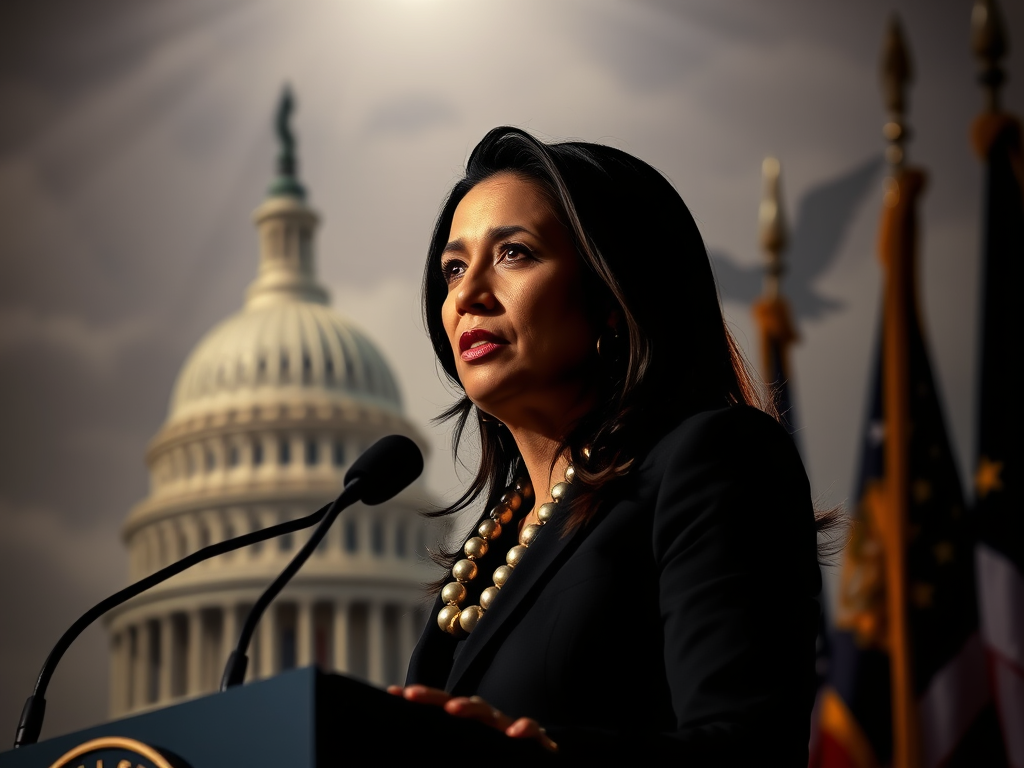

In 2017, while serving as a Democratic member of Congress, Tulsi Gabbard traveled to Syria, where she met the nation’s authoritarian leader, Bashar al-Assad. During this time, she accused the United States of supporting terrorist groups in the region.
The day after Vladimir Putin launched a full-scale invasion of Ukraine in 2022, Gabbard attributed the conflict to U.S. and NATO policies, claiming they provoked the war by disregarding Russia’s security concerns.

Subsequently, she suggested that the U.S. covertly collaborated with Ukraine on dangerous biological research and bore responsibility for the September 2022 bombing of the Nord Stream gas pipeline connecting Russia to Germany. U.S. officials and European investigators have since attributed the sabotage to Ukrainian operatives.

Gabbard’s remarks have drawn sharp criticism from across the political spectrum in Washington, with many accusing her of echoing anti-American propaganda favored by the nation’s adversaries. Her comments have also earned her significant attention from Russia’s state-controlled media, which has amplified her views. Most recently, she caught the eye of President-elect Donald J. Trump, who last week appointed her to oversee the nation’s 18 intelligence agencies and departments as director of national intelligence.
This appointment has alarmed national security experts, who highlight Gabbard’s lack of intelligence experience and her alignment with disinformation narratives often promoted by the Kremlin. Despite no evidence of direct collaboration with Russian intelligence, analysts suggest her views align closely with Russia’s geopolitical stance, particularly in opposing U.S. military intervention.

Russian media has celebrated Gabbard’s nomination, even as the Kremlin remains cautious about U.S. policy under a second Trump administration. Publications such as Komsomolskaya Pravda have praised her, calling her a perceived ally of Moscow. Russian state broadcaster Rossiya-1 referred to her as a “comrade” in Trump’s emerging cabinet, emphasizing her interest in improving U.S.-Russia relations.
Jonathan Teubner, CEO of FilterLabs, an analytics firm that monitors media narratives, observed that Gabbard represents a stark break from the post-Cold War U.S. foreign policy consensus. He noted, “For Russia, she embodies the changes they hoped to see in American leadership.”

Critics of Trump’s decision argue that Gabbard’s appointment could undermine U.S. national security. Ruth Ben-Ghiat, a historian at New York University, described the move as a sign of alignment with Putin’s worldview, warning that it could jeopardize the country’s intelligence operations.
In response to questions about Gabbard’s pro-Russia rhetoric, Trump’s transition team referred to the president-elect’s earlier statement, describing her as bringing a “fearless spirit” to her new role.

If confirmed, Gabbard would oversee intelligence agencies that monitor and counter Russian disinformation—an ironic twist, given her alignment with Kremlin narratives. Her confirmation faces significant hurdles in the Senate, where bipartisan concerns have been raised over her views on Russia and Ukraine.
Trump’s choice reflects his distrust of intelligence agencies, a stance he held during his first administration. Gabbard’s perspectives suggest she shares this skepticism, particularly regarding Russia and U.S. involvement in Ukraine.

Gabbard’s evolution in politics has been dramatic. Once a Democratic presidential candidate in 2020 who endorsed Joe Biden, she has since broken with her party, embracing a worldview critical of American military power. She joined the Republican Party in 2024 and campaigned for Trump, praising him as a leader committed to peace.
Her military background, including tours in Iraq and Kuwait, has heavily influenced her political positions. However, her outspoken critiques of U.S. policies, particularly on Ukraine, have made her a polarizing figure domestically and a prominent voice in Russian media, which frequently amplifies her statements.
As director of national intelligence, Gabbard would have significant influence over the daily intelligence briefings prepared for President Trump, potentially shaping how intelligence aligns with his views. Despite the controversy, her nomination marks a pivotal moment in her career, positioning her at the center of U.S. intelligence operations during a period of heightened geopolitical tension.




Leave a Reply