
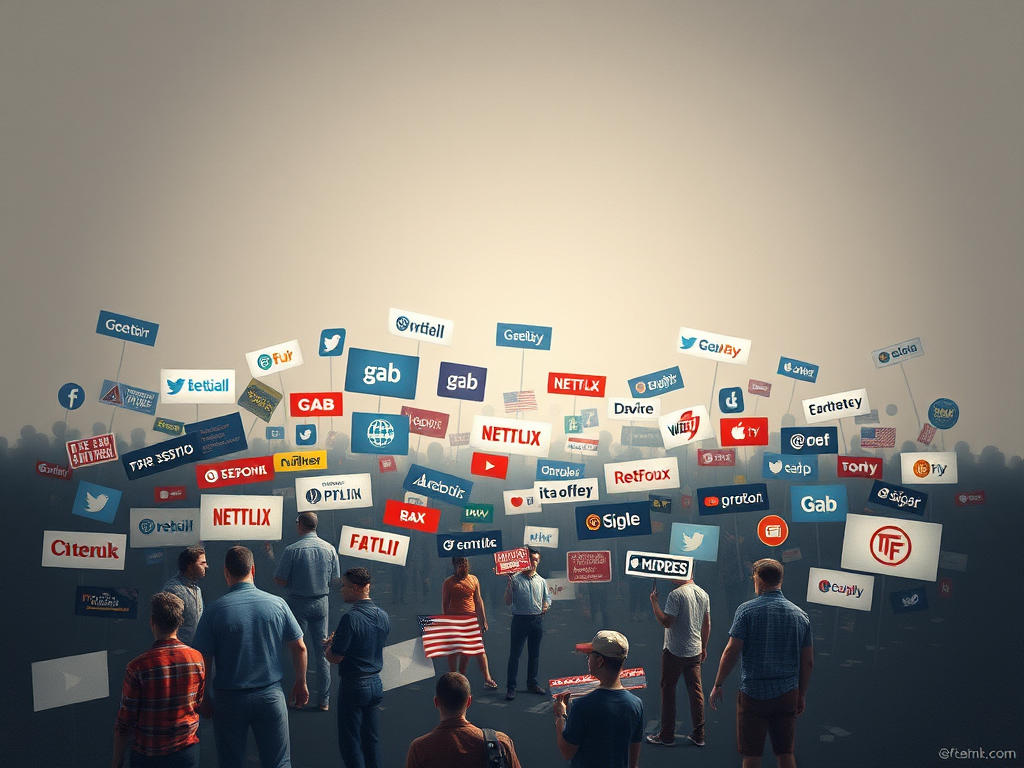
Earlier this month, following Donald J. Trump’s victory in the presidential election, his supporters flocked to various online platforms to celebrate.
Truth Social, the social network owned by Mr. Trump, saw hundreds of thousands of posts praising his win. On X, the platform formerly known as Twitter and owned by Elon Musk, speculation about the new administration’s plans ran wild. Meanwhile, right-leaning platforms like Gab and Parler were inundated with memes glorifying Mr. Trump’s success.

In stark contrast, no equivalent digital spaces existed for left-leaning voices. Platforms such as Meta’s Instagram, Threads, and Facebook had scaled back their focus on political content ahead of the election, while X had shifted to favor right-wing narratives. No other tech companies had stepped in to create a prominent online hub for liberals.
“This has created a noticeable gap for the Democrats,” said Phillip Walzak, a political consultant based in New York. “The absence of comparable platforms leaves Democrats at a considerable disadvantage.”
The election underscored a broader trend: social media has increasingly shifted towards the right. While platforms like Facebook, Instagram, and TikTok remain popular for entertainment and lighthearted content, online political discussions have migrated predominantly to right-wing spaces, fostering deeply partisan conversations.

This shift was largely an unintended outcome of decisions made by major social media companies nearly four years ago. After the January 6, 2021, attack on the U.S. Capitol, platforms like Facebook and Twitter banned Mr. Trump and many far-right groups. In response, conservatives, decrying these actions as censorship, migrated to or launched their own platforms. By the time mainstream platforms reinstated Mr. Trump and other right-leaning figures, these alternative platforms had significantly bolstered their followings and influence.
This shift has left the Democratic Party at a strategic disadvantage, especially as Republicans are poised to control the House, Senate, and presidency. Within Democratic circles, some strategists have discussed the lack of digital tools to amplify their agenda. Others have lamented missed opportunities to establish a Democratic equivalent to platforms like Truth Social.
The disparity became glaringly evident on November 5, when Vice President Kamala Harris and Mr. Trump both encouraged voter turnout via social media. According to a New York Times analysis, Mr. Trump’s posts consistently outperformed Ms. Harris’s in terms of likes and shares. For instance, his most popular post on Facebook garnered nearly 160,000 likes and over 15,000 shares, compared to Ms. Harris’s 18,000 likes and 1,500 shares. On Instagram, Mr. Trump’s post with his signature “Make America Great Again” slogan received over 2.1 million likes, while Ms. Harris’s post celebrating Gen Z voters earned 569,000 likes. On X, Mr. Trump’s call to vote surpassed one million likes, far outpacing Ms. Harris’s 318,000 likes.
Joan Donovan, an assistant professor at Boston University and founder of the Critical Internet Studies Institute, highlighted the challenge Democrats face on these platforms. “The right was intentional in carving out their own digital spaces,” she explained. “It was a calculated effort to align their political movement with specific platforms.”

Meta, Truth Social, Parler, and X either declined to comment or did not respond to requests for statements. Andrew Torba, CEO of Gab, affirmed the right’s commitment to these platforms, stating, “We will continue to use our own tools to mobilize, and nothing can stop us.”
The rise of right-wing platforms traces back to the post-January 6 era. Platforms like Gab and Parler marketed themselves as conservative-friendly spaces after Facebook and Twitter suspended accounts associated with the Capitol riots and the “Stop the Steal” movement. Gab experienced an 800% traffic surge and doubled its user base to 3.4 million within a year. In February 2022, Trump Media debuted Truth Social, further expanding the ecosystem of right-leaning platforms.
Meanwhile, Meta reduced its emphasis on political content. Starting in January 2020, CEO Mark Zuckerberg initiated steps to minimize politics on Facebook, later dismantling teams focused on election integrity and removing tools for tracking misinformation. In early 2024, Instagram and Threads reiterated their intent to steer clear of political content. At the same time, Elon Musk’s acquisition of Twitter—and its rebranding to X—marked a shift towards supporting Mr. Trump’s agenda. Musk’s own X account, the platform’s most-followed, has played a pivotal role in shaping the conversation.
This realignment has driven many left-leaning users away from X. Among the notable departures are former CNN anchor Don Lemon and The Guardian newspaper. Platforms like Bluesky and Mastodon have emerged as alternatives, with Bluesky gaining over a million users since the election, bringing its total to 15 million. Representative Alexandria Ocasio-Cortez recently praised Bluesky as a “welcoming space” and stressed the importance of fostering humane conversations to counteract authoritarianism.
Despite these efforts, Phillip Walzak sees a critical gap. “There’s still no dedicated space for Democratic supporters to thrive online,” he noted. “Without a platform that matches the current infrastructure supporting Republican causes, the left remains at a significant disadvantage.”



Leave a Reply