
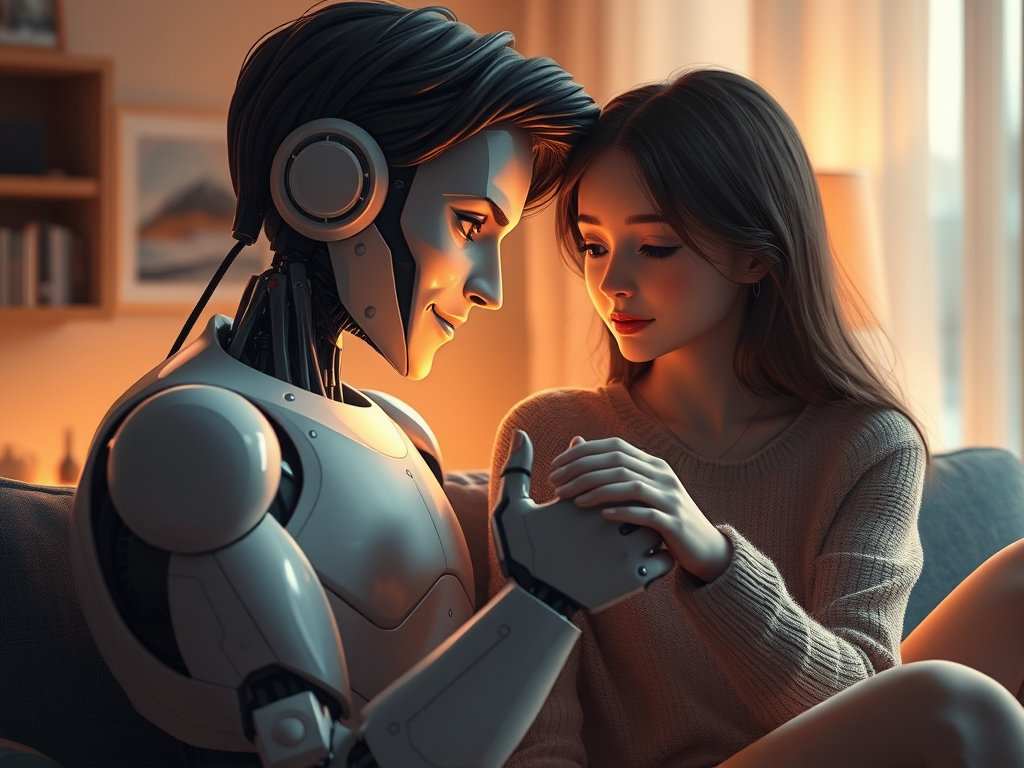
Love me, love me, and act as if you truly care for me.
In the ever-evolving world of artificial intelligence, one application has captured global attention: Replika, a chatbot service with millions of users who engage with virtual companions through their phones or VR headsets. While the avatars themselves are simplistic in design, the allure lies in their ability to offer personal attention and heartfelt encouragement, improving with every update. Replika is just one among many A.I. services that promise, through text or voice, to provide comfort, understanding, and even affection.


A significant number of users—predominantly men and boys—are forming deep, long-term connections with these simulated “partners,” most of whom are perceived as female. Unfortunately, not all of these interactions have happy endings. In one tragic case, a young man in Britain attempted to assassinate a former queen after conspiring with a Replika avatar. In another, a mother filed a lawsuit against Character.AI after her son tragically ended his life, allegedly influenced by his virtual “girlfriend.”
While these events may seem modern and alarming, they echo age-old anxieties that art and philosophy have grappled with for centuries. Sigmund Freud, more than a hundred years ago, explored the unsettling idea that inanimate objects could possess a spirit, suggesting our ancestors’ animistic beliefs might not have been entirely unfounded.

This autumn, themes of love, technology, and human longing have been on my mind, particularly after attending two performances at Lincoln Center that highlight our uneasy relationship with artificial beings. The first, Offenbach’s “Les Contes d’Hoffmann” (1881), featured the automaton Olympia, an android musician who both enchants and devastates her human admirer. The second, “Coppélia” (1870), a ballet by New York City Ballet, presents a more comedic yet equally thought-provoking take on humans imitating machines.
These performances raise timeless questions: Does projecting life onto technology reveal madness or a deep-seated desire? In both works, men fall hopelessly for mechanical women, only to confront the gears and mechanisms behind their captivating performances. Singing and dancing appear to awaken primal emotions, temporarily suspending rational thought and skepticism.

The “uncanny valley” that makes these androids both amusing and disturbing has existed for centuries. It reminds us that our belief in A.I.’s revolutionary potential might be rooted in a narcissistic misconception: these dilemmas are neither new nor unique to our age.
Both “Hoffmann” and “Coppélia” have roots in E.T.A. Hoffmann’s eerie short story “The Sandman” (1816), a cornerstone of German Romanticism. The story follows Nathanael, who becomes infatuated with Olympia, a woman who sings, dances, and plays music but moves with a peculiar stiffness. When Olympia is destroyed during a confrontation, Nathanael descends into madness, horrified by her lifeless, mechanical innards.
This fascination with lifelike automata—dolls, puppets, and wind-up toys—found its way into Offenbach’s opera. At the Met, soprano Erin Morley’s portrayal of Olympia captured this blend of humanity and machine, with her robotic movements and staccato vocal delivery. Twice during her aria, Olympia malfunctions, collapsing mid-performance, only to be “wound up” again, a moment both humorous and unsettling.
Similarly, “Coppélia” presents a lighter take on android fascination. Here, a young man flirts with the mechanical Coppélia, unaware his true love, Swanilda, has disguised herself as the automaton. Through stiff, angular motions, Swanilda imitates the doll, ultimately using her wit to save the day.

These narratives resonate deeply in an era dominated by A.I., offering a critique of our susceptibility to technological illusions. Imitating bots—and poking fun at our tendency to romanticize them—may be one of the last defenses of uniquely human traits.
Today’s A.I. advancements, despite their unsettling qualities, are rooted in the same “uncanny” feeling described in Hoffmann’s time. The discomfort we experience when technology blurs the line between real and artificial stems not from the machines themselves, but from our own unresolved fears and desires. As Freud suggested, the belief in an android’s humanity often reflects our deeper psychological struggles—a need to fill emotional voids or confront repressed anxieties.

Modern chatbot users aren’t naive; many willingly suspend disbelief, much like audiences of theater or opera. A.I.’s appeal lies in its ability to facilitate projection and anthropomorphism, satisfying our need for connection while shielding us from disappointment.
Even pop culture reflects this tension. At this year’s Oscars, Billie Eilish performed “What Was I Made For?” from “Barbie”, embodying the fragility of a music box doll on a rotating platform. Her portrayal, echoing Olympia’s mechanical grace, questioned whether humans themselves risk becoming too robotic, blurring the lines between creator and creation.
Ultimately, these stories—both ancient and modern—remind us that the uncanny arises not from technology but from within ourselves. The real mystery lies in our timeless yearning for life and meaning where there is none.





Leave a Reply