
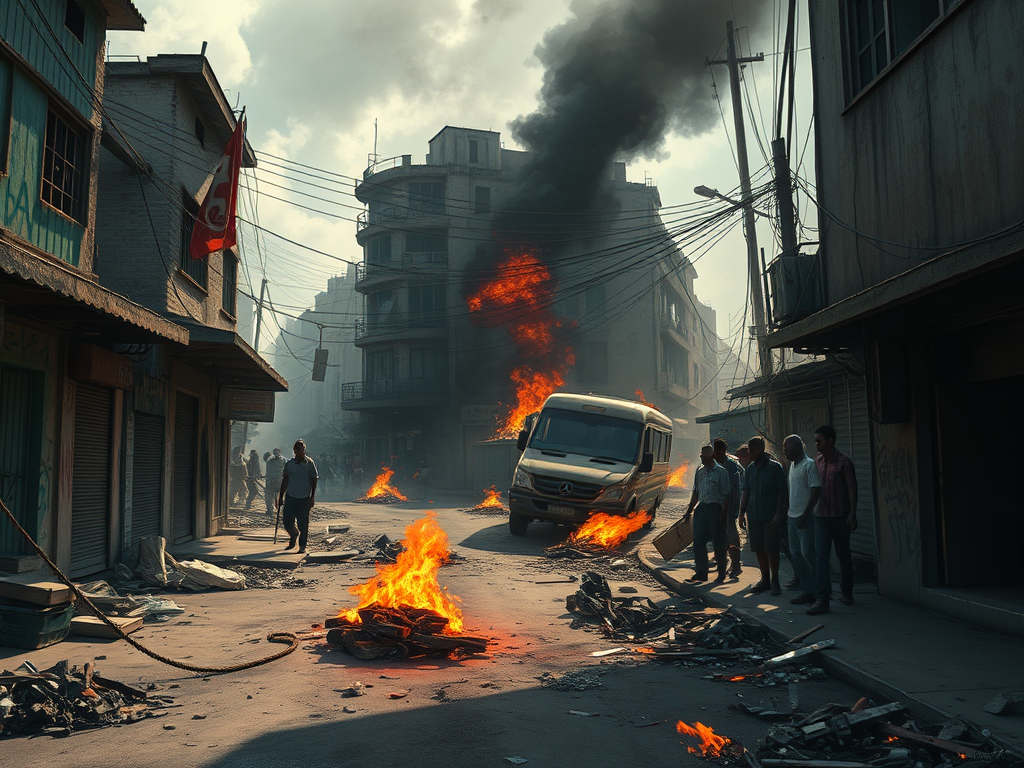

Haiti, a nation battered by gang violence and political instability, has faced a devastating year. In 2024 alone, the country has seen three different prime ministers, over 4,000 deaths, and such extreme gang aggression that its international airport has had to close twice.
Despite the U.S. investing $600 million in an international police force aimed at restoring order, last week’s surge in violence highlights the depth of the crisis. The Federal Aviation Administration (FAA) has even restricted U.S. aircraft from flying below 10,000 feet in Haitian airspace due to the threat of gang gunfire.

With yet another interim prime minister stepping in while gangs continue to gain ground, Haitians are desperate for relief. However, stabilization efforts are faltering, presenting a grave challenge as President-elect Donald J. Trump prepares to take office. Few have solutions to offer.
“I’m completely at a loss,” said Susan D. Page, a University of Michigan Law professor and former U.N. official in Haiti. “Everyone seems to be in shock.”

How did we get here?
Haiti’s current turmoil stems from more than 15 years of crises, marked by a catastrophic earthquake, mismanaged aid, failed international interventions, and flawed elections. In 2021, the assassination of President Jovenel Moïse exacerbated tensions. The U.S. played a significant role in appointing Ariel Henry as the next prime minister—a decision widely opposed by Haitians. Under Henry’s leadership, gang violence and kidnappings surged.

Rather than deploying American troops, the Biden administration supported a Kenyan-led international mission to bolster Haiti’s police force. However, in February, while Henry was in Kenya finalizing plans, rival gangs in Haiti united, unleashed chaos, and forced him to flee.
The violence left neighborhoods destroyed, civilians dead, and the main airport shut down for months. In response, Haiti, with U.S. and Caribbean assistance, formed a nine-member transitional presidential council. Garry Conille, a former U.N. official, was appointed interim prime minister, and the arrival of Kenyan forces in June briefly curbed gang activity.
Where do things stand now?
Last week, the transitional council dismissed Conille and appointed a new interim leader. In retaliation, gangs intensified their attacks, shooting at three U.S. aircraft and seizing more neighborhoods in Port-au-Prince. Videos circulated online show residents fleeing with children and luggage, as violence escalates to unprecedented levels.
Experts fear gangs could soon infiltrate the wealthier areas of Port-au-Prince, traditionally spared from violence, potentially leaving the entire capital under gang control.

What’s next?
The Kenyan-led Multinational Security Support mission (M.S.S.) has fallen short of expectations, with fewer than 400 officers, compared to the 2,500 initially proposed. Efforts to transform the M.S.S. into a U.N. peacekeeping mission, which would bring additional resources and funding, have been met with resistance. China and Russia, both with veto power in the U.N. Security Council, oppose the plan.
If the U.N. proposal fails, expanding the M.S.S. may be the only viable option. However, securing more funds from Congress remains a challenge, as Haiti’s crisis struggles to garner the same level of urgency as global emergencies like Ukraine.
Some experts believe negotiations with gangs may become unavoidable, though this path is fraught with challenges. Talks would require disarming and reintegrating gang members—many of whom are impoverished youth—into society through job training and education. Yet, meaningful progress in such discussions is unlikely until Haitian forces or the M.S.S. can dismantle the gangs’ leadership.
Addressing the root causes
Experts emphasize the need to cut off the flow of weapons from the U.S. to Haiti. Solutions such as arms embargoes or targeted sanctions on gang financiers are critical. Many Haitians also argue that resources should focus on strengthening their national police force rather than relying on foreign missions.
Vélina Élysée Charlier, a human rights activist, lamented, “We’ve wasted time, money, and energy that could have gone towards a Haitian-led solution.”
Meanwhile, Leslie Voltaire, president of the transitional council, expressed cautious optimism, citing plans for constitutional reform and presidential elections next November. However, he acknowledged the slow pace of international assistance.
“The road map is clear, but it’s extremely bumpy,” Voltaire said, adding that he hopes to see the Kenyan mission better equipped soon.
As the crisis deepens, the question remains: will international efforts evolve fast enough to address Haiti’s spiraling instability?


Leave a Reply