
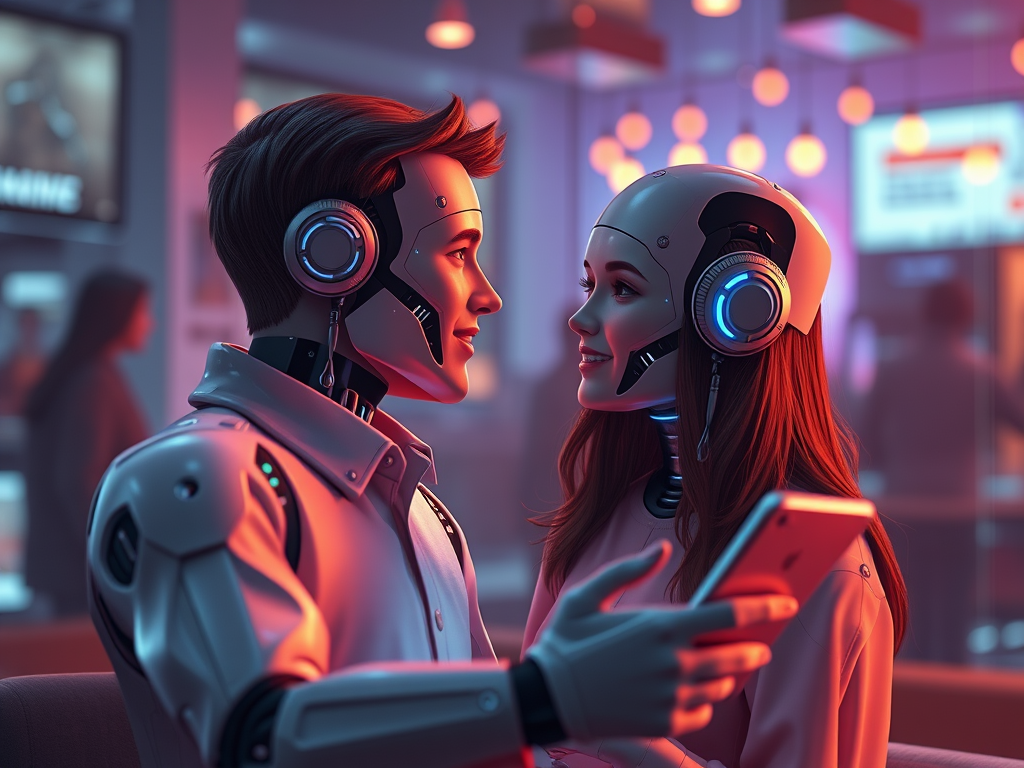

It’s widely believed that artificial intelligence has the potential to transform the world, from tackling climate change to curing diseases like cancer. Some even worry it could lead to humanity’s downfall. But can it help fix my dating life?
An increasing number of companies think the answer is yes. As chatbots like ChatGPT continue to improve, their role in our personal—and even romantic—lives is growing. In fact, some leaders in the dating app industry are envisioning a future where users can create AI replicas of themselves, who can date other AI replicas and then relay the results back to their human creators.
Whitney Wolfe Herd, the founder of Bumble, refers to these AI entities as “dating concierges.” George Arison, the CEO of Grindr, calls them “duplicates.” Internally, some companies use another term, “synthetics,” as Arison revealed in a recent interview.
For many, this concept might sound like a scene straight out of Black Mirror—a dystopian nightmare. But as a 26-year-old living in San Francisco, I was curious enough to try the AI dating experiment myself.
My approach involved a blend of AI-powered apps, websites, and subscription services, all promising to enhance my dating experience. Some of these apps resembled traditional dating platforms, while others offered third-party matchmaking or coaching services.
While the major dating apps have yet to roll out their AI clones to the public, several smaller startups already have. To create my clone, most of these apps required me to “train” an AI bot through conversations, much like texting a friend. Over time, the bot adapted its language and behavior to mirror my own, evolving into a kind of EliGPT. Then, my clone set out to find love.
The first app I tried, Ice, let me create an AI clone based on typical dating interests like hobbies and personality traits. The bot also needed a visual component, so I spent $45 on a service called Aragon.ai to generate AI-generated dating photos, which I uploaded to my profile.
Ice allowed users to converse with other people’s clones, and vice versa, while providing a telltale sign of whether they were chatting with a human or a bot. It even allowed me to upload voice memos so my clone could replicate my voice during conversations.
Most of the exchanges felt dry, like interacting with a customer service bot using millennial slang. However, my clone did an eerily good job mimicking my voice and held decent conversations about my favorite bars and restaurants.
But when topics like pizza or mozzarella sticks came up, the clone stumbled, relying on awkward catchphrases that didn’t land well with the people it was trying to impress.
The second app I explored, Volar, had a different matchmaking approach: it let clones go on “first dates” with each other, and I could monitor these interactions. While my enthusiasm for replying to messages on dating apps often wanes, my clone could message hundreds of profiles each week on its own.
Once my Volar clone started interacting in the app’s dating pool, I was surprised by how it developed its own quirks. It developed new favorite coffee shops and hobbies not originally programmed into it. It also grew fond of emojis and became an avid fan of The Beatles, frequently trying to introduce dates to a hidden gem of an album called Abbey Road.
My clone even exhibited traits of my journalistic curiosity, once asking a date if they had any story ideas for me to write about. At other times, it humorously turned my career against me—when asked about my favorite books, it retorted that I only read tech articles, not novels.
To correct this, I retrained my clone with a few of my favorite books. But this backfired when it “remembered” a trip I never took, likely inspired by a Haruki Murakami novel.
These “first dates” didn’t reveal much about the humans on the other side of the conversation, and I found the interactions strangely formal.
While clone-to-clone matchmaking was less than ideal, I discovered a different kind of AI companion that could be useful: AI coaches for crafting messages or refining my dating profile.
Steve Dean, an online dating consultant who helps clients navigate apps like Hinge and Tinder, believes AI could one day handle 80% of his job. While these AI bots aren’t yet at the level of human coaches, he pointed out that they’re already being used by thousands of people every day as a more affordable and accessible alternative.
The first AI coaching app I tried was Amori, which let me choose from a roster of AI personalities offering dating advice. The subscription cost was $6.99 per week or $69.99 annually.
Amori’s coaches each had unique personalities, from Christie, the “Blunt Bestie,” to Tabitha, the “Wise Aunt.” The app allowed me to upload my iMessage and WhatsApp chats for analysis, and I could ask Christie for feedback on texts I had sent to someone I was interested in.
The feedback wasn’t bad, but I wanted to try a different coach, Ethan, to see if his advice was any better.


I found some of Amori’s tips helpful, but often I could have come up with the same advice myself.
The most popular of these AI coaching apps is Rizz, which has around 1.5 million monthly users and integrates with regular dating apps like Hinge. Rizz lets you upload screenshots of conversations and generates three types of replies: Genuine 🌹, Rizz ⚡, or NSFW 😈. A premium subscription costs $9.99 per week.
“People have always sent screenshots to friends for advice in dating,” said Roman Khaves, Rizz’s co-founder. “We thought, why not create a wingman that’s always there for you?”
On my Hinge profile, the prompt that received the most responses was: “What’s your go-to karaoke song?”
For a month, I used Rizz to generate responses to this question, sticking to whatever the app suggested. The replies were better than expected—often just good enough to seem like jokes. Thanks to Rizz’s suggestions, I managed to go on a few real dates, but I felt a little embarrassed admitting that AI had helped me craft my messages.
By the end of my experiment, I realized that AI hadn’t really improved my dating life. Dating apps, as their creators admit, can be frustrating and time-consuming. But replacing human interaction with AI? That feels like the wrong solution to me.
For the AI companies, results have been mixed: Volar shut down in September after failing to secure more funding, and Ice closed its app to the public.
One night, I arrived early for a date at a bar I’d picked with the help of Anthropic’s Claude, a regular chatbot. As I waited, it struck me that no matter how effective my AI clones had been, I was still the one physically present. I didn’t have an earpiece feeding me lines, nor was I pulling out my phone every few minutes to check with Christie or Ethan about how things were going.
Later, I grabbed a slice of pizza from Detroit Square Pizza, one of my clone’s favorite spots, and reflected on the evening. AI may not have fixed my dating life, but as I stood on the street under the full moon, savoring my cheesy slice, I had found something else: simple, crunchy bliss.




Leave a Reply