
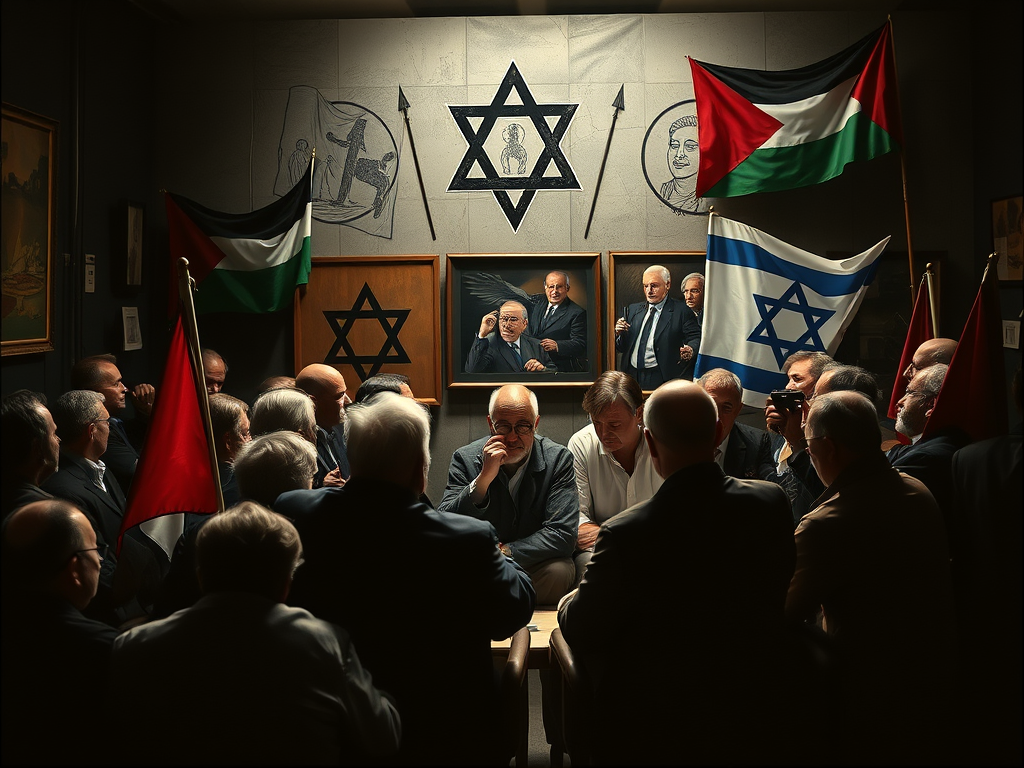

The owner of the renowned Artforum journal dismissed its chief editor after they published an open letter supporting “Palestinian liberation,” which triggered resignations and a boycott by writers and artists. Additionally, a prominent Hollywood agent resigned from their position at Creative Artists Agency after sharing social media posts that described Israel’s military actions in Gaza as “genocide.”
The interim CEO of a San Francisco art museum resigned after facing backlash from artists and employees who demanded divestment from Israel. She described the response as “vitriolic and antisemitic attacks” directed at her personally. Last month, the long-serving head of PEN America also stepped down, after facing criticism from authors who accused the organization of not taking a strong enough stance against Israel’s actions. Some critics, including those within the Jewish community, blamed the former CEO for her ties to Zionism and imperialism.
The war’s impact has reverberated throughout the arts and culture sector, affecting movie productions, museums, book festivals, and academic institutions, sparking debates on what constitutes acceptable discourse on the conflict. Many observers believe that the narrowing of the debate since the October 7, 2023 Hamas attack on Israel, which resulted in over 1,200 deaths and prompted an Israeli military response killing tens of thousands in Gaza, risks undermining the arts world’s commitment to free and open expression.
Jonathan Zimmerman, a history professor at the University of Pennsylvania, expressed disappointment, saying he hoped the events of October 7 would foster a consensus on liberal pluralism, but it did not materialize. At Penn, a Palestinian literary festival held weeks before the attack led to a donor backlash, and the university’s president resigned after she was criticized for not addressing whether students calling for Jewish genocide should be punished.
The past year has shown a recurring pattern: Institutional leaders, such as executives and owners, have largely sought to suppress critical views of Israel, while lower-ranking employees and less prominent artists have pushed back against pro-Israel rhetoric. For instance, a bookstore employee in Brooklyn disrupted an event featuring a Zionist rabbi, and authors at the Albany Book Festival withdrew from a panel that included a pro-Israel speaker.
At the Noguchi Museum in Queens, three employees were fired for wearing kaffiyehs, symbols of Palestinian solidarity, after the museum implemented a policy prohibiting political clothing or symbols.
Naomi Firestone-Teeter, head of the Jewish Book Council, lamented the growing trend of disqualifying support for Israel in certain spaces. She noted how terms like “Zionist” and “Israeli” have increasingly become negative labels used to silence opposing views.
Cultural discourse, she argued, is being stifled. “We want to promote a diversity of voices, to foster dialogue and debate,” she said.
Musa al-Gharbi, a sociologist at Stony Brook University, observed that pro-Israel sentiments remain strong in cultural organizations, noting that the pro-Israel side is more organized in exerting influence on decision-makers.
This divide is also generational: Older Americans, who are more likely to hold senior positions in cultural institutions, tend to support Israel’s military actions more than younger Americans, who are often employed in lower-level positions. A Pew Research Center poll earlier this year found that nearly half of adults under 30 viewed Israel’s response to Hamas as unacceptable, compared to just 29% of those over 50.
In previous protest movements, students and artists opposed to the Vietnam War or South African apartheid often clashed with university administrations and large corporations, a dynamic that still plays out today in a less uniform manner.
At the Academy Museum of Motion Pictures, a Hollywood museum, objections from Jewish professionals led to revisions of an exhibition about Jewish founders of the film industry, particularly after the October 7 attack. In the same period, hundreds of Jewish actors, producers, and other industry figures condemned remarks made by director Jonathan Glazer, who criticized Israel while accepting an Oscar for his Holocaust film The Zone of Interest. However, some Jewish filmmakers defended Glazer.
At the 92NY cultural center in Manhattan, a series of events unfolded after the center postponed a talk by author Viet Thanh Nguyen in response to his criticism of Israel following the Hamas attack. This led several other writers to cancel their appearances in solidarity with Nguyen. Later, pro-Palestinian staff members at 92NY resigned after the institution introduced a policy barring employees from expressing political views.

Despite the backlash against such policies, 92NY defended its stance, calling it a broad policy meant to limit political advocacy in general.
The strong pro-Israel position in American cultural institutions can seem counterintuitive to many American Jews, who feel vulnerable amid rising antisemitism. After the October 7 attack, many Jewish cultural workers felt betrayed by colleagues who did not denounce Hamas’s actions.
Lila Corwin Berman, a historian at Temple University, explained that the organized Jewish community’s strategic presence in various American institutions has helped it exert influence in these debates.
For those advocating for Palestinian solidarity, the challenge is the structural power imbalance. As Laura Raicovich, former director of the Queens Museum, pointed out, efforts to balance power between Israel and Palestine are often futile due to the disparity in influence.
This ongoing tension presents a dilemma for those in cultural spaces who wish to uphold open discourse while grappling with their support for Israel. Zimmerman, the Penn professor, emphasized the importance of embracing free and spirited debate, even if it means encountering uncomfortable or controversial expressions. “Our entire project is premised on free exchange,” he concluded.




Leave a Reply