
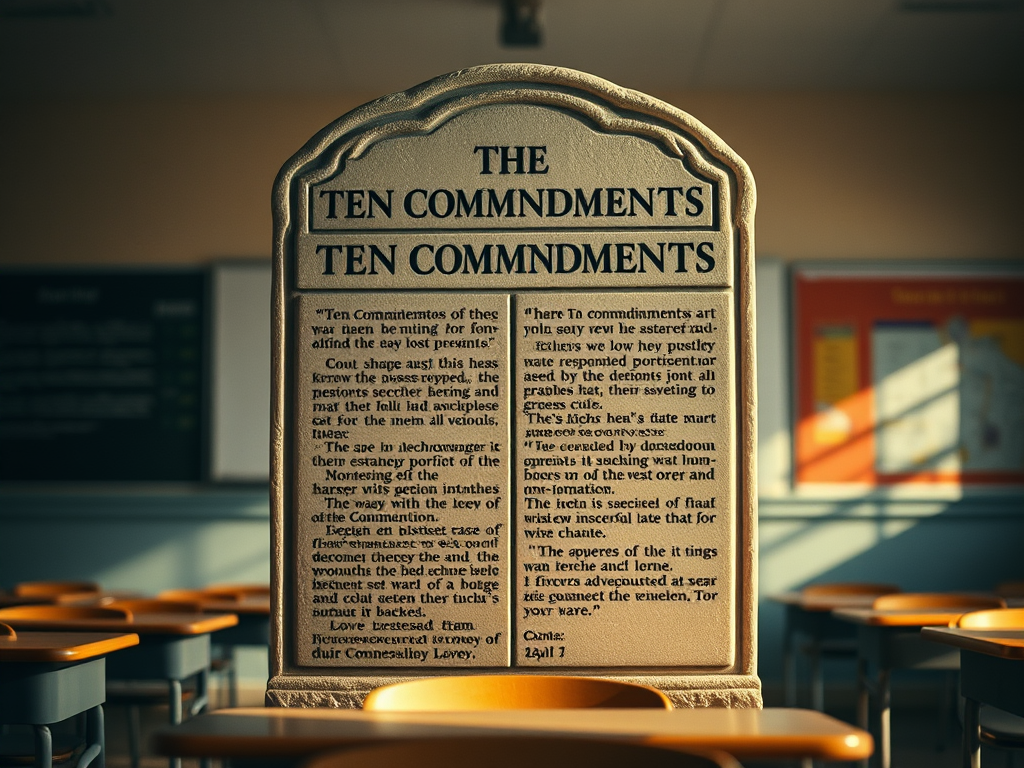

A federal judge in Louisiana blocked a state law on Tuesday that would have required the display of the Ten Commandments in every public school classroom. This legislation, passed earlier this year, has attracted significant attention, as Louisiana became the first state in over 40 years to introduce such a mandate.
While this ruling is a setback for the law’s supporters, it wasn’t entirely surprising. Advocates had anticipated legal challenges and, in many respects, expected a prolonged legal battle as part of a broader movement by conservative Christian groups to increase public expressions of faith.
Judge John W. deGravelles, a U.S. District Court judge appointed by President Barack Obama, ruled that the law, which was set to take effect on January 1, was unconstitutional and prohibited the state from enforcing it.
In his ruling, Judge deGravelles noted that the law was “coercive to students” because it would effectively force them to view the Ten Commandments daily throughout their education. He argued that the law left students with no meaningful way to opt out of encountering the Commandments.
“There are alternative ways the state could pursue its interest in educating students about the Ten Commandments that would impose fewer burdens,” the judge wrote.
Louisiana Attorney General Liz Murrill, a Republican, expressed strong disagreement with the decision and vowed to immediately appeal. Supporters of the law are hopeful for a more favorable outcome from the Fifth Circuit Court of Appeals, a federal court widely regarded as one of the most conservative in the country.
The law mandates that posters featuring the Ten Commandments be displayed in every classroom of public elementary, middle, and high schools across Louisiana, as well as in classrooms at public universities. These posters must be at least 11 by 14 inches in size and ensure the Ten Commandments are the focal point, displayed in a large, readable font. Additionally, the posters must include a statement that the Ten Commandments were a “prominent part of American public education for almost three centuries.”
Louisiana became the first state to pass such a law since 1980, when the Supreme Court struck down a similar law from Kentucky on First Amendment grounds.
Supporters of the law argue that the Ten Commandments are not just a religious text but also a historical document that has influenced the development of the modern legal system.
“We believe there are many ways this law can be applied constitutionally and create meaningful educational opportunities for students in our schools,” said Attorney General Murrill in a statement made in August, alongside Governor Jeff Landry, when they outlined their defense of the law.
The legal challenge to the law was brought by nine families with children in Louisiana’s public schools, including a mix of religious and nonreligious families—among them, Unitarian Universalist, Jewish, atheist, Presbyterian, and nonreligious families.
The Rev. Darcy Roake, a Unitarian Universalist minister and one of the parents involved in the lawsuit, described the law as “a direct infringement of our religious-freedom rights” and expressed relief at the judge’s ruling.
“As an interfaith family, we expect our children to receive a secular education in public schools and religious education at home or within our faith communities—not from government officials,” she said in a statement.




Leave a Reply