
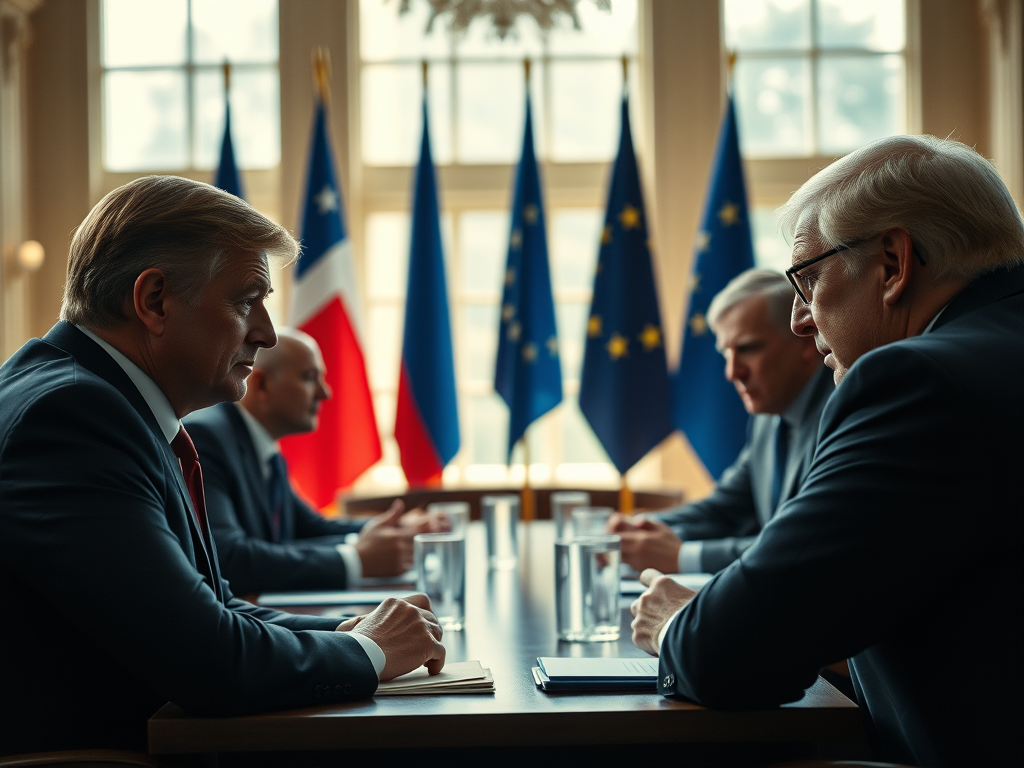

Donald J. Trump’s potential victory would challenge America’s European allies, testing their unity, encouraging them to bolster their military capacities, and prompting them to more vigorously safeguard their economic interests.
In preparation for such an outcome, European leaders have already initiated efforts to sustain support for Ukraine, ensure NATO’s stability, and plan responses if Mr. Trump enacts his proposed sweeping tariffs on U.S. imports.
However, Europe has considerable work ahead. A second Trump term could push Europe to become more self-reliant, though it is uncertain if the continent is ready to fully seize this opportunity. Political challenges in both France and Germany add to the difficulty of forming a unified response, and despite Mr. Trump’s first term and the ongoing war in Ukraine, Europeans have been slow to adapt.
“A Trump victory is challenging for Europe, as it raises a difficult question they have avoided: ‘How should we deal with a United States that increasingly views us as a competitor and inconvenience, rather than a partner?’” said Georgina Wright, deputy director for International Studies at Paris’s Institut Montaigne. “This should unite Europe, but unity isn’t guaranteed.”
Mr. Trump’s unpredictability, likely empowered by a Republican Congress, worries European allies. While his positions are sometimes clear, such as his skepticism of multilateral alliances, his admiration for Russian President Vladimir V. Putin, and his disdain for Ukraine’s President Volodymyr Zelensky, these stances add further uncertainty to European-U.S. relations, says François Heisbourg, a French defense analyst.

Europe will persist in maintaining communication with a potential Trump administration while also staying connected with American lawmakers supportive of NATO and the trans-Atlantic alliance.
Europe’s primary concerns are economic, security, and democratic in nature. In terms of economics, the European Union has considered strategies for handling a Trump presidency for months. E.U. officials have devised an offer to increase purchases of American goods to preempt new tariffs and prepared reciprocal tariffs if necessary.
Security is another pressing issue, especially with regard to Ukraine, as Mr. Trump claims he can end the war quickly, alongside his sporadic threats to withdraw the U.S. from NATO. Heisbourg credits Mr. Trump for prompting higher defense spending from Europe but notes that NATO’s collective defense Article 5 is not meant to be a “protection racket,” which Trump’s view of NATO might suggest.
A credible NATO depends on a solid commitment to Article 5, and some fear that Mr. Trump could undermine this commitment, which might encourage Russia to challenge NATO’s resolve.
Poland and other Central European countries, such as the Baltic nations and Hungary, enjoyed a productive relationship with Mr. Trump during his first term. Poland’s foreign minister, Radoslaw Sikorski, indicated in Warsaw that he maintains regular contact with Trump’s security advisers, urging that Europe must take greater responsibility for its security, primarily through increased defense investments.
Poland aims to strengthen Europe’s defenses, ideally with Britain, France, and Germany. However, as Heisbourg points out, the political struggles of the French and German governments could weaken Europe’s unified stance, with some nations possibly pursuing separate deals with Trump, as they did previously.
Despite Chancellor Olaf Scholz of Germany’s prioritization of ties with President Biden, Germany’s governing coalition has recently shown signs of internal division. This political instability risks portraying Germany as a problematic member in the European alliance.
The deeper issue, as noted by Jana Puglierin from the European Council on Foreign Relations, is that Europe must confront the possibility that Trump represents a structural change in America’s global role, marked by a pivot towards Asia and a growing reluctance to engage in global responsibilities. This upcoming election should serve as a wake-up call for Europeans.
Michael Link, the German government’s coordinator for trans-Atlantic relations, stated that Trump’s re-election would make it crucial to strengthen the E.U. and NATO’s European pillar. Link warned that Europeans cannot passively await Trump’s actions but must clarify expectations from the U.S., especially regarding NATO commitments and U.S. support for Ukraine, emphasizing that a Russian victory would ultimately empower China.

Concerns also extend to democratic values and the rule of law, with Mr. Trump’s admiration for authoritarian leaders like Mr. Putin, Hungary’s Prime Minister Viktor Orban, Israel’s Prime Minister Benjamin Netanyahu, and China’s President Xi Jinping.
Trump’s re-election could further fuel nationalist and protectionist trends among right-wing leaders in Europe, such as Hungary’s Orban, who advocates “illiberal democracy,” and Prime Minister Giorgia Meloni of Italy. Trump’s influence could inspire similar policies that restrict migration and emphasize protectionism.
With liberal values already facing challenges, Trump’s potential victory could intensify right-wing extremism in Europe, undermine the continent’s cohesion, and weaken its global influence.
“Promoting liberal values is significantly harder when the leader of the United States, the world’s largest democracy, openly questions them,” Wright observed.also concern about democratic values and the rule of law, and Mr. Trump’s evident admiration for those he considers strong leaders, like Mr. Putin, Prime Minister Viktor Orban of Hungary, Prime Minister Benjamin Netanyahu of Israel and President Xi Jinping of China.

Mr. Trump is seen as the standard-bearer for those populist center-right and right-wing leaders in Europe like Mr. Orban, who has established what he calls an “illiberal democracy,” as well as Prime Minister Robert Fico of Slovakia and Prime Minister Giorgia Meloni of Italy.
His victory is inevitably going to inspire them and encourage others to duplicate more nationalist and less liberal policies built on stopping unwanted migration and on protectionism.
Europe is already seeing a decline in support for democratic, liberal, progressive values and the rise of extremist parties on the right. Mr. Trump’s victory will embolden them and weaken Europe’s coherence and its voice.
“Spreading liberal values is a lot harder when the president of the largest democracy, the United States, openly contests them,” Ms. Wright said.




Leave a Reply