

Director Ridley Scott made one of his biggest career achievements with the film Gladiator, which starred Russell Crowe and won the Oscar for Best Picture 24 years ago. Now at 86, Scott’s pace hasn’t slowed; he sometimes directs two films a year.
His latest project, Gladiator II, continues the story two decades after Maximus, Crowe’s character, heroically perished in the arena. Lucius, played by Paul Mescal, is revealed as Maximus’s secret son, having grown into a skilled fighter in North Africa. A looming conflict led by the Roman general Marcus Acacius (Pedro Pascal) brings Lucius back to Rome, where Macrinus (Denzel Washington), a shrewd arms dealer, seeks to use him for personal gain.
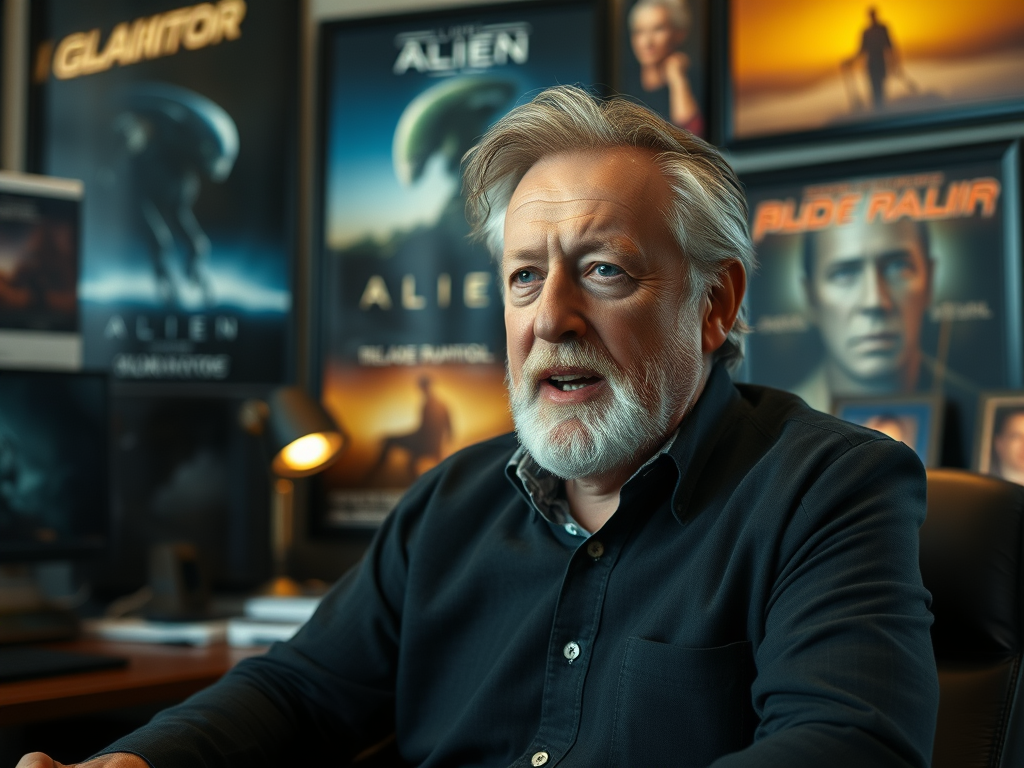
In October, I sat down with Scott in his Los Angeles office, where posters of some of his iconic films like Alien, Blade Runner, and The Martian adorned the walls. As he geared up for the Nov. 22 release of Gladiator II, he was already deep in preproduction for a Bee Gees biopic, slated to begin filming in February, and had started planning his next sci-fi adaptation.
“When I’m working on something like this, I feel alive,” he shared. “It’s not stress to me; it’s adrenaline, and that’s good for you.”
This interview has been edited for clarity.
After over two decades, what drove you to finally bring a Gladiator sequel to life?
[The first Gladiator in 2000] enjoyed growing popularity—initially well-received but later beloved, thanks to streaming platforms. Unlike films that disappear after release, Gladiator stayed relevant, so I kept hearing how much people loved it. That made me think, “We should do something more.”
It was obvious where the story could go. In many sequels, there’s no survivor or story continuation, but here we had Lucius, who had faded from the picture. So, we start with his journey, as a boy constantly on the run. It felt like a strong foundation.
After Gladiator’s success, did you consider sequels that could somehow include Russell Crowe?
Russell and I discussed it a couple of years later, and he said, “But I’m dead.” I suggested that in battle, there might be a way to bring him back from “the other side.” But he’d either need to be Maximus’s double or someone else.
At one point, Nick Cave even wrote a sequel script where Maximus was resurrected as a god’s envoy against Jesus Christ. That didn’t go forward.
Yes, it was a grand concept, very theatrical. Even Steven Spielberg, who advised on the original film, wasn’t sure about it, so I let it go.
What finally felt right about this new direction?
The enthusiasm for Gladiator never waned, so I wanted to respect that—and financially, if it’s done well, it’s a winning choice. I thought, “I’ll sit with this until we find the right path.”
When you chose Lucius as the focal point, many young actors were interested. Why did you pick Paul Mescal?
I first noticed Paul in Normal People and thought, “He looks like Richard Harris.” There was something in his profile. Casting is crucial; I’ve been fortunate to spot stars early, like Sigourney Weaver for Alien and Brad Pitt for Thelma & Louise. A good casting director is as essential as a good camera.
Paul hasn’t done a major studio film before. Did you feel he needed any adjustment?

Paul is very perceptive. I told him, “When you see the scale, you’ll adjust quickly.” When he saw the Rome set in Malta, I reassured him, “This is ours to create together.” He embraced it immediately.
Did you envision Denzel’s role specifically for him?
Not initially, but there’s a painting by Jean-Léon Gérôme that inspired me: a majestic, bejeweled Black figure. Denzel’s character has charm, cunning, and a hint of gangster.
Is Denzel easy to work with?
Denzel is intense and somewhat methodical. Even off-camera, he stays connected to his role.
Barry Keoghan was set to play a villain but had to withdraw. What happened?
Barry got involved in Saltburn. He’s incredibly talented, on par with Joaquin Phoenix. Like with Joaquin, it’s worth the challenge.
Joaquin almost dropped out of Gladiator. How do you convince actors like him to stay?

Sometimes, you become a friend or father figure. For Gladiator, we both had to adapt quickly.
It’s said that Paul Thomas Anderson helped with Napoleon. True?
Yes, while working on Licorice Pizza, he offered advice on Napoleon. We had a blast brainstorming together.
Reports say the Gladiator II budget exceeded $300 million. Was that due to the production halt?
No, we actually saved $10 million, completing it in 51 days. But we may have started too fast. I’m budget-aware and am embracing A.I. now.
Do you see A.I. impacting jobs?
Some roles may need rethinking. It’s tough, but adapting is necessary.
In retrospect, does Gladiator’s Oscar win feel like it reflects the success you envisioned?

I didn’t mind not winning Best Director; I was recognized elsewhere. It’s fulfilling just to be able to keep creating.
You’ve received Oscar nods for Gladiator, Black Hawk Down, and Thelma & Louise. Do you feel they’re the right films to represent your career?
I think so, though The Duellists deserved a nod too—it won at Cannes. But I avoid Cannes now.
Do you see a link between ancient Rome in Gladiator II and today’s political climate?
Absolutely. Our culture isn’t immune to similar cruelty and disparity. Rome’s brutality served as entertainment, a parallel that’s frighteningly relevant.
And yet, you acknowledge that wealth can generate opportunity. Does that complicate your view of society?
Indeed, billionaires often drive employment. But I can’t fathom why people are homeless in prosperous places like California. Perhaps higher taxes could help—yet is it the solution or poor governance?

Well, he has been directing.
Yeah. But they tend to be small.
You think he’ll scale upward?
Yeah. Though he may not because he’s always liked theater — he’s doing “Othello” on Broadway. He may prefer that because the bigger the film, more aggravation comes with it. You’ve got to be able to handle it.
Denzel may work less as an actor, but you don’t strike me as somebody who’s eager to wind down his career at all.
No, it’s crazy.
Your mother lived all the way into her mid-90s, right?
Yeah. She said to me, “This is ridiculous,” held my hand and died. Isn’t that great?




Leave a Reply