
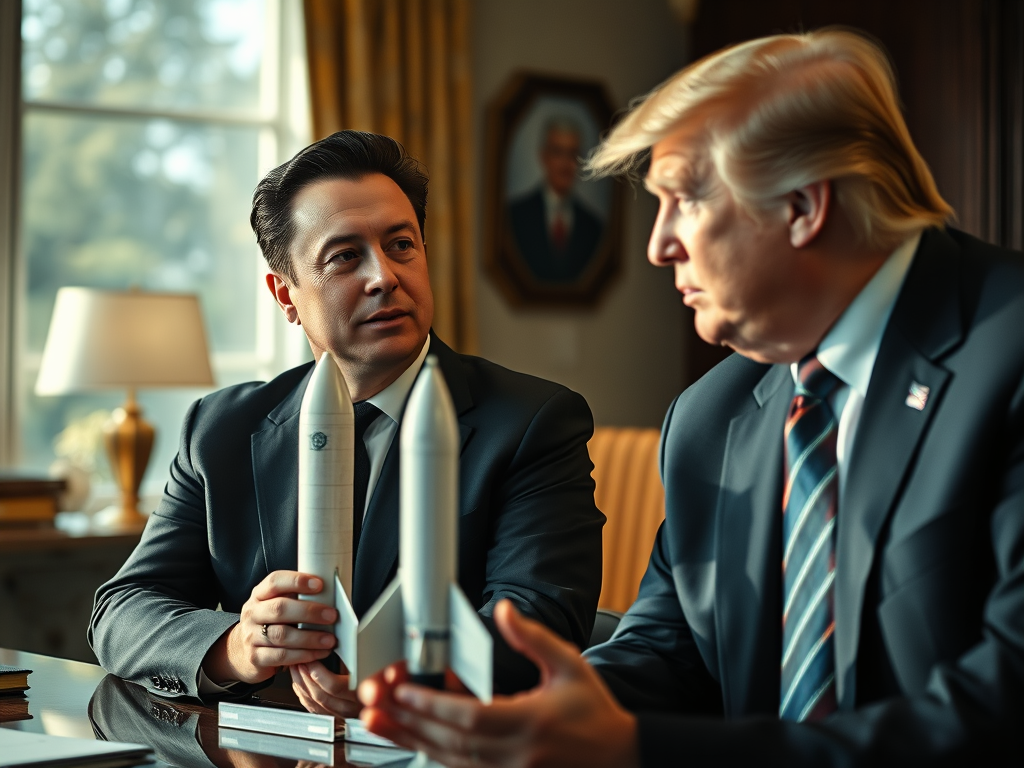

Before Donald J. Trump’s re-election, Elon Musk, one of his prominent supporters, approached him with a significant request for his upcoming presidential transition. Musk proposed that Trump bring in key employees from his space exploration company, SpaceX, to serve in high-ranking government roles, particularly in the Department of Defense, as reported by two people familiar with the discussions.
This request indicates Musk’s potential gains from his substantial contributions to Trump’s campaign, where he reportedly invested over $100 million, continuously promoted Trump’s platform on his social media network, X, and made several public appearances on Trump’s behalf, particularly in the swing state of Pennsylvania. Musk’s push to embed SpaceX personnel within one of the company’s largest clients, the Defense Department, illustrates his desire to place trusted allies in a possible Trump administration, despite the potential conflict of interest due to his extensive government contracts.
Representatives for Musk, SpaceX, Tesla, and Trump’s transition team declined to comment on Wednesday. Musk’s companies—six in total—are closely tied to various federal agencies, collectively benefiting from billions in contracts related to launching rockets, building satellites, and offering space communication services. Tesla alone profits significantly from emissions credits backed by federal policies and could be impacted by any shifts in government regulations regarding electric vehicles.
With Trump’s return to office, Musk could have direct influence over agencies regulating his companies, especially if Trump follows through on a pledge to appoint Musk to a government efficiency commission. This role would give Musk considerable sway, akin to his cost-cutting approach at X (formerly Twitter), where he reportedly aims to slash federal expenditures by at least $2 trillion. This arrangement may further reduce regulatory oversight on Musk’s enterprises, a prospect troubling to some experts who view it as undermining government checks on his influence.
Some analysts predict that under a Trump administration, Musk’s companies may face fewer investigations or regulatory challenges from the Department of Justice, as seen in Trump’s first term. Indeed, Trump’s views on electric vehicles have shifted since Musk’s endorsement, with Trump recently supporting electric cars, reversing his previous stance critical of government EV incentives.
As Musk’s net worth soared by $20 billion with Tesla’s stock rise post-election, his company stands to benefit from ongoing federal subsidies and credits for EVs and emissions, advantages that may continue under Trump’s administration. However, Tesla and SpaceX’s relationship with federal agencies extends beyond subsidies. For example, SpaceX secured $3 billion in federal contracts last year alone and has deep ties with the Department of Defense and NASA.
With backing from allies in Congress, Musk is already pushing for further government support, as seen in efforts to restore an $856 million broadband subsidy for SpaceX. This advocacy extends to influential figures like FCC commissioner Brendan Carr, who has publicly supported Musk on social media, even in disputes outside his regulatory domain.
SpaceX’s relationship with the federal government remains critical, especially with its reliance on Defense Department contracts. Some officials express concern over the Pentagon’s dependency on SpaceX for national security launches, a position Musk could leverage with Trump’s support.
Musk’s influence may also steer NASA’s priorities, possibly shifting focus from its Artemis moon mission to Musk’s dream of reaching Mars. Trump has previously expressed disinterest in a moon return, hinting he might back Musk’s Mars ambitions.
In addition, Musk has suggested appointing trusted SpaceX employees to the Defense Department. Among them, Gen. Terrence J. O’Shaughnessy, a retired Air Force general, and Tim Hughes, a government affairs executive, are two names Musk has recommended, though they haven’t publicly commented on the potential appointments.
Musk’s role in a Trump administration might parallel the influence Peter Thiel wielded during Trump’s initial presidency, where he strategically placed key allies in government positions. Musk’s alignment with Trump could lead to similar opportunities, especially with support from other tech investors in his circle, including David Sacks and Joe Lonsdale.
As Trump’s administration unfolds, Musk’s investment is likely to yield tangible rewards. “He would have done well regardless,” said Stephen Myrow of Beacon Policy Advisors. “But he stands to gain even more under Trump. His investment appears well-calculated.”th his investment.”




Leave a Reply