
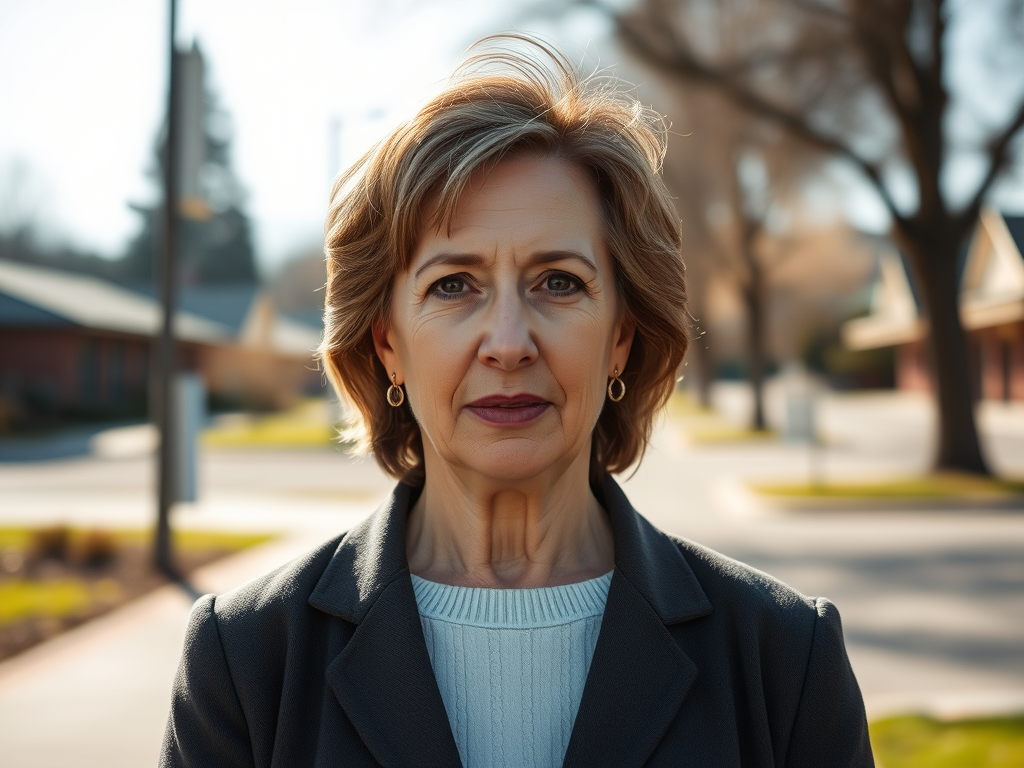

Emily Schaefer is an advocate for large-scale deportations, prefers stricter immigration limits, and does not support pathways to citizenship for undocumented individuals who have been in the United States for many years.
But she isn’t a Republican.
At 52, Schaefer has been a lifelong Democrat, openly disliking Donald J. Trump, yet she cast her vote for him.
“I’ve never supported a Republican before. But we’re overwhelmed with immigrants, and citizens are being overlooked,” said Schaefer, who resides in Beaverton, Oregon.
Trump’s strong stance on immigration struck a chord with Schaefer. She believes that her son’s public school in Oregon has seen a decline in education quality due to a large number of students who lack English skills. She also pointed out that undocumented individuals qualify for health services in Oregon based on income, while Americans in need struggle to get similar help.
“It’s ridiculous what Biden and Harris have allowed to happen,” she stated.
The record-breaking rise in migration at the southern border under the Biden administration has intensified views on immigration nationwide. While Republicans have shown the most significant shift, Democrats and independents are also increasingly supportive of conservative immigration policies, recent polls reveal.
In July, Gallup reported that 55% of Americans wanted reduced immigration, a notable increase from 28% in 2020.
Trump’s appeal surged by framing immigration as a crisis, calling it an “invasion” that required drastic measures, including mass deportations, which he proposed could be enforced through an old, rarely-used law, the Alien Enemies Act. Polls have shown that many voters now favor parts of Trump’s hardline approach.

In an October poll by the New York Times and Siena College, 57% of respondents supported deporting immigrants living in the U.S. illegally. This includes 30% of Democrats and 58% of independents. Furthermore, more than half of Americans, including 20% of Democrats, now favor a border wall with Mexico, a rise from around 40% in 2016 and 2020.
“There’s little public support for large-scale immigration anymore,” commented Muzaffar Chishti, a senior fellow with the Migration Policy Institute.
Under Biden, a combination of global crises—political instability, economic collapse, violence, and climate change—have driven a wave of migration comparable to post-World War II levels. Meanwhile, the U.S. economy, with low unemployment rates, acted as a significant draw.
“Global migration changes made increased border pressure unavoidable,” said Wayne Cornelius, an immigration expert from UC San Diego.
However, Americans across party lines have criticized the Biden administration for not addressing the perceived disorder at the border.
Karen Bobis, 25, an independent voter originally from the Philippines, supported Trump over his strict immigration stance. She recalled her family’s long wait to legally immigrate, contrasting it with the ease of unauthorized entry for others.
“They should go through the process, with paperwork and all,” said Bobis after casting her vote in Reno, Nevada.

Vice President Kamala Harris promoted her experience as California’s former attorney general, emphasizing her role in tackling drug cartels and her support for a bipartisan border security bill. However, Trump’s influence discouraged Republicans from backing it.
Sonya Duffy, a 53-year-old Democrat from New York City, voted for Harris mainly due to her views on reproductive rights but admitted her frustration with how the Democratic Party had downplayed the border crisis. The urgency hit home for her when Texas Governor Greg Abbott sent buses of migrants to cities like New York, straining local resources.
After a peak in June, unlawful crossings dropped significantly due to new restrictions on asylum claims introduced by Biden’s administration, though Trump’s rhetoric still dominated voter sentiment.
Rodrigo Garcia, 26, of Milwaukee, a Mexican American who voted for Trump again, expressed a desire for immigration limits. “There should be a cap on who comes into America, rather than just allowing everyone,” he said.
According to a national Times/Siena poll, many voters favored both deportations and a pathway to citizenship for undocumented immigrants. For some voters, immigration policies represent a larger question of what kind of country the United States should become—open and diverse, or closed and culturally unified, observed Sarah Coleman, an immigration historian at Texas State University.
Economic worries have further heightened anti-immigrant sentiment, with inflation being a significant issue this election cycle.
“The Trump campaign effectively linked the immigration crisis to economic issues,” noted Coleman.
In 2015, Trump began his first campaign by condemning Mexican migrants and pledging to build a border wall. His message garnered support, and he eventually defeated Hillary Clinton.
By 2019, border interceptions surged to their highest levels in over a decade despite Trump’s attempt to deter families by separating migrant children from parents.
When the pandemic emerged in March 2020, the Trump administration used health emergency laws to block border entry, leading to mass detentions and expulsions. Camps developed along the Mexican border, where migrants faced brutal conditions under cartel control.
Meanwhile, in 2020, half of Democrats told Gallup they supported increased immigration—the most favorable view of immigration seen in 15 years, following Trump’s extreme policies.
“Trump’s stance was so extreme, it pushed many people the other way,” said Diana Mutz, a political science professor at the University of Pennsylvania.
Biden entered office promising a humane immigration policy and began reversing Trump’s actions. But the end of pandemic restrictions led to increased migration from various countries, driven by economic and political hardships and eased by social media.
The Biden administration introduced a temporary relief program in 2023 for citizens of several nations with U.S. sponsors, and attempted to streamline border crossings. Yet, by December, unauthorized entries reached record levels, further fueling Trump’s campaign momentum for a third presidential bid.




Leave a Reply