
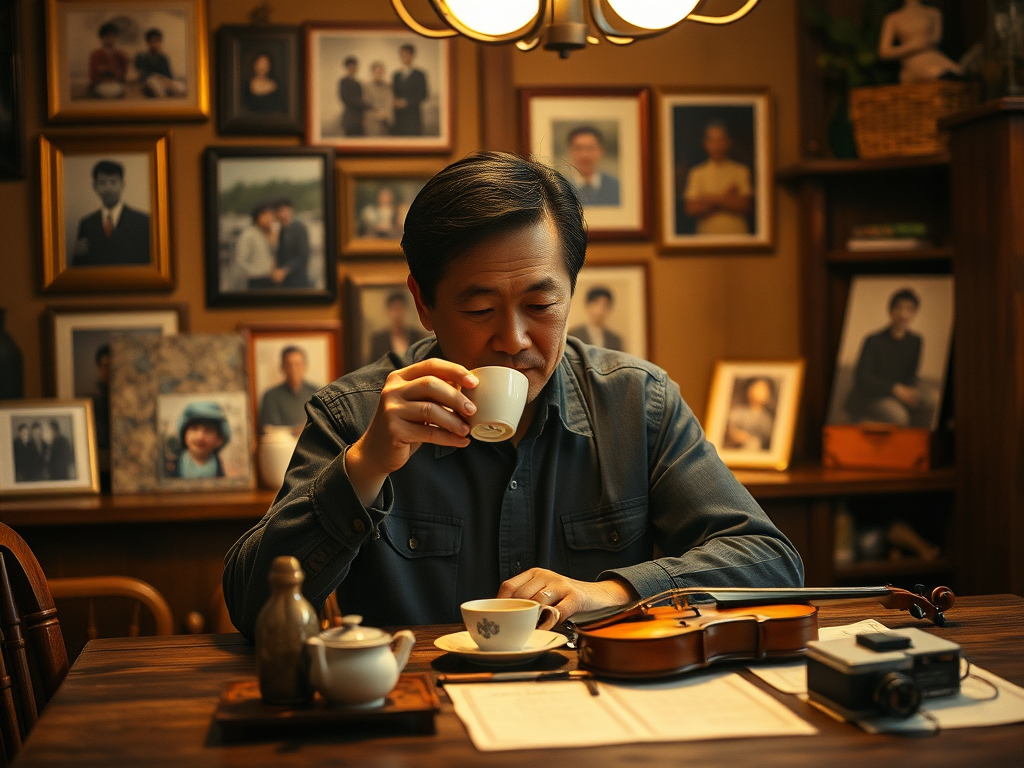

On a September morning, musician Tim Long sat at his dining table, looking through family photos and reflecting on how sometimes positive outcomes can arise from hardship.
Long’s mother, Stella, a member of the Choctaw Nation, endured severe poverty in rural eastern Oklahoma. When she was young, her widowed mother remarried and moved nearby, leaving Stella and her four brothers largely on their own. Eventually, the state placed the children in a boarding school where Stella contracted tuberculosis. She lost a lung and spent a total of five years in quarantine over two separate periods.
During this time, a classical music radio station became a source of comfort for her, and she developed a deep appreciation for Beethoven.
“Without that, I wouldn’t be in music,” said Long, 56, sipping oolong tea. “My life wouldn’t be the same if my parents hadn’t had that broader perspective.”
Long’s career in music has been varied, spanning violin and piano performance, conducting, coaching singers, and teaching. Recently, he’s embraced a new and perhaps most meaningful role: commissioning new music.
During the pandemic, Long conceived the North American Indigenous Songbook, a project aimed at fostering a collection of vocal works by Native American composers. The first set of these songs will debut on November 16 at National Sawdust in Brooklyn, showcasing works that range from traditional to avant-garde and even singer-songwriter styles.
“I think this project is beautiful for how it expands the repertoire,” said Pulitzer Prize-winning composer Raven Chacon, a contributor. “It’s a way of showing who we are, making music from tribal backgrounds.”
The idea for the songbook took shape after the murder of George Floyd in 2020. Though warm and sentimental, Long is also known for his blunt honesty. He recalls how, four years ago, some artists came to him, feeling guilty and eager to perform works by composers outside the usual white, male-dominated canon. They asked if he knew of Native American songs.
The Trail of Tears had displaced both sides of Long’s family to Oklahoma in the 1800s. His mother’s Choctaw family lived in poverty, while his father’s Muscogee Creek family settled in an area where oil was later discovered.
“He grew up in a nice house,” Long said. “He looked like a little rich kid. If not for those circumstances, I wouldn’t have had the opportunities I did, thanks to ancestors whose lives were more privileged.”
Growing up in Holdenville, Oklahoma, Long became captivated by his mother’s Beethoven records and developed a deep love for classical music. His parents, noticing his talent on a toy piano, borrowed a real one from family members, allowing him to flourish under the guidance of a local teenage teacher.
Yet, Long noted, “There were almost no Native American figures in this world of classical music.”
This invisibility reflects a broader issue of Native erasure: “People just don’t see us,” he said. “Even the most educated folks often know next to nothing about us.”
Introverted as a child, Long had a vivid imagination, where sound and image melded synesthetically. He would play with toy cars, each representing different flutists whose “sounds” were inspired by the cars’ shapes. He’d even conduct imaginary violin auditions, assigning styles to fantasy musicians.
“I was in my own world,” he said. “My parents let me be because I was quiet in my room.”
This isolation extended in other ways. “Growing up gay in Oklahoma, in the ’80s, during the AIDS crisis,” he said, “I felt shame, for being both Indian and gay.”

As an undergraduate at Oklahoma City University, he feared association with openly gay students and struggled with feelings of unworthiness. Even in the master’s program at the Eastman School of Music in Rochester, New York—where he now teaches and directs the opera program—and later in New York City, he battled these feelings.
“I was living like someone from the reservation, drinking excessively and feeling shame,” he said.
With time, he found focus and confidence. Meeting his future husband, baritone Christopher Dylan Herbert, in 2003, he began conducting. Though initially uncomfortable, he adjusted to the psychology required for leading an ensemble.
Long had been mentored by Louis Ballard, a leading Native American composer, and participated in rare programs for Native artists in classical music. However, he was reluctant to leverage his heritage for career advancement.


Then, he was invited to conduct the opera Missing in Canada, a work about missing and murdered Indigenous women. The rehearsal process included tribal elders, who helped performers learn Gitxsan, an Indigenous language featured in the libretto. It was a transformative experience for Long.
“I thought it was just another gig,” Long said. “But hearing the audience sobbing throughout the performance made me realize how fortunate I was. For the first time, I felt a sense of responsibility about being Native.”
After this shift, he was prepared when artists sought Native repertoire. “There was no existing songbook like this,” he said. “I saw an opportunity to create a legacy.”
During the pandemic, he sketched out the North American Indigenous Songbook concept with his father-in-law, Randy Plimpton, who agreed to help finance it. They established the Plimpton Foundation to attract additional support, and National Sawdust in Brooklyn joined as a partner.
“This aligns perfectly with our mission to showcase works from underrepresented communities,” said Ana De Archuleta, managing director of National Sawdust.
The first round of commissions went to Native composers Long knew, each contributing a unique style. Chacon’s piece, with Diné poet Manny Loley’s text, has an experimental feel, while R. Carlos Nakai pairs voice with flute, and Martha Redbone’s work incorporates funk elements.

By the end of the year, there will be 19 commissioned pieces, accessible in a digital format to encourage widespread performance. Long insists these works are meant for everyone to perform, not only Native artists.
“There’s sometimes an excessive fear of appropriation,” he said. “These are meant for anyone to play with respect.”
For Long, this project led him to try composition himself. Inspired by recent personal losses, he’s written a song titled The Luminous Loss.
“I’m still finishing it,” he said. “The lyrics bring so much emotion; it’s hard to move on but harder not to return.”
“Strangely, my improvisations lean toward pop,” he added. “It’s more like musical theater—no big statements, just honesty.”




Leave a Reply