
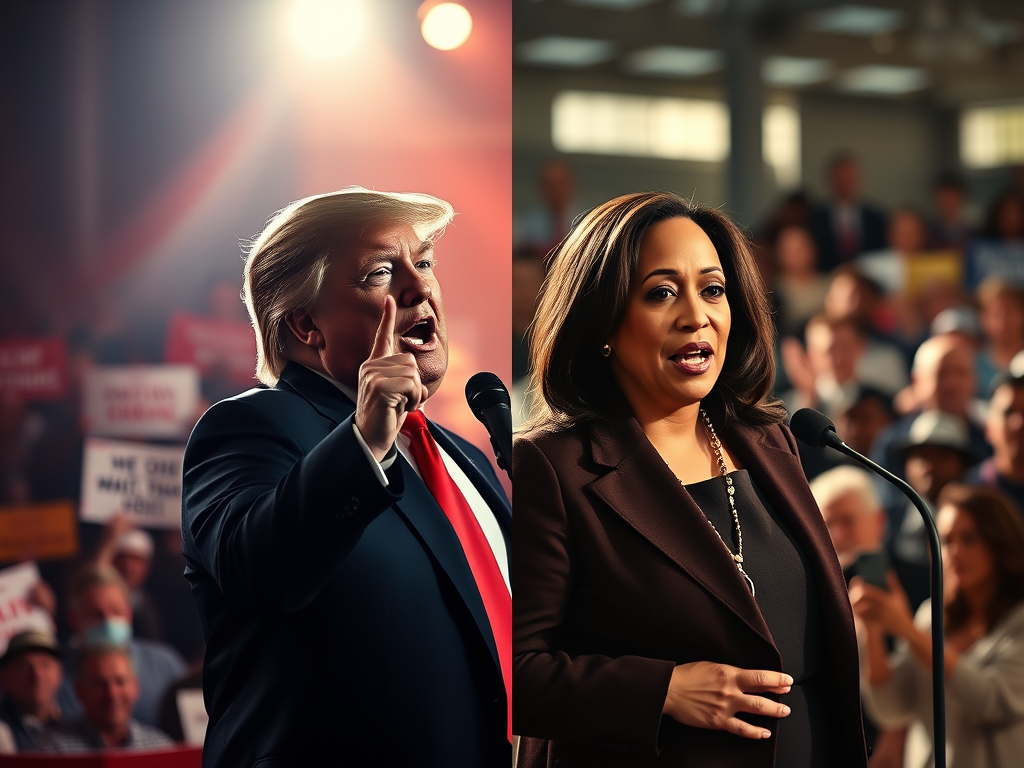

As voters prepare to cast their ballots on Tuesday, Donald J. Trump’s vision for America’s future is unmistakable. He has pledged a period of “retribution” against his adversaries, vowed to deport millions of immigrants, and stoked fears regarding the rise of fascism.
However, there is another promise he is making that may go unnoticed, yet is equally significant: he intends to promote his followers’ interpretation of Christianity throughout American life and governance.
Publicly, the former president has refrained from touting his major achievement that endeared him to conservative Christians: the overturning of Roe v. Wade. He has also distanced himself from Project 2025, the conservative framework for a Trump presidency.
Instead, his support for what he terms “my beautiful Christians” focuses heavily on their anxieties about losing influence in an increasingly secular and pluralistic society—one where a majority of women support Vice President Kamala Harris.
During his final campaign events with conservative Christian activists and leaders, Mr. Trump is promising to not only advocate for their policy goals but also amplify their ideological clout. He asserts he will affirm the belief that God created only two genders, male and female. He plans to establish a federal task force to combat anti-Christian discrimination. Additionally, he promises greater access for conservative Christian leaders should he win.
“It will be directly into the Oval Office — and me,” Mr. Trump told pastors in Georgia. “We must save religion in this country.”
His vision of a strengthened Christian influence starkly contrasts with the pluralistic and feminist vision embodied by Ms. Harris.

She represents the multifaith and increasingly secular America she aspires to lead, maintaining a personal faith where Christianity and liberal feminism coexist. In her closing remarks on the Ellipse in Washington, D.C., Ms. Harris reminisced about attending civil rights marches with her parents, where “people of all races, faiths, and walks of life united to champion freedom and opportunity.”
On a call for Black pastors last Sunday, Ms. Harris encouraged them to express their faith through actions that uplift everyone. “It is a power to promote freedom, justice, and opportunity for all of God’s children,” she stated.
Mr. Trump and his supporters are framing the election as a kind of holy war. They have hastily labeled Ms. Harris as anti-Christian, particularly targeting her Catholic faith—a strategy they effectively employed against Hillary Clinton in 2016.
Attacks on Ms. Harris based on her Christianity are deeply intertwined with conservative evangelical views on womanhood. At a recent gathering for conservative Christian women on the National Mall, attendees prayed for the election while smashing a concrete altar they claimed symbolized “the spirit of Ishtar,” an ancient goddess of femininity.
“It represents the altar of abortion, the altar of sexual immorality, the altar of pornography, the altar that promotes transitioning and mutilating children!” one leader exclaimed. “It is the altar of the goddess of the rainbow, the altar that has led to divorce!”
At another event, Ms. Harris was interrupted while discussing how Trump-nominated justices had overturned Roe.
“Jesus is Lord,” young men in the audience shouted in response. She replied, “Oh, you’re at the wrong rally.”
Later at his own rally, Senator JD Vance, the Republican vice-presidential nominee, echoed the sentiment: “That’s right—Jesus is king.”
When asked to clarify his statement, a spokesperson for Mr. Vance explained that “Senator Vance affirmed the timeless Christian belief that Christ reigns over all creation.” He added, “The Trump-Vance administration will defend religious freedoms for Americans of all faiths.”
However, Trump’s opponents are concerned he would prioritize conservative Christianity, potentially undermining the traditional separation of religion and state.

“This is a pivotal election for the separation of church and state,” warned Rachel Laser, president of Americans United for Separation of Church and State. “This overreach threatens our core freedoms, equality, and democracy like never before. The stakes are incredibly high.”
For nearly a decade, right-wing Christian influence has intensified, largely under Trump’s leadership. He entered the White House in 2016 promising that “Christianity will have power.” In 2020, federal agents forcibly cleared racial justice protesters from Lafayette Square, allowing Mr. Trump to walk to a nearby church while holding a Bible—symbolizing a fusion of Christian and governmental authority.
The notion that the U.S. government should be rooted in a Christian worldview gained traction during Trump’s administration and within the Supreme Court, state legislatures, and school boards. This influence is evident both in and outside government through the reversal of Roe, opposition to transgender rights, battles against critical race theory, book bans, restrictions on female clergy, and punitive measures against women for seeking abortions.
Even under a Democratic administration, conservative Christian power has maintained a stronghold in Republican-dominated areas. For instance, the chief justice of the Alabama Supreme Court invoked God in a landmark ruling asserting that frozen embryos possess rights as children, jeopardizing in vitro fertilization. Oklahoma mandated that public schools teach the Bible, blurring the lines between religious education and public schooling.
Nationally, the notion of prioritizing Christian teachings over government actions remains a minority view. According to the Pew Research Center, only 15 percent of Americans believe the government should abandon the separation of church and state. A slightly larger group, 28 percent, contends that when the Bible and public opinion clash, the Bible should take precedence.
While the movement has faced backlash, especially during the 2022 midterms when candidates advocating for the end of church-state separation lost, the overturning of Roe has prompted pushback even in traditionally conservative states.
Liberal evangelicals, Catholics, and interfaith organizations are rallying behind Ms. Harris in key battleground states like Pennsylvania, Michigan, and Arizona. They are running advertisements featuring women sharing their trauma from sexual abuse within their churches, drawing parallels with Mr. Trump’s own sexual abuse conviction; showing wives voting differently from their Trump-supporting husbands; and highlighting women discussing their pregnancy challenges following the Roe decision.
Bishop Michael Curry, the presiding bishop of the Episcopal Church, who recently retired, noted that he could never have anticipated ten years ago that his tenure would end amid a “Christian nationalism threatening our nation’s soul,” as he wrote in a recent church report.
The rise of this particular strain of Christian power, Bishop Curry remarked in an interview, evokes historical instances where Christian ideology was used to justify the oppression of Indigenous peoples and slavery.
“It reflects a similar mindset that posits one particular way of thinking as superior, enabling the subjugation of others,” he said.
This election serves as a real-time assessment of the liberal coalition’s strength and its ability to challenge Mr. Trump’s unwavering support from conservative Christians.
Republican Christian strategists are disseminating a unified message across their extensive network of churches, pastors, and policy organizations, urging evangelicals and Catholics to recognize that many of them do not vote. They believe that if they did, millions of new votes would go to the Republican party.
“You cannot genuinely claim to be a Christian in this country and vote for the Democratic Party, which supports positions that contradict Biblical teachings,” stated Jason Rapert, president of the National Association of Christian Lawmakers, founded in 2019 to enhance Christian influence in government.
Mr. Rapert was present at the Georgia pastor event where Mr. Trump promised direct access to the Oval Office. His organization advocates for legislation rooted in Christian values, including granting constitutional rights to embryos.
“There is a revival occurring in America, but it is an Antichrist revival propagated by evangelists like Barack Hussein Obama, Hillary Clinton, Nancy Pelosi, and Kamala Harris,” Mr. Rapert declared. “It’s an altar call to emptiness.”
Kelly Shackelford, president of the First Liberty Institute, a legal organization based in Texas, also attended Trump’s event, hoping to further conservative legal victories.
The Supreme Court, bolstered by three justices appointed by Trump, has significantly increased the role of religion in public affairs. Just three days after overturning Roe in 2022, the Court ruled that a high school football coach has the constitutional right to pray at the 50-yard line, rejecting a key precedent that required courts to scrutinize whether the government endorses a religion.
“The primary barrier the government used to prevent such actions has been eliminated,” Mr. Shackelford noted, anticipating additional potential successes.
Even if Ms. Harris wins, the rise of conservative Christian values is likely to persist in many regions across the country, posing long-term challenges for Democrats.
The conservative Christian power structure remains robust in various states. In Alabama, Republican lawmakers frequently reference the Bible when enacting laws that limit voting rights, LGBTQ rights, and women’s rights, according to JaTaune Bosby Gilchrist, executive director of the American Civil Liberties Union of Alabama.
“It will take decades to shift this nation towards genuinely valuing the Constitution,” she said.




Leave a Reply