
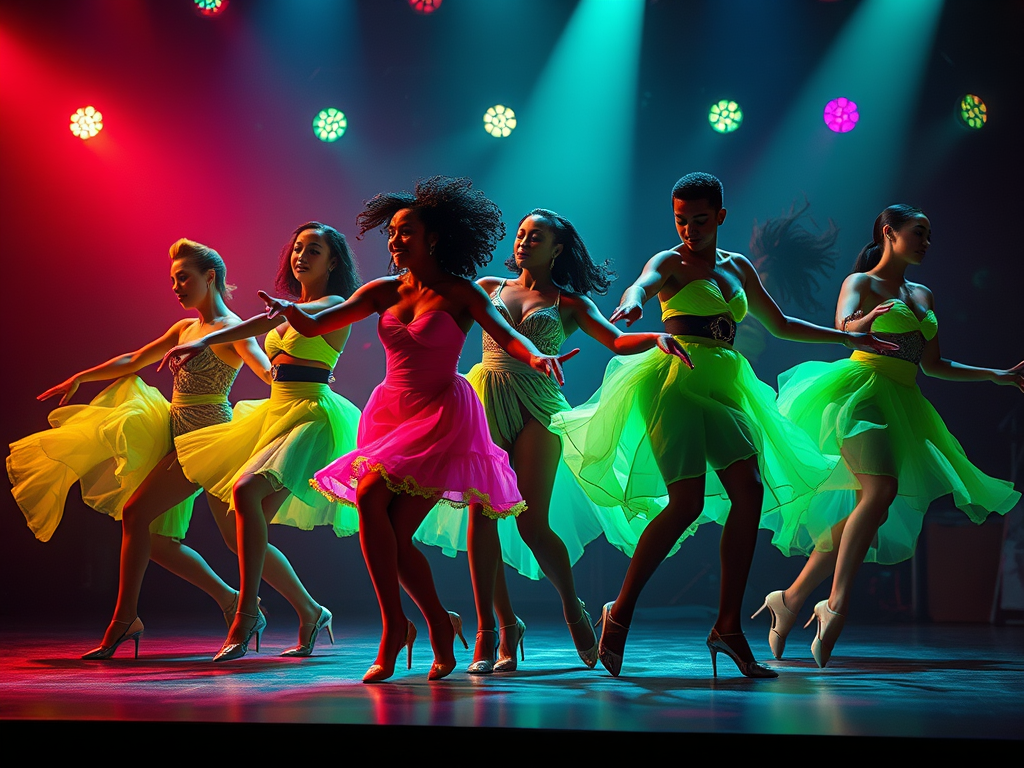

When dancers gather, they bring with them a deep archive of experience, a blend of formal training and everyday movements shaped by life. In “Movement,” which debuted at N.Y.U. Skirball in New York City, choreographer Netta Yerushalmy delves into this wealth of physical knowledge. With a group of seven dancers from diverse backgrounds (and others who contributed to the creative process), Yerushalmy creates a 70-minute piece that remixes choreography from existing material, fully engaging the dancers’ embodied memories.
Yerushalmy has long been interested in uncovering movement that already exists, from her early living-room performances caught on home videos (referenced in her 2014 work “Helga and the Three Sailors”) to well-known pieces of modern dance, as seen in “Paramodernities,” her 2018 six-part series. “Movement” intensifies her exploration of quoting and sampling, raising questions about ownership and cultural context while revealing the wide range of influences carried within a small group of dancers — and how these influences are passed along.
The numerous references in “Movement,” some noted at the show’s conclusion, are drawn from an array of sources: dance classes and competitions; TikTok and TV; gym routines; family events; religious ceremonies; work with other choreographers; and Yerushalmy’s own past projects. Some reflect the dancers’ backgrounds in Taiwan, Korea, Senegal, Israel, and across the U.S., while others stem from their broad freelance careers in New York City.

These movements may resonate with different viewers. There are Martha Graham-inspired cupped hands and contractions, the bold walk of a voguing catwalk, sweeping Afro-Cuban orisha dance arms, and the dainty prance of Swan Lake’s “little swans.” Yet, within the rapid flow of chopped and rearranged movement, these familiar moments are fleeting, quickly giving way to fresh sequences, all set to Paula Matthusen’s electroacoustic score.
The piece opens with Caitlin Scranton alone onstage, kneeling in profile as her torso shifts against a pulsing tone. Soon, Hsiao-Jou Tang, Catie Leasca, Jin Ju Song-Begin, Burr Johnson, Joyce Edwards, and Christopher Ralph emerge, highlighted by Tuce Yasak’s lighting and Magdalena Jarkowiec’s fluorescent green costumes. Initially absorbed in their own movements, the dancers gradually synchronize, building toward moments of unity — an Electric Slide, a grapevine with clasped hands, a kick line like the Rockettes — that become more satisfying visually.
While the work’s precise construction and dynamic rhythm hold attention, one might question whether blending such diverse cultural and historical references flattens their individual meanings. What does it signify to merge them into a single piece?
Answering this, the final sequence brings specificity and homage. As the dancers weave across the stage in a conga line, flushed from the performance, movement credits appear, citing sources and teachers. A 12-page document accompanying the performance lists more, giving context to the influences at play. Family, mentors, and colleagues feel newly present in the space, as if the conga line reaches across time, honoring the past and hinting at the future.




Leave a Reply