
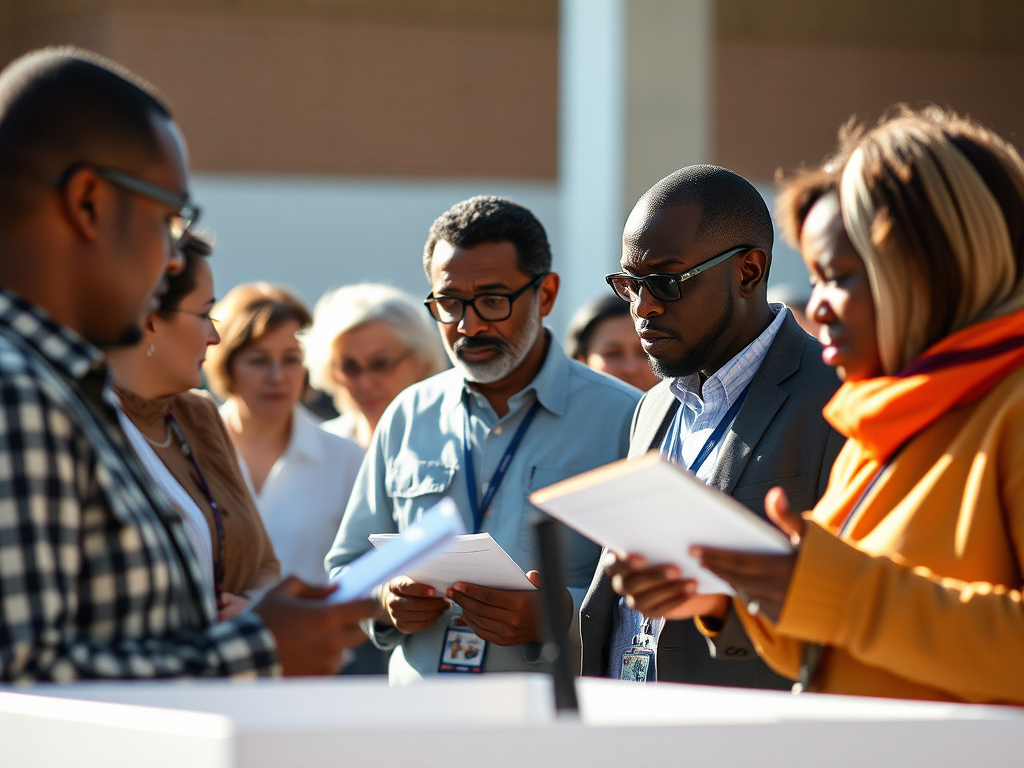

The civics textbook defines a poll monitor’s role simply: to oversee the voting process, ensuring candidates, political parties, and the public can trust that elections are conducted honestly and transparently.
However, this role has evolved since the 2020 presidential election, during which Donald J. Trump and his allies utilized information collected by Republican monitors in their efforts to contest the election results.
This year, the party has expanded its recruitment of monitors—volunteers tasked with observing the voting process firsthand at polling places. Many of these individuals believe the 2020 election was fraudulent and have received training to actively search for signs of voter fraud.
Their responsibilities include documenting any disputes or irregularities at polling locations. In certain instances, volunteers are provided with lists of voters whose eligibility they may challenge, as indicated by recordings from training sessions and meetings reviewed by The New York Times.
These voters are often identified using flawed methodologies based on computer algorithms, according to experts.
Such challenges could complicate matters if an election is closely contested, or could be used to raise doubts about the election results, according to election officials and experts.

In a survey of more than two dozen election officials conducted by The Times, many reported no significant issues or challenges at polling places as early voting commenced.
Historically, both political parties and voting advocacy organizations have overestimated the number of monitors and their potential impact.
The primary concern now is the possibility of disruption on Election Day or afterward, through challenges and litigation that could impede the electoral process or delay vote counting in various states.
Tammy Patrick, chief programs officer at the National Association of Election Officials, warned that individuals may misrepresent situations by taking photos or recording events out of context, which could mislead the public about what is happening.
The Republican National Committee claims to have recruited 230,000 volunteers for poll monitoring and related roles nationwide. This figure significantly exceeds numbers from previous elections, though the committee did not clarify whether all recruits completed training or are expected to be present at the polls.

Training sessions emphasize the importance of civility among monitors. Presentation materials often remind attendees to “understand the process and observe,” and to “respect voting rights and the laws that protect them.”
To bolster their ranks, Republican officials have drawn on members of grassroots organizations that contend the 2020 election was fraudulent and have been trained to aggressively search for evidence of fraud.
The party has collaborated with the Election Integrity Network, which comprises about 30 state groups formed in response to election conspiracy theories following the 2020 election. Some of these groups have held extensive training sessions instructing participants to act like “sentries” in a “military organization.”


Cleta Mitchell, a lawyer instrumental in efforts to overturn Trump’s defeat, leads the network. She expressed pride in the network’s work, stating that citizen poll monitoring is essential for ensuring honest and transparent elections.
Danielle Alvarez, a spokesperson for the Republican National Committee and the Trump campaign, described the trainees as patriots who would enhance transparency and accountability in the electoral process, framing their efforts as a response to perceived attempts by Democrats to undermine elections.
This marks the second presidential election since the Republican Party was released from a federal court order that prohibited it from mounting initiatives against voter fraud, an order initially imposed in 1982 after the party exploited fraud claims to suppress votes among minority groups.
Despite persistent allegations from Trump and other Republicans regarding rigged elections, evidence of widespread voter fraud remains extremely rare. Numerous recounts, audits, and studies—including those conducted by Republicans—following Trump’s 2020 defeat found no substantial evidence of voting issues.
Both parties routinely utilize election observers at polling places, not only to monitor for misconduct but also to perform political tasks, such as informing party officials about voter turnout. Democrats also train poll monitors, focusing on preventing voter suppression rather than investigating fraud.
In many states, poll monitors and sometimes even poll workers are credentialed through local election offices via political parties.
This year’s pro-Trump initiative relies on coordination between Republican officials and local affiliates of Mitchell’s group. The focus is not solely on identifying voting irregularities but also on gathering information about activities in polling places and election offices.
However, the monitors could also play a role if Trump or other candidates challenge election results.
Recently, Trump campaign allies have filed numerous lawsuits in key states that may pave the way for post-election disputes over various aspects of the voting process.
Some training sessions emphasize the importance of information gathering, instructing participants to take note of anything that could be relevant in potential lawsuits.
A poll observer’s primary duty is to “document, document, document,” according to Mike Hoffman, the Republican National Committee’s election integrity director for Wisconsin, who told trainees in May that “over-documentation” is crucial.
Both national Republican and state Election Integrity Network officials have urged trainees to seek paid positions as poll workers or temporary workers in election offices.
Heather Honey, who leads the Pennsylvania chapter of the network, emphasized the importance of filling these roles to gain access that authorized representatives might not have.
Challenges to voter eligibility appear imminent.
In North Carolina’s Election Integrity Network affiliate, members are preparing to contest thousands of voters after they have submitted mail-in ballots, as state law allows challenges to these ballots up to five days post-Election Day.
According to Jim Womack, president of the North Carolina branch, the goal is to establish grounds for contesting a close loss. He noted that if a candidate is aware of “questionable votes,” they could leverage that information to challenge the election outcome.
Election laws in most battleground states complicate, if not prohibit, mass challenges. Yet during a special election in suburban Milwaukee in July, police had to intervene to remove right-wing activists, posing as election observers at polling places, who attempted to contest every absentee ballot despite being informed they were violating the law.
Celestine Jeffreys, a clerk in the predominantly Democratic Green Bay, Wisconsin, indicated that she had been preparing for such scenarios for over a year. She noted that early voting thus far had not seen many challenges.
“My concern is that unsubstantiated challenges could disrupt the process and delay voting for everyone else,” Jeffreys remarked.
Tammy Patrick from the National Association of Election Officials expressed that while interest in monitoring polls is welcome—transparency is vital for trust—some overly enthusiastic monitors approach the situation as if they’re solving a crime, only to find the voting process to be largely uneventful and well-managed.
However, it takes little to spark outrage. Scott McDonnell, clerk for Dane County, Wisconsin, recounted an incident from a few years ago when a video of poll workers initializing ballots—a standard procedure—was misinterpreted as them filling out ballots, resulting in a social media uproar that took days to rectify.
“They spend 10 minutes creating a narrative, and you spend four days debunking it. Then they move on to the next,” he lamented.




Leave a Reply