
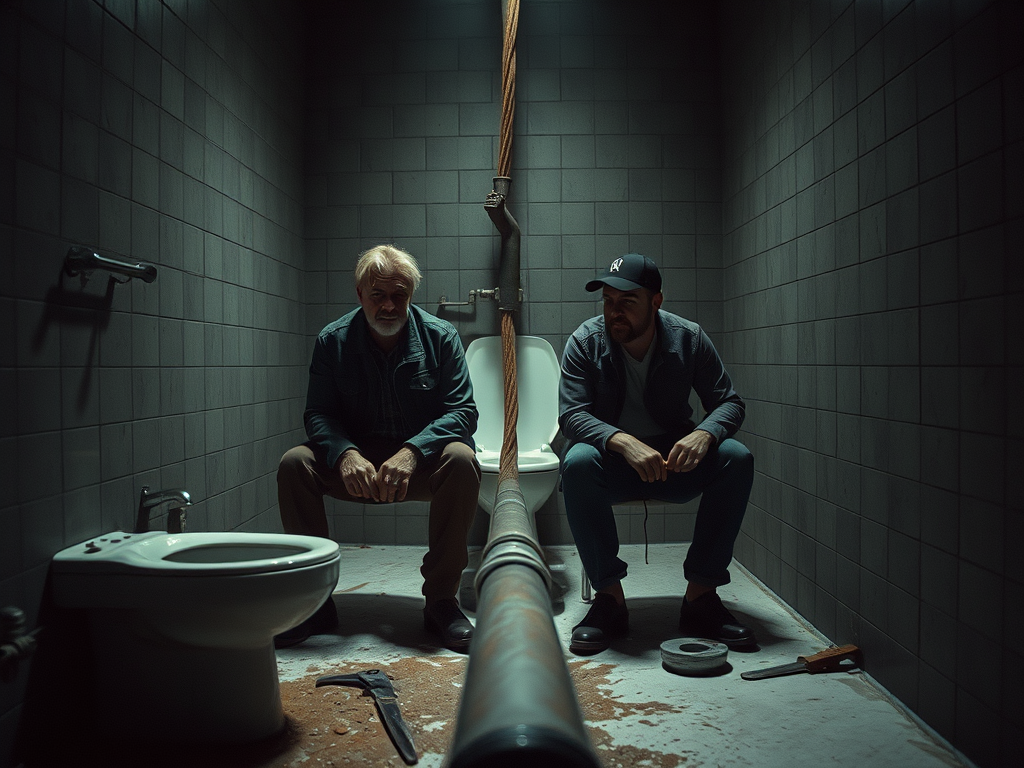
Two men awaken in a deserted industrial restroom, each tethered to a pipe. After discovering hacksaws hidden in a toilet tank, they attempt to sever their thick chains, but their efforts prove futile.
At that moment, a doctor played by Cary Elwes realizes something chilling about their captor, illuminating the harrowing dilemma at the heart of “Saw”: “He doesn’t want us to cut through our chains. He wants us to cut through our feet.”
Released two decades ago this week, “Saw” was never intended to become a hit. It was conceived as a low-budget showcase for two Australian film students eager to make a mark with an audacious idea: a serial killer who compels his victims to demonstrate their will to live through gruesome, sacrificial challenges.
To their surprise, the film grossed over 80 times its budget at the box office, established a new horror icon for the 21st century, and gave rise to the term “torture porn,” with each sequel intensifying the repulsion.
It’s easy to forget, two decades later, that the original “Saw” was more focused on moral dilemmas than sheer bloodshed.
“What would you do to save your own life, or someone else’s?” asked actress Shawnee Smith, encapsulating the central conflict that drives the franchise’s intricate traps. To escape the “reverse bear trap” that’s clamped around her head, Smith’s character must locate a key hidden within another person’s still-living body.

Elwes, famed for his role as Westley in “The Princess Bride,” was drawn to “Saw” because it intertwined horror with profound ethical questions.
“It’s a thriller for those who like to think,” he remarked.
The idea that sparked “Saw” was straightforward: two men locked in a room with a corpse lying between them. James Wan and Leigh Whannell, classmates at the Royal Melbourne Institute of Technology, brainstormed until this concept resonated. They collaborated on the script, with Wan directing.
Wan, who has since directed both blockbuster Hollywood films and unconventional horror like “Insidious” and “Malignant,” noted how “Saw” subverted classic horror conventions.
“Oh, you’ve seen that? You think you know where this is going?” Wan said from a dingy bathroom in London, a fitting nod to “Saw” and the only location where he could get cell service while filming the latest installment of “The Conjuring.” “I’m going to show you something unexpected.”
“Saw” blends familiar horror elements—serial killers, haunted detectives, unsettling puppets—while focusing on the stark binary of its fundamental choice.
Unlike the self-aware horror movies that preceded it, like “Scream” or the elaborate setups of “Final Destination,” no amount of genre familiarity can shield the characters in “Saw” from facing an ultimate decision.
Film critic David Edelstein characterized “Saw” and similar films, particularly Eli Roth’s “Hostel” (2005), as “torture porn” in a 2006 essay for New York magazine. However, the original “Saw” is not particularly gruesome compared to the graphic scenes in this year’s “Terrifier 3” and “In a Violent Nature.”

“Saw” leans more toward detective thriller with a gruesome twist. The titular tool acts as a grim Chekhov’s gun, while the characters’ desperation fuels the horror.
The traps throughout the franchise are designed by John Kramer (Tobin Bell), a terminally ill cancer patient who feels anger toward those squandering their lives. Though Kramer becomes known as Jigsaw, he isn’t a serial killer in the traditional sense; each victim is given a chance to survive.
“Deep down, while he can be ruthless, John’s mission is to save souls,” Bell explained.
This concept was influenced by Whannell’s personal experiences with chronic migraines in his twenties. While waiting for a CT scan, he contemplated how a diagnosis of a severe brain tumor might alter someone’s outlook.
“The game revolves around time,” Whannell, who also plays the second man trapped in the bathroom, said, referring to the killer’s intentions. “He imposes a time limit, forcing them to confront how much they truly want to live.”
The journey to create “Saw” wasn’t straightforward. When the time came to produce the film, financing in Australia fell through.
Wan and Whannell were prepared to scrape together funds for a low-budget shoot, but Whannell’s manager, Stacey Testro, believed it could thrive in Hollywood, where she had connections. Instead of merely presenting a script to U.S. producers, the duo created a 10-minute short film showcasing the reverse bear trap sequence.
Testro recalled watching the short in her living room, her luggage ready by the door as a car waited to take her to the airport. “It was exhilarating,” she said.
Producers at Evolution Entertainment—Gregg Hoffman, Oren Koules, and Mark Burg—were sufficiently impressed to allocate a $700,000 budget for the chaotic 18-day shoot, which kept costs low by filming primarily in the bathroom set. Wan, who had previously focused on stop-motion animation, also crafted Billy the Puppet, an eerie ventriloquist dummy, complete with red spiral cheeks and a tricycle, who delivers the franchise’s iconic line: “I want to play a game.”
Using materials like papier-mâché, table tennis balls for eyes, and cardboard boxes for a child-sized tuxedo, Wan created the unsettling figure (he initially included a bowler hat, but it looked too silly).
The tight budget didn’t hinder the film’s concepts from resonating with audiences.
“The first movie delved into ethics—how far can you go and what defines right and wrong in humanity?” Burg reflected, noting that Evolution viewed “Saw” as their answer to David Fincher’s “Se7en” (1995).

Whannell described his vision for “Saw” as a blend of “Se7en” and “Cube.” In Fincher’s film, detectives played by Brad Pitt and Morgan Freeman pursue a serial killer whose murders reflect the seven deadly sins, punishing his victims through elaborate setups that symbolize their moral failings. Meanwhile, “Cube” (1997) features prisoners navigating a mysterious jail filled with deadly traps.
Over the years, the “Saw” franchise—soon to release its 11th film through Lionsgate—has occasionally diverged from the original film’s themes. Wan never returned to direct another “Saw,” while Whannell contributed to “Saw II” and penned the screenplay for “Saw III.”
Since “Saw” debuted, Wan has helmed major franchise films like “Aquaman” (2018) and “Furious 7” (2015). Whannell has also taken on directing, including “The Invisible Man” (2020) starring Elisabeth Moss and the upcoming “Wolf Man,” both modern interpretations of classic horror narratives.
Ultimately, the success traces back to two aspiring filmmakers seeking a compelling story and landing on ethical dilemmas with bloody consequences.
Whannell takes pride in the franchise’s significant influence on popular culture, highlighting a favorite moment: In “The Sopranos,” a character becomes obsessed with pitching a film described as “Saw” meets “The Godfather Part II.” Recently, Billy the Puppet was incorporated into the popular battle royale game Fortnite.
“Whether we intended to or not,” Whannell remarked, “we essentially created the millennial Freddy Krueger.”




Leave a Reply