
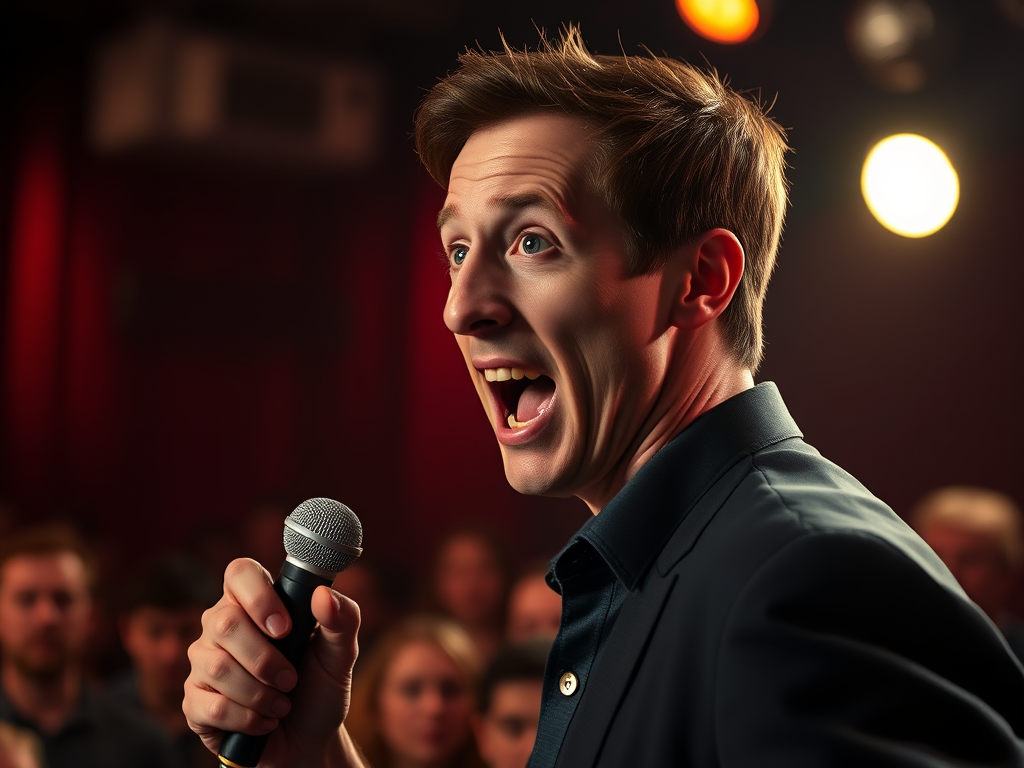

Tony Hinchcliffe’s stand-up performance, known for its sharp insults, quickly became a hot topic in the presidential campaign on Sunday after he faced backlash for racist remarks made during a Donald J. Trump rally. The comments drew criticism, including from Tim Walz, the Democratic vice-presidential candidate.
As he has done previously in controversial situations, Hinchcliffe stood by his statements. He took to X to assert that Walz had taken his joke out of context to portray it as racist. However, Walz’s critique was not based on a misunderstanding. The context of Hinchcliffe’s misguided punchlines is significant: they were delivered at a Trump rally just nine days before the election.
Not too long ago, questions arose about the lack of conservative comedians or a right-leaning counterpart to “The Daily Show.” These inquiries seemed somewhat naïve, as comedy has often contained conservative elements. Anyone familiar with middle school humor knows that jokes can reinforce societal norms just as effectively as they can challenge them.
Over the years, comedy has increasingly taken on a partisan flavor. The shift from the neutral style of Johnny Carson to the politically charged rhetoric of anti-Trump hosts illustrates this trend. In this election cycle, a robust group of pro-Trump comedians has emerged, largely comprised of male comics affiliated with Joe Rogan. While major music artists have vocally supported Vice President Kamala Harris, the comedians rallying behind Trump have made a significant impact.
Trump and his running mate, JD Vance, frequently appear on comedy podcasts to connect with younger male voters who are disillusioned with traditional media. Recently, Vance has guest-starred on shows hosted by satirical comic Tim Dillon and the uniquely poetic Theo Von. Following widespread speculation, Trump did indeed sit down with Rogan, the leading figure in comedy podcasts, who has elevated many of these comedians’ profiles. Trump has also appeared on Von’s podcast and that of New York stand-up Andrew Schulz, who notably headlined Madison Square Garden this year.
This doesn’t even account for Greg Gutfeld, who offers a right-wing alternative to late-night television and has featured Trump as well.
Podcast hosts often resist being labeled politically. Rogan, for instance, has rejected the conservative label, describing himself instead as a bleeding-heart liberal, though he often criticizes the left more vigorously than the right. While these podcasts feature relaxed, unfiltered discussions, there are moments of mild dissent. For example, Schulz laughed when Trump claimed he was “basically truthful,” and Rogan occasionally mocked Trump’s rambling answers, attempting to elicit concrete proof regarding the alleged rigging of the 2020 election.
Nevertheless, a review of the many hours these comedians have spent with Trump largely shows an affectionate admiration and a sense of camaraderie. Conversely, Harris has received a similarly warm welcome on Howard Stern’s Sirius program and “The Late Show With Stephen Colbert,” with some comedians like George Lopez stepping in to support her. However, the Trump campaign has utilized many more comedians to disseminate its message, making their shared interests more apparent.
Trump and his hosts exhibit a shared disdain for the media, a reflexive paranoia regarding cancel culture, a penchant for transgressive humor, and an affinity for cutting insults. These podcasters may present themselves as cynical truth-tellers, yet they are hopeless romantics regarding comedy. Thus, when Rogan remarked to Trump, “You have, like, comedic instincts,” it was a high compliment.
Discussions of policy or concern over offensive and false statements about immigrants are scarce in these exchanges. For these comedians, Trump’s jabs serve as evidence of his authenticity.
The current conservative movement places significant value on comedy, particularly as a vehicle for free speech issues. Take Elon Musk, a top Trump supporter, who tweeted shortly after acquiring Twitter—a move motivated partly by the platform’s suppression of The Babylon Bee, a conservative equivalent of The Onion—that “Comedy is now legal.”
Hinchcliffe echoed this sentiment during his set at the Madison Square Garden rally, claiming, “Censorship is among us, people. It’s a very, very, very big deal,” and advocating to “make speech free again.” His lack of humor in these statements is striking. The fact that it has never been easier to express almost anything, including the most offensive or false remarks, to a global audience seems irrelevant. The narrative of censorship affecting comedy has been reiterated so frequently across numerous podcasts that it is widely accepted as fact.
This aligns with the conservative media’s fixation on the notion that their voices are being silenced. It resonates strongly with male listeners who feel pressured to navigate others’ sensitivities.
Hinchcliffe’s performance backfired on Sunday. His infamous comparison of Puerto Rico to garbage provoked backlash from prominent Latino figures like Bad Bunny and Ricky Martin, who expressed their support for Harris. Uncharacteristically, the Trump campaign distanced itself from Hinchcliffe, stating that his remarks did not represent their views.
However, this offensive set wasn’t an accidental slip; his comments were premeditated and delivered via teleprompter. This style of provocative, trolling comedy thrives on the outraged reactions it elicits, which then fuels discussions about free speech and generates new media cycles. Harris has typically responded dismissively to such provocations, indicating her awareness of the baiting tactic. Yet Walz, sensing an opportunity to connect with Puerto Rican voters in swing states, strongly criticized the comic.
The question remains: will more individuals be alienated by crass jokes rooted in outdated stereotypes than those who revel in a campaign that promises to defy authority? The change in the role of comedy since Trump’s first presidential run is certainly noteworthy.
Reflecting back, one might identify a pivotal moment when Trump appeared on “The Tonight Show” in 2016. Jimmy Fallon faced a torrent of criticism for his light-hearted approach, soft questions, and, most memorably, for playfully tousling Trump’s hair. Many argued that he was effectively “normalizing” Trump, a notion that now seems naïve.
The reality is that Donald Trump had long been normalized through various aspects of popular culture, from tabloid coverage to the influence of “The Apprentice” producer Mark Burnett, as well as late-night hosts like David Letterman. For various reasons, Fallon became a convenient target for public ire. The enduring consequence has been that late-night shows, which once welcomed Trump, have largely ceased to invite him, instead making him a frequent target of their satire.
Since that time, a new ecosystem of comedy media has developed online, and Trump has adeptly leveraged it. The stars of these platforms are unconcerned with normalizing Trump; they not only embrace but amplify his most extreme tendencies. This has become the new norm.




Leave a Reply