
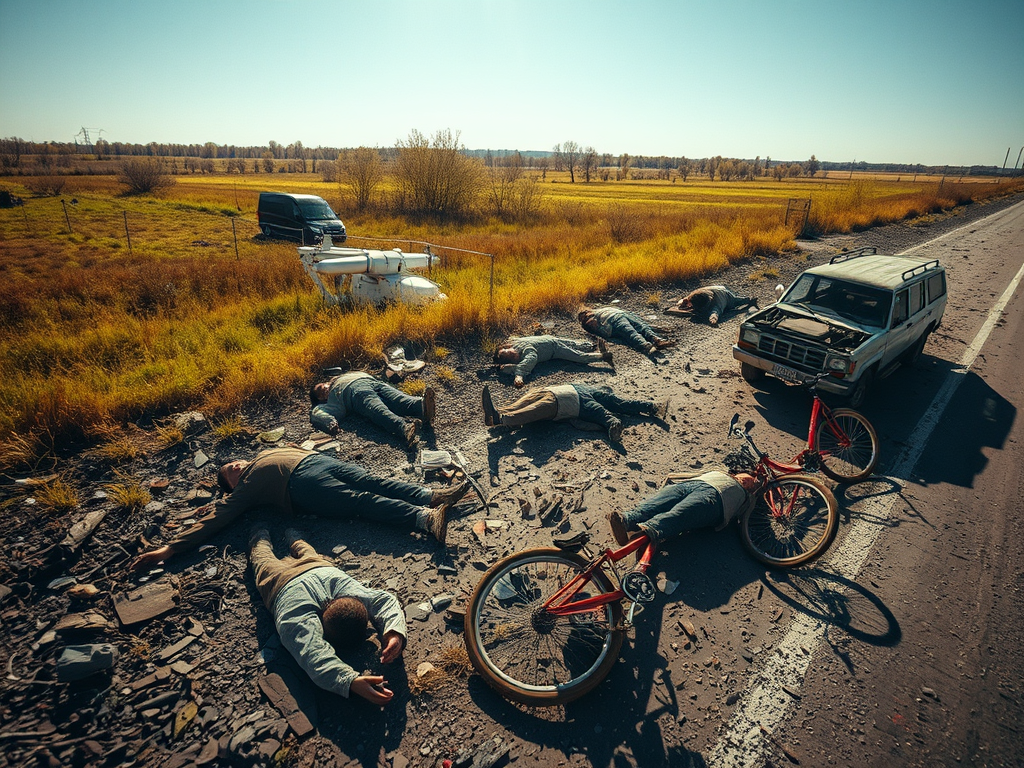

A drone flying over the village of Korenevo in Russia’s Kursk region—an area invaded by Ukraine in August—captured a harrowing sight: at least seven bodies strewn along the road, the majority dressed in civilian clothing.
Scattered along the roadside were wrecked vehicles, some containing corpses. One individual was found tangled with a red bicycle. Due to severe decomposition caused by the summer heat, some bodies were identified solely by their dental remains, as reported by a volunteer involved in the recovery efforts.
The footage and images were taken during the initial phase of Ukraine’s offensive, marking the first incursion into Russian territory since World War II. The region witnessed intense clashes between Russian and Ukrainian forces, with crossfire complicating the identification of those responsible for the fatalities based on available evidence.
The casualties in Korenevo starkly illustrate the impact on Russian civilians resulting from Ukraine’s territorial gains in Kursk. They also reflect Ukraine’s unprecedented role as an invading and occupying force in the two-and-a-half years of conflict.
Since Ukrainian troops launched a surprising offensive into western Russia over two months ago, assessing the experiences of ordinary Russians has proven challenging. The destruction of cellphone towers has hindered communication with residents, while the area is largely off-limits to independent journalists. Propaganda has dominated the narrative from both Russia and Ukraine, each having reasons to minimize the human cost.
Through verified videos, satellite images, photographs, and testimonies from nearly 20 locals, The New York Times has compiled a comprehensive account of the civilian experience during Ukraine’s invasion. Some individuals spoke openly on record, while others were identified by first names only due to safety concerns.
Civilians who visited Korenevo after Russian troops expelled Ukrainian forces recounted the chaotic aftermath of violent encounters.

“Every vehicle that approached the area was fired upon,” said volunteer Maria Skrob, who assisted in transporting bodies to a morgue. “Everyone was trying to escape, but as you can see, they were unsuccessful.”
Eight bodies were visible in the drone footage and images. Ms. Skrob indicated that the heat had rendered many remains unrecognizable and stated that a total of 15 bodies were recovered, though this figure could not be independently verified.
She claimed in an interview that Ukrainian soldiers targeted fleeing civilians in Korenevo, although she provided no evidence. Residents from the nearby village of Kurilovka also alleged that Ukrainian forces shot at civilians attempting to flee. Ukraine has denied these accusations, and neither assertion has been independently confirmed.
Residents mentioned that prior Ukrainian shelling, coupled with a lack of warnings from local officials, led many to underestimate the danger and remain at home until it was too late.
Olga, a Korenevo resident, recounted that her family was sitting down to eat when explosions erupted. “Korenevo descended into hell,” she said in a phone interview. “No one came to evacuate us; no one told us to leave.”
As local officials abandoned their posts, residents took the initiative to evacuate those in greatest need. However, by August 10, Russian soldiers still in Korenevo warned volunteer Ivan Naumov that staying was too perilous.
“Poking your nose there is pointless — it’s in gun sights,” Mr. Naumov, a firefighter, conveyed in a voice message reviewed by The Times. “It equals death.”
He advised others to avoid crossing a bridge over the Krepna River into Korenevo’s eastern suburb, where the bodies were later found.
The Russian government has not released detailed information regarding the deaths in Korenevo. Meanwhile, the Ukrainian military dismissed reports of the fatalities as Russian propaganda.
Analysts and sociologists suggest that Ukraine’s invasion imposes a moral dilemma for Kyiv’s government. In Kursk, Ukrainian forces are grappling with perceived threats from actual and potential spies and saboteurs, all while overseeing thousands of citizens in an area they have occupied.
The Ukrainian military faces scrutiny to uphold the same standards of warfare that Russian forces have allegedly violated repeatedly in Ukraine—instances of executions, torture, sexual violence, and the forced relocation of Ukrainian children to Russia, as documented by Ukrainian and international prosecutors.
Dmytro Lubinets, Ukraine’s human rights commissioner, has stressed that the country will adhere to humanitarian laws. “We are different,” he stated in an interview following the incursion. “It’s the main argument for our international partners to provide assistance.”
The Ukrainian military claimed it has recorded “no violations” of the Geneva Conventions in Kursk.
To support these assertions, Ukrainian soldiers and officials have shared videos depicting their forces delivering food and water to residents in occupied areas.
In August, Ukraine established a military administration in Kursk to offer humanitarian assistance, law enforcement, and essential services in the occupied territory. Oleksiy Dmytrashkivsky, a spokesperson for the military authority in Kursk, mentioned on September 18 that “several thousand” civilians remained in the Ukrainian-controlled region.
However, Kyiv has provided limited details regarding the operations of the occupation authority, and Mr. Dmytrashkivsky has not responded to interview requests.
Civilians’ accounts present a mixed view of Ukraine’s conduct in Kursk.
Some Russians reported passing by Ukrainian soldiers without incident on the first day of the invasion, August 6.
“I nearly brushed against them on the road,” said Sergei, a Korenevo local, recalling his encounter with Ukrainian armored vehicles. “For some reason, no one shot at me.”
The Times spoke with three individuals who had escaped to safer areas and managed to communicate with family members who remained. They described relatively humane treatment.
One elderly man recounted that Ukrainian soldiers had brought him fresh bread and canned meat. Platon Mamatov, a Russian soldier and blogger, noted signs of normalcy during his drone flights over the occupied territory, including footage of a woman gardening and a man drawing water from a well.
However, there were also instances of more severe treatment.
In one verified video, two Ukrainian servicemen mock an elderly Russian man outside the occupied town of Sudzha, with one soldier derisively calling him “a Russian swine.”
Another soldier in the same video wore a World War II-style helmet with SS insignia. Some units in the Ukrainian military have displayed Nazi symbols, sometimes ironically, in response to Russia’s portrayal of Ukraine as a neo-Nazi state to justify its invasion.
Verified videos released by the Ukrainian military show strikes being conducted in residential areas. In some instances, Russian soldiers can be seen entering buildings before the attacks occur. However, it remains unclear whether civilians were present at the time.
These strikes have resulted in damage to residential properties and infrastructure.
Russian forces have also targeted civilian areas in their counteroffensive against Ukrainian forces in Kursk, according to verified videos.
In Kurilovka, residents alleged that Ukrainian soldiers shot and killed fleeing civilians.
The veracity of these shooting reports is particularly challenging to establish, as fighting persists in the region. While there is occasional visual evidence of civilian casualties, the responsible parties remain ambiguous.
In Kurilovka, at least four civilian vehicles were reportedly hit by automatic gunfire during the early hours of the invasion, based on phone interviews with survivors and their relatives. One passenger, a 28-year-old pregnant woman named Nina Kuznetsova, was reportedly killed by gunfire, according to her sister and husband, who was in a different vehicle that also came under fire.
Another resident, Aleksei Trubitsyn, 28, was killed moments earlier in an explosion that obliterated his car, as recounted by his sister Kristina.
When a group of Ukrainian soldiers approached Ms. Trubitsyn’s mother while she sought to recover his body from the wreckage, they claimed that his vehicle had struck an anti-tank mine, without clarifying which side was responsible for placing it.
In Korenevo, across the Ukrainian-controlled zone, satellite imagery analysis confirms that most of the vehicles and victims were located along the street between August 10 and 14. It remains uncertain if all the fatalities stemmed from the same incident; however, Ms. Skrob, the volunteer, asserted that the deaths occurred during an ambush on August 11.

On August 17, Mr. Mamatov recorded drone footage of the bodies and subsequently shared it on social media, marking the first visual documentation of the deaths.
According to soldiers involved in the operation in Kursk, Ukrainian commanders instructed their units to treat civilians with respect. Members of the 61st Mechanized Brigade were directed to “avoid conflict” with civilians and to “assist as if they were doctors,” as stated by Lt. Col. Artem Kholodkevych, the brigade’s deputy commander.
However, as Russian efforts to reclaim territory intensify, so too do the dangers faced by civilians, military analysts warn.
Meanwhile, around 250 residents from Kursk have been urging both the Russian and Ukrainian governments to facilitate the safe passage of nearly 500 relatives who lack basic services as conditions deteriorate.
“At what cost will we regain the town?” asked Tatiana Mozgovaya, whose husband remains in Sudzha. “It seems no one cares about the people who are still there.”




Leave a Reply