
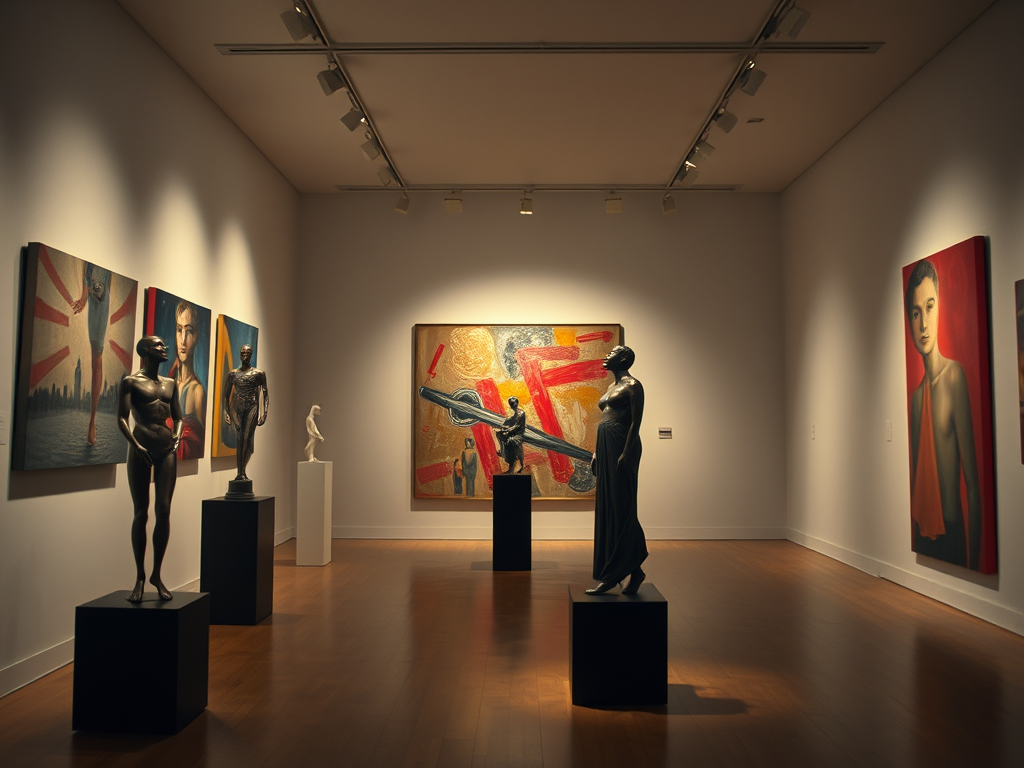

In 1977, Marian Goodman launched her gallery in Manhattan with a show featuring Belgian poet-turned-conceptual artist Marcel Broodthaers, back when asset managers hadn’t yet set their sights on the art world. While there was some money involved even then, the landscape has certainly changed, especially now as the gallery transitions from the hands of the nonagenarian dealer to her five appointed successors. It has also moved to a new space in TriBeCa, leaving behind its long-time location on West 57th Street.
The gallery’s first exhibition in the new location, showcasing works from 50 artists spanning nearly half a century, opens on Saturday. It features prominent figures from Goodman’s art-heavy roster, yet money has never been her primary concern. Since her early days in the 1960s as a dealer specializing in prints, Goodman has been drawn to—and has skillfully represented—minimalist and conceptually-driven European artists like Gerhard Richter, Broodthaers, and Joseph Beuys.

While the gallery is often mentioned alongside the mega-galleries due to Goodman’s reputation, its long-standing influence, and the big names it represents, it remains what Philipp Kaiser, a lead partner, describes as “one of the biggest small galleries.” Unlike many of its competitors, Goodman’s gallery has resisted the trend toward aggressive global expansion that has become common in recent years. The gallery now has outposts in Los Angeles and Paris, but these developments were slow and deliberate, just as the move within Manhattan took years of planning. Interestingly, they never ventured into the bustling gallery districts of Chelsea or SoHo. Rose Lord, a partner of 22 years, recalls how the gallery regularly discussed moving to a busier location during her first decade there.
This somewhat old-school approach, reminiscent of an era filled with artists’ lofts and informal gatherings, adds a nostalgic and contemplative mood to the new exhibition, “Your Patience Is Appreciated.” The show includes minimal sculptures from the 1960s by figures like Giovanni Anselmo (1934-2023), juxtaposed with more commercially viable conceptual pieces like a shiny abstract painting by Bernard Frize. Curated under Kaiser’s guidance, the exhibition feels spacious and reflective, acting as both a hopeful marker for the gallery’s future and a eulogy for the scene that originally nurtured it. This sense of contrast—between past and future—mirrors the artistic tension seen in works by Anselmo and Frize alike.

Anselmo, one of the few Goodman artists associated with Arte Povera, an avant-garde Italian movement from the 1960s, used whimsical and incongruous materials to tackle heavy themes like time, mortality, and desire. His dark humor runs through the new show, which stretches across three floors and temporary rooms designed for video installations.
For Anselmo, dissonance is key—between his minimalist gestures and the vast themes he addresses. On the second floor, his untitled steel rod from 1966, standing 8½ feet tall but slightly leaning from its wooden base, serves as a kind of metaphysical dowsing rod, revealing the invisible force of gravity. It’s playful but undeniably serious. Surrounding it are similarly linear works by artists of a younger generation—like Leonor Antunes’ brass rod curtains and Delcy Morelos’ bundles of string coated in soil and wax—and contemporaries like Giuseppe Penone.
Penone’s contribution includes a wall drawing of wavering concentric rings, alongside pieces that attempt to capture the passage of a human body through time. His work pairs beautifully with one of the show’s highlights, Pierre Huyghe’s “Timekeeper Drill Core (MGG 57th Street).” For this piece, Huyghe sanded down a section of the gallery’s old 57th Street wall, revealing decades of different paint layers in concentric circles. The result is an archaeological commentary on the nature of time, with a visual reminiscent of a jawbreaker candy. Huyghe created two such pieces, and neither is identical, further emphasizing time’s elusive quality.
In the first room of the exhibition, a large photograph by Tacita Dean of a flowering cherry tree stands opposite Gabriel Orozco’s “Four Bicycles (There Is Always One Direction),” an assemblage of bike parts from the 1990s. The cherry blossoms, a symbol of life’s fleeting nature in Japan, evoke a dizzying sense of impermanence, heightened by Orozco’s disorienting, upside-down wheels.

The exhibition’s mood turns melancholic in a room showing James Coleman’s 35-minute film “Retake With Evidence,” a one-man performance by Harvey Keitel first seen in 2007. The atmosphere is similarly somber in a smaller room housing Steve McQueen’s only lightbox piece, “Lynching Tree” (2013).
Much like the original Arte Povera movement, some pieces in “Your Patience Is Appreciated” can feel dense or overly clever. For example, without explanation, viewers may not realize that Tavares Strachan’s “Endless Love, Simone I” and “Endless Love, Simone II” marble sculptures are modeled after Nina Simone’s profile. However, the works offer a fascinating dialogue on form and identity when viewed alongside Robert Smithson’s metal ziggurat.

On the gallery’s third floor, destined for storage and private viewing rooms, the exhibition demonstrates the gallery’s core mission—helping viewers engage with artists by placing their works in meaningful context. The works here span from Sabine Moritz’s abstract painting to Tony Cragg’s reflective steel sculptures. These pieces, seen together, create a natural sense of cohesion, their power multiplied in the collective space.

The gallery’s legacy, spanning over decades, looms large throughout the exhibition. Many artists have been represented by Goodman since the 1980s, and items like Dan Graham’s doodled plans for sculptures keep the gallery’s long history palpable. While some notable artists, like Gerhard Richter and Nan Goldin, have left, newer voices like Andrea Fraser and Delcy Morelos have brought fresh perspectives. As the gallery moves forward, it continues to focus on conceptually driven art while exploring new forms and interpretations.

One of the most evocative works is a photograph by Thomas Struth, taken one year after Goodman’s gallery opened on 57th Street. It captures Leonard Street in TriBeCa, a reminder of a time when the neighborhood was filled with industrial spaces and emerging artists. Now, TriBeCa is one of the wealthiest residential areas in New York, home to a thriving gallery scene—solidified by the arrival of the Marian Goodman Gallery. Though housed in a meticulously renovated 19th-century warehouse, the gallery’s new space retains a sense of modesty, with white walls and black ceiling beams, eschewing the spa-like aesthetic of some Chelsea galleries. It feels like the end of one chapter, and, with any luck, the beginning of another.




Leave a Reply